


Your complimentary articles
You’ve read one of your two complimentary articles for this month. To have complete access to the thousands of philosophy articles on this site, please
You can register for a free account to have four complimentary articles per month. We will occasionally email you a newsletter, from which you can unsubscribe at any time. We do not sell personal data or otherwise disclose personal information to other organisations.
Articles
Evolution or Progress?
Adam Neiblum asks what the difference is, and why it matters.
‘Progress’ and ‘evolution’ are widely considered synonyms, and are used interchangeably every day. Most people also regard evolution, in the Darwinian sense, to be a form of progress or improvement. We often hear talk about our species evolving to a higher state of being or a more advanced consciousness. But progress and evolution are not the same thing, and describe very different forms of change. Recognizing the differing kinds of change has a direct bearing upon our understanding of what it means to be Homo sapiens, both as a member of a culture and also as an animal – a product of the very evolutionary process that has created and shaped every species, including our own. So the conflation of ‘progress’ and ‘evolution’ matters more than a mere semantic error.
First, evolution consists of:
A) A genetic mutation in an organism;
B) A consequent change in body and/or behavior;
C) Rigorous testing of that body and/or behavior through interactions between the organism and its environment. If this change benefits the organism in terms of better reproductive potential – that is, in its ‘fitness’ – that change spreads into the subsequent generations.
Progress, meanwhile, consists of:
A) An ideal or goal – literacy, or justice, for example;
B) A gap between this ideal and the real-world state of affairs;
C) A process of movement – individually, collectively, or even species-wide – towards that goal or ideal.
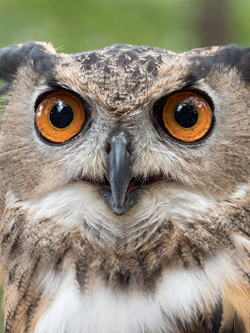
Owl © Rhododendrites 2019 Creative Commons 4
We can see that these are not the same ideas. Evolution is neither purposeful nor intentional: it has no ideal, aim, or end-point. For evolutionary change, there are no stand-alone goals. Progress, on the other hand, is goal-directed by definition. It is aimed towards stand-alone ideals. It is all about goals, even if they may be abstract, distant, even unattainable – such as justice, beauty, or goodness. The higher ideals are also often de-contextualized: justice is justice, regardless of the environment. Also, progress is cultural, while evolution is biological. Nature and nurture, if you will. Yet the fundamental principles of biology and of culture are not the same.
Progress can have an opposite. Humans can remain culturally static, or even regress. But evolutionary change is not directional in this sense, and does not go ‘in reverse’. The concept of ‘de-evolution’ does not apply in biology. The evolution of cetaceans illustrates this point well. Whales and dolphins share a common land-based mammalian ancestor with our primate lineage. But our lineages eventually split around forty million years ago – ours went increasingly into the forests and up trees; theirs went back into the water. So, they went from fins to legs, but then back to fins again. This is evolution in action. But which part is ‘progress’? Out of the water? Back into the water? Fins to feet? Or feet back to fins? The answer is ‘none of the above’. Either way, both the coming and the going is evolution, not merely the parts we judge ‘an improvement’, that is, ‘progress’. Evolution neither goes ‘forward’, nor in ‘reverse’ since there is no goal, so no directionality.
Adaptation is Not Long-Term Progress
Outside of the scientific community, however, evolution is still widely considered a progressive phenomenon, a form of ‘natural improvement’. But natural selection isn’t like that. Evolution does tend towards addition : nature tends to add on, so modifying the previous biology to fulfill new roles. Thus life tends towards greater complexity over time. But ‘complexity’ and ‘progress’ are not synonyms. Indeed, they often diverge considerably. If evolution were a perfecting process, we would look around us today and see only the very best exemplars of flight, sight, swimming, hearing, etc. But consider the panoply of life in our time: basic single-celled organisms continue to thrive, even ‘dominate’ life on earth, billions of years after life began, as basic single-celled organisms. These simple life forms even constitute indispensable elements within our complex animal bodies. And ‘primitive’ complex species – crocodiles, turtles, sharks, mosquitoes, dragonflies… – also continue to thrive as they did hundreds of millions of years ago. Finally, for every ‘ideal’ exemplar of, say, flight – the albatross, hummingbird, or bat – there is also a bumbling quail, pigeon, or flying (that is, ‘controlled falling’) squirrel, snake, or frog. And for every eagle-eyed eagle, there is a blind cave fish, or mole thriving in the dark.
Evolution is not progress. The changes it generates are valuable entirely relative to context: ‘better’ or ‘worse’ as stand-alone goals or ideals do not apply. For evolution in general, traits may be just different, or better or worse perhaps in very specific environments, but not inherently, that is, decontextually, better or worse. An octopus would not benefit from feathered wings; nor an albatross from smart tentacles. The concept of progress simply does not map on to the reality of evolutionary change.
Evolutionary Insights
Why then do we erroneously project overall improvement onto the biological process? And when we’re thinking ‘progress’, why do we sometimes refer to it as ‘evolution’?
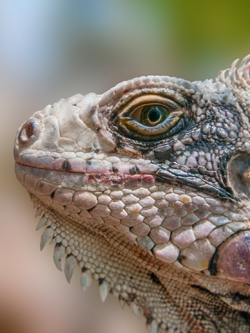
Iguana © Wilfredor 2014 Creative Commons 1
Over multiple centuries, those of us under the influence of Christian ideas were taught to believe that we were made both separate from and superior to the rest of the animal kingdom. In this, I think Christianity piggybacks upon evolved cognitive biases, that is, on a biologically hard-wired instinct for human exceptionalism. This instinct enabled our inclination to believe that we are the purpose of it all, with the rest of nature merely the stage or the supporting cast. But in 1859 Charles Darwin changed everything when he published On the Origin of Species, initiating the evolution revolution.
It’s been a very slow revolution. Recognition of the cultural and ethical ramifications of evolutionary theory has been glacial. This is because Darwin’s work landed in a culture in the grips of Christendom’s anthropocentrism, and we’ve largely retained its exceptionalist belief that we’re the purpose of it all. We imagine ourselves the goal of evolution, the end result of nature’s creative process, and that our distinctive traits are the best traits. As Stephen Jay Gould wrote, “we have managed to retain an interpretation of human importance scarcely different in many crucial respects from the exalted state we occupied as the supposed products of direct creation in God’s image” (Dinosaur in a Haystack: Reflections in Natural History, 1996).
Under the continued influence of this anthropocentrism, we continue to misinterpret evolution as a progressive process of improvement, quite intentional, and with a clear purpose, to make us. Misinterpreting Darwin, we’ve simply morphed from being the Christian ‘crown of creation’ to being the naturalistic ‘pinnacle of evolution’. In doing so, we continue to conceive of human beings as the metric against which all other life forms are to be measured – and found wanting.
Consider visual perception. I asked Google (the average person’s fount of basic knowledge) which animal has the best vision. Its answer: the eagle – which is a creature with the same basic form of vision as our own. But visual perception has evolved in a wide range of forms. We fail to properly appreciate this diversity because of our anthropocentric bias. Consider however the mantis shrimp. This species has evolved twelve different types of color photoreceptors, as opposed to our mere three! Even trying to imagine the psychedelic visual world this creature inhabits simply boggles the mind. But assuredly this organism fares better with their vision than they would with the eagles’ or our own. The dragonfly, jumping spider, box jellyfish, even the common housefly, are further examples of the extremely divergent and context-dependent nature of visual perception.
Considering our species as the apex of a progressive process is not merely arrogant and inaccurate, it distorts our knowledge of Darwin’s work, evolution, culture, progress, human nature, other life forms, and our place within the whole. Our ignorant exceptionalist self-conception is also arguably at the core of many of the devastating problems we now face, including our rapine relationship with the global biosphere, affecting the very planet upon which we evolved and on which we entirely depend for our continued thriving. Indeed, our supercilious conceit is already encouraging another mass extinction.
Onwards & Upwards

Macaque © Animais Fotos 2010 Creative Commons 3
99.9% of all species that have ever evolved eventually became extinct. Fundamentally, we’re no different. We are in no way guaranteed a positive outcome, the proverbial ‘happy ending’, despite the assurances of either Christianity or capitalism.
The most important trait which distinguishes humans from the rest of earth’s abundant life forms is our capacity for complex shared and cumulative learning. This can, and generally does, shape our ideals and goals. Because of all this, our future is in our own hands. A bit disconcerting perhaps. But also very empowering. A rallying cry.
To the extent that reason, science, and knowledge genuinely determine our goals, we do progress. This holistic progress represents a fulfillment of human potential. Progressing towards the goal of environmental sustainability will not be a result of a new ‘spirituality’, divine intervention, or a naturocentric mythology. If it is to happen, it will be a result of human beings choosing a progress rooted in science, reason and knowledge.
Darwin’s theory of evolution, that is, of descent with modification through natural and sexual selection, refers to the slow, non-linear, and intentionless change caused by the interaction between gene, body, and environment. Progress is the far more rapid, uniquely human phenomenon of intentional movement towards a goal or ideal. Ideally, our goal and ideals should not be based upon coercion, indoctrination, or compliance to authority. Instead, they should be rooted in evidence, reason, and science. Evolution has endowed us with the unique capacity to progress. But the two concepts are by no means synonymous, and should be used with these important distinctions in mind.
© Adam Neiblum 2025
Adam Neiblum is the author of Rise of the Nones: The Importance of Freedom from Religion (Hypatia Press, 2023).
Advertisement
