


Your complimentary articles
You’ve read one of your two complimentary articles for this month. To have complete access to the thousands of philosophy articles on this site, please
You can register for a free account to have four complimentary articles per month. We will occasionally email you a newsletter, from which you can unsubscribe at any time. We do not sell personal data or otherwise disclose personal information to other organisations.
Articles
Identity in the Age of Connectivity
Sara Asran explores the dynamics of identity online.
Human identity is a captivating and intricate subject. One could argue that with the emergence of digital platforms, and the widespread availability of more diverse media, literature and learning opportunities than ever before, the way the average person defines themselves has undergone a significant transformation. Unlike just a couple of decades ago, when identity was often linked to one’s personal traits and role within one’s community, today it is becoming increasingly entangled with the things we consume, especially online.
A compelling case study of this identity shift can be observed in TikTok culture. While trends on this app emerge in a manner similar to trends spread through magazines and television in the past (albeit at an incredibly accelerated pace), what’s striking on TikTok is how its users’ sense of themselves is increasingly intertwined with the clothes they wear, the media they engage with, even the food they eat. Though the notion of products shaping identities was famously propagated by Edward Bernays, the ‘father of public relations’, way back in the 1920s, this does underscore his profound understanding of human behavior.
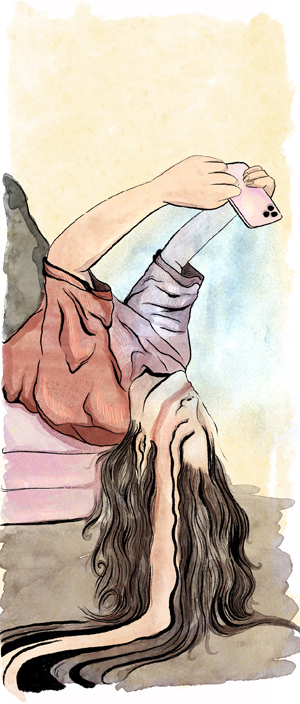
Today it’s challenging to find individuals who primarily define themselves by their intrinsic traits; instead, many tend to define themselves by what they consume. But alongside straightforwardly promotion of the products themselves, there’s now a more subtle and insidious marketing approach at play. These trends are strategically targeted towards women by associating a particular combination of products with a particular type of woman. For instance, a trend emerged wherein a mix of various new products, including specific clothing, jewelry, and branded hair and makeup products, were promoted simultaneously. They were marketed under the guise of the ‘clean girl’ trend. A ‘clean girl’ is essentially the kind of woman who consistently appears well-groomed and put together, emanates a pleasant fragrance, and boasts fresh, radiant skin. The marketing extends beyond the immediate attributes of the products themselves: it represents an effort to emulate the image of the clean girl, which is associated with a well-off, high-class lifestyle and a harmonious family background. So this and other such approaches can be seen as a means for individuals to role-play various personas they aspire to embody through the use of these products.
Oksana Cherepashchuk
Instagram: @ksu.artlife
This transformation gives rise to a paradox: if individuals are so eager to distinguish themselves from the crowd, why do they engage in these carefully orchestrated trends that essentially commodify their identity, categorising them through consumerism?
The straightforward response is capitalism. Capitalism has wrought a profound shift in the way we perceive ourselves and others. In a world driven by consumerism, competition and envy, people are increasingly inclined to shape themselves into marketable entities by endeavoring to make their identities palatable to a wide audience. As a result, we witness a proliferation of labels, each striving to capture the ‘unique facets’ of an individual’s identity. These labels are becoming exceedingly niche – meticulously tailored to encompass the intricate nuances of various personality types.
However, as these definitions grow increasingly specialized, there arises a disquieting trend. Many times, the narrower the categories become, the more disconcerting their implications. This phenomenon becomes even more pronounced among younger generations, where we observe the unsettling glorification of mental illnesses. Certain trends, like the ‘coquette girl’ or the ‘alt girl’, for instance, have emerged as allegories for mental health conditions. These conditions are sometimes presented in a manner that seeks to exalt them or make them seem desirable. Rather than being concealed or stigmatized, the conditions are paraded as defining aspects of one’s identity, seeking to render them appealing in the digital realm.
The Erosion of Community
In the past, growing up meant being surrounded by people who often held starkly contrasting viewpoints. Conversations on diverse subjects were commonplace, but disagreement usually didn’t erode the bonds of affection between the holders of opposing views. However, in today’s world characterized by the proliferation of specialized online communities, a different dynamic prevails. Many find themselves comfortably ensconced within echo chambers, where ideas are rarely challenged. These insular habitats diminish the motivation to engage in meaningful discussions with other points-of-view, inadvertently weakening the bonds that once held diverse communities together. Our innate tendency is to form attachments, and this pronounced disconnection from communal bonds has contributed to an alarming upsurge in loneliness, particularly among younger generations. In this evolving landscape, people are increasingly being conditioned for self-reliance, and this individualizing culture perpetuates the notion that ‘we are born alone and die alone’.
What is Love?
I believe that romantic love defies any rigid formula. We often mistakenly regard it as contingent upon shared interests or beliefs. However, the truth about love is far more profound: we possess the capacity to love individuals irrespective of commonalities or differences. Even when considering factors like physical appearance, compatibility, and chemistry, I still perceive love as primarily a spontaneous ‘decision’ made by the brain’s non-conscious processes, not by reason. I contend that the fundamental chemical processes that turn attraction into love have not changed. Under the influence of these same neurochemical reactions, we still perceive the person we randomly fall in love with as extraordinarily special. It’s only as these neurochemical effects eventually diminish that we begin to notice their flaws, prompting us to wonder how we could have overlooked them.
Throughout most of history, the average person’s exposure to potential partners was relatively limited. In those circumstances, individuals might have chosen their significant other often almost randomly, through an unsolicited cascade of neurochemical reactions and corresponding emotional attachments. Physical proximity itself played a significant role. This profound and complex experience of falling in love was therefore a testament to the power of the brain’s chemistry to shape our perceptions.
However, the notion of unconditional love, so long celebrated as a central theme in poetry and literature, is now widely derided and equally widely mythologized. A more transactional and, quite frankly, misguided perspective on love frequently echoes through online communities, particularly those dominated by males. Within these spaces, viewers are often fed the notion that romantic love boils down to a transaction wherein men provide services while women offer beauty. It is a simplistically reductionist view drawn from evolutionary psychology, and it tends to strip away all the intricate nuances and the enchanting essence of what love truly encompasses.
This distorted perception of love, which more and more people are tending to adopt, can again be directly attributed to the influence of consumerism. In a world driven by transactional exchanges, it becomes challenging to conceive of a feeling as elusive and unquantifiable as love, as operating outside the bounds of material goods and services. However, it is a paradox of our nature that love isn’t a product of logical decision-making, it’s a subconscious impulse that compels us to form emotional connections, and in the context of romantic love, this impulse serves as a driving force for procreation.
The Paradox of Choice
The phenomenon of distorted connection can also be ascribed to what psychologists call the ‘paradox of choice’, in which having more choice makes us worse off, not better off. Choices become harder when there are too many options. For instance, our awareness of the vast number of people in the world and the ease of communication with many of them, has led some to believe that the essence of love has evolved. They argue that in the past, when we met a compatible person in our local community and fell in love, we might have genuinely believed they were uniquely right for us because we lacked awareness of alternatives. However, today’s knowledge of the abundance of potential partners can lead to the belief that we can never again experience love in the same way. This extensive choice also fosters the belief that individuals must put in extra effort to market themselves in the dating landscape. Here people start to see themselves as products in a competitive market, in which they must work diligently to advertise their qualities in the face of numerous competitors.
Dating platforms like Tinder are a tangible manifestation of this modern tendency toward self-commodification and self-marketing. They reduce complex individuals to carefully curated profiles, whereby, in the pursuit of romantic connections, users are marketing themselves as commodities. While some argue that these platforms have facilitated genuine, healthy relationships, I attribute their successes more to our inherent human capacity to form attachments in random, unexpected ways – rather than to the algorithms’ fumbling attempts to define and predict the multifaceted nature of human love.
© Sara Asran 2026
Sara Asran has an academic background in International Relations and Cybersecurity. She also writes comics and other fiction, exploring philosophical themes.
Advertisement
