


Your complimentary articles
You’ve read one of your two complimentary articles for this month. To have complete access to the thousands of philosophy articles on this site, please
You can register for a free account to have four complimentary articles per month. We will occasionally email you a newsletter, from which you can unsubscribe at any time. We do not sell personal data or otherwise disclose personal information to other organisations.
Articles
In Defense of Idleness
Wendell O’Brien says, ‘Just Don’t Do It’.
In a sense, every living person is always doing something – breathing, at least, or sitting in a chair – and even a dead man is lying in his tomb. There are nonetheless perfectly good senses in which a person, even if alive, may be said to be, at some time or other, ‘doing nothing’ or ‘being idle’. My primary concern in this essay is to defend idleness – not for everyone, and not all the time, but in moderation, for those who love and have a disposition for it.
In various Eastern traditions there are states sometimes conceived of as ones in which you do nothing. In Daoism, for instance, there is wu wei, or non-action, the sage’s customary mode of being. And in the Bhagavad Gita, Lord Krishna speaks of a kind of detached state in which there is consciousness and movement, but no action. In both Hindu and Buddhist traditions there are meditation practices that involve sitting still, shutting down the senses, emptying the mind – not doing anything; and not feeling or thinking anything, either.
‘Doing nothing’ and ‘idling’ quite commonly, in the West as well as the East, mean doing nothing useful or important, or nothing that has any connection with your work, or your long-term goals. To be idle is to putter, loaf, doodle, dawdle, or dangle, just hanging around and passing the time, maybe just sitting and staring out the window. Thoreau did this sort of thing now and then at Walden Pond:
“There were times when I could not afford to sacrifice the bloom of the present moment to any work, whether of the head or hands… Sometimes, in a summer morning, having taken my accustomed bath, I sat in my sunny doorway from sunrise till noon, rapt in a revery, amidst the pines and hickories and sumachs, in undisturbed solitude and stillness… The day advanced as if to light some work of mine; it was morning, and lo, now it is evening, and nothing memorable is accomplished.”
(Walden, 1854)
Thinking, observing, and casual reading amount to doing nothing in an established sense. They are forms of contemplation in contrast with the active life. There’s a meaningful distinction between the adventurer and the idler who sits at home reading about the adventurer’s adventures, just as there is between the actor and the audience, or the player and the spectator. In each case, the one does something while the other does nothing.
There are people who naturally take to extended periods of idleness. The ideal life for them is one in which they do nothing a fair amount of the time. Others are loafers and idlers by nature; their customary mode of being is one in which they do nothing. I know people like that. I am pleased that there are people who naturally take to this sort of life, and whose circumstances permit them to live it. It must also be admitted that many people are not cut out for a life of idleness. There are some who are miserable when they are not up and doing something. Their natural modus operandi is one of work, effort, making plans, pursuing goals, accomplishing things.
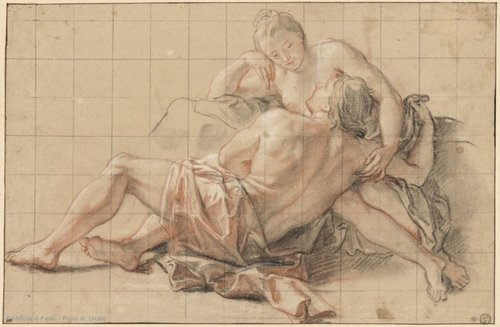
Man Resting in the Lap of a Woman by Antoine Coypel, c.1716
Objections & Replies
Let me state some objections to idleness, and see what can be said in response to them on behalf of the idler.
One objection is that idlers are lazy, and everybody knows laziness is bad. ‘Laziness’, ‘sloth’, and ‘indolence’ are terms that have negativity nested in them. To call someone ‘lazy’ is a criticism.
I do not believe that a fondness for idleness necessarily implies a favorable attitude toward laziness. A good person does not want to be averse to any activity that is necessary. She does not want to be idle when she feels she should be doing something. Whether busy or idle, she wants to be able to do whatever she’s doing without thinking she should be doing something else.
Another objection is that the idler, insofar as he really is idle, misses out on life and doesn’t really live. He merely observes life and doesn’t live it. He is among the walking (or sitting) dead.
This objection is nonsense. Those who are cut out for action might be living less fully if, for some reason they’re required by their circumstances to idle instead. There are such people, I’m sure. But there are also those who are peculiarly suited by nature to a life of repose and retirement. I’m inclined to think that there are many among the latter class. For such people, activities frequently feel more like distractions from life than life itself. They feel like they are present when they are not dancing – when they’re doing nothing except watching dancers. In the case of such naturally inactive people, it seems ridiculous to say that they are not really living when they’re still. An idling car may not be going anywhere, but it’s still running, and a car moving fast down the highway is no more alive than one idling in the garage. I’m not sympathetic, then, to an idea that’s widespread: to wit, that to love life requires packing as much activity as possible into it between birth and death.
I can’t refute that idea; but I can set over against it a contrary notion that seems just as plausible, and that can be found in the writings of thinkers such as Charles Lamb, Arthur Schopenhauer, Ralph Waldo Emerson, Henry Thoreau, Robert Louis Stevenson, Bertrand Russell, J. B. Priestly, Josef Pieper, Ursula Le Guin, and Iris Murdoch. It’s an idea I’ve already mentioned – namely, that the hustle and bustle doesn’t feel like a life to many people, but rather like distractions from it. One is most fully alive when one is just sitting, and ‘it was morning and, lo, now it is evening’. As Charles Lamb writes:
“A man can never have… too little to do. Had I a little son, I would christen him NOTHING-TO-DO; he should do nothing. Man, I verily believe, is out of his element as long as he is operative. I am altogether for the life contemplative.” (‘The Superannuated Man’, 1951)
I do not want to say that ‘man’ is out of his element as long as he is operative, only that some men and women are. Some people remain ‘in their element’ only by keeping their activities close to a minimum and leaving ample time for doing nothing.
A third objection to idleness may be put like this: “It isn’t fair. The world’s work must be done. You unjustly burden others with more than their share of work when, taking your ease, you refuse to do yours.”
I have to concede that everyone should do his or her fair share of whatever work is needful. It is bad to be a freeloader. Few, if any, are justified in always doing nothing but nothing. If there’s something that needs to be done and there’s no one around who is willing and able to do it except you, and if you agree that it needs to be done and you are able to do it, and you can’t come up with a reason why you shouldn’t do it that would satisfy other reasonable people, then you should do it. ‘Thou art the man’, as it says in an old book.
However, as the great idlers have reminded us, much of the world’s work – perhaps most of it – is not only unnecessary but positively harmful. Too much work is done, too much business transacted, too many actions performed, too many projects undertaken, too many meetings held. What is commonly regarded as necessary is anything but.
How one would prove such a proposition I don’t know. I’m sure it would require some irksome drudgery, so I won’t attempt it. What I will do instead (at the risk of committing an informal fallacy) is appeal to authority, quoting three heroes of old, and thereby provide the semblance of an argument. Thoreau remarks: “This world is a place of business. What an infinite bustle! It is nothing but work, work, work… I think there is nothing, not even crime, more opposed to poetry, to philosophy, ay, to life itself, than this incessant business” (Walden & Other Writings of Henry David Thoreau, p.712). Bertrand Russell adds, “I think that there is far too much work done in the world, that immense harm is caused by the belief that work is virtuous”. He goes on to express the hope – which turned out to be unfulfilled, as far as I know – that “the leaders of the YMCA will start a campaign to induce good young men to do nothing” (‘In Praise of Idleness’ by B. Russell, 1935). But it is J.B. Priestley who makes the point best, in my opinion. Let me quote a passage of his at length:
“All the evil in this world is brought about by persons who are always up and doing… The world, we all freely admit, is in a muddle, but I for one do not think that it is laziness that has brought it to such a pass. It is not the active virtues that it lacks but the passive ones… If, for example, in July 1914, when there was some capital idling weather, everybody, emperors, Kings, archdukes, statesmen, generals, journalists, had been suddenly smitten with an intense desire to do nothing, just to hang about in the sunshine and consume tobacco, then we should all have been much better off than we are now… The whole world would be better off if it spent every possible moment it could, these next ten years, lying flat on its back on a moor, doing nothing.”
(‘On Doing Nothing,’ in A Book of English Essays, 1951, pp.343, 344, 346.)
Before turning to other aspects of this theme I want to consider a fourth objection: How can a person indulge in leisure when there’s so much good that he or she could be doing, so much evil she could be fighting?
There are several possible answers:
(1) Leisure itself is good. When someone takes her leisure, she is adding to the sum total of good stuff in the world.
(2) Some people don’t like to fight anything. It doesn’t agree with their constitution. If evil must be fought, let others do it, or let them do it themselves by some such strategy as nonresistance.
(3) As for doing good in the positive sense, some people, among them idlers, are not very good at it. Whenever they try their hand at it, they are never very confident that what they’re doing is in fact good for anyone. They’re much more confident they’re doing good when they leave people and things alone. Still, they may very well try in various ways to contribute to the well-being of those around them. They give people rides, pet dogs, and tell jokes. They go around being bright and cheerful, hoping their cheerfulness will rub off on others instead of irritating them (as it sometimes does, I’m afraid).
Thoreau says:
“As for Doing-good, that is one of the professions which are full. Moreover, I have tried it fairly, and, strange as it may seem, am satisfied that it does not agree with my constitution. Probably I should not consciously and deliberately forsake my particular calling to do the good which society demands of me, to save the universe from annihilation; and I believe that a like but infinitely greater steadfastness elsewhere is all that now preserves it.” (p.65)
(4) I suspect that the best thing some people can do for other people is to provide a shining example of happy idleness. That’s about all they can offer to this world of frenetic activity and frayed nerves. They would set an example for animals too, if they could; but I doubt that the beasts would pick up on it – and anyway, with the exception of a few creatures such as ants and small perching birds, they don’t need it as far as I can tell. The beasts of field and home alike seem to be, by and large, idlers.
Positive Reasons for Idling
So much for objections and replies. What might be the positive reasons for idleness?
(1) In doing nothing a person is not doing anything harmful. This might not seem much to some, but it strikes me as significant. To get through life without hurting anything, to leave the world no worse than you found it, would be a great achievement in my opinion. I like this picture of the sage’s life in the Dhammapada : “As the bee takes the essence of a flower and flies away without destroying its beauty and perfume, so the sage wanders in this life” (p.42).
(2) In doing nothing, one is setting a fine example for young people, particularly one’s own children and one’s students. Perhaps because of you, the idler – somebody out there – will do a little less than she would otherwise have done, and the world will be a better place for it.
(3) Idleness is good for the natural environment and contributes little to climate change. The less people are up and about, the less they consume. The less they consume, the less the forests are robbed of their trees and the fossils of their fuels.
(4) Idleness is friendly to the nature of some people, as I’ve already noted. They feel like they’re cut out for it. It’s in the blood. Perhaps they come from a long, flat line of idlers. Perhaps because of that, they have a talent for idling, and exercising the talent makes them happy. In general, all else being equal, a person ought, or at least may, do what agrees with her nature, what she’s good at, and what makes her happy. Therefore some people should for the most part do nothing.
(5) The idleness of some may indirectly benefit others precisely because it makes the idlers happy. When some people are busy, they are unhappy. When they are unhappy, they are mean. For some people, then, idleness might even be a duty, given their tendency to be disagreeable when they don’t engage in it.
(6) A favorite theme of the Daoist sages Laozi and Zhuangzi is idleness. “Free and easy, tending to nothing is his job,” Zhuangzi says of the Perfect Man. Some people want to be like that – experts in idleness, their area of specialization (though, as things are, it might not be advisable for them to put it on their CV). That the greatest Daoist philosophers advocated idleness might be a positive reason to embrace it for those who admire Daoism.
Conclusion
Finally, it might be objected: “Why all the fuss? Who would have a problem with idleness for certain people under certain conditions?” Well, I’m making a fuss because as a matter of fact many people do object to idleness. There is a tendency to think that, all else being equal, it is better to be active than inactive. In sessions in which I, along with others, have been charged with the responsibility of evaluating people, I have frequently heard commendations of people for their activity. Not once have I heard anyone praised for her inactivity. It’s received wisdom that activity is better than idleness. The point I want to insist on is that that isn’t necessarily the case. Most of the evil in the world has been done by activists – people exerting themselves doing things. I want to speak a word on behalf of those who are not like that. I want to suggest that, in evaluations and such, the statement ‘He hasn’t done much’ is just as eligible to serve as a compliment as a criticism. I suspect that the world would be a better place if more people did less.
© Dr Wendell O’Brien 2026
Wendell O’Brien is Emeritus Professor of Philosophy at Morehead State University, Kentucky.
Advertisement
