


Your complimentary articles
You’ve read one of your two complimentary articles for this month. To have complete access to the thousands of philosophy articles on this site, please
You can register for a free account to have four complimentary articles per month. We will occasionally email you a newsletter, from which you can unsubscribe at any time. We do not sell personal data or otherwise disclose personal information to other organisations.
News
News: April/May 2025
Jürgen Habermas, a crucial critical theorist • Susan Haack, a sage of philosophy and law • On Liberty was co-authored by HTM & JSM — News reports by Anja Steinbauer
Jürgen Habermas
The philosopher and critical theorist Jürgen Habermas passed away on March 14, 2026, at the age of 96. A member of the Frankfurt School, he was among the most influential thinkers of the modern era. His career began in Frankfurt am Main in the 1950s at the Institute for Social Research run by Theodor Adorno. In 1961, he completed his habilitation in Marburg with The Structural Transformation of the Public Sphere. After a few years at Heidelberg University, he succeeded Max Horkheimer in 1964 as Professor of Philosophy and Sociology at Goethe University Frankfurt. His inaugural lecture later became the 1968 book Knowledge and Human Interests. During the student protests of that period, Habermas was seen as a supporter, though he rejected the movement’s radicalization.
In 1971, he moved to Starnberg near Munich, where for ten years he directed the Max Planck Institute for the Study of the Conditions of Scientific-Technical Life. In his final year there, he published his groundbreaking work The Theory of Communicative Action. He then returned to Frankfurt, holding another chair in philosophy until his retirement in 1994.
In later life, living beside Lake Starnberg, he continued to speak out on public issues such as the Kosovo War, brain research, and religious conflicts. His spoken delivery was characteristically shaped by a speech impediment caused by a congenital cleft palate.
Susan Haack
Professor Susan Haack, who was Professor of Philosophy and Professor of Law at the University of Miami, died on 10th March 2026. (She was interviewed by Angela Tan last year in Philosophy Now Issue 169.) Haack studied philosophy at Oxford under Gilbert Ryle and Michael Dummett, then took her PhD at Cambridge. She was a Fellow at New Hall, Cambridge and later served as Professor of Philosophy at the University of Warwick before moving to the USA.
Susan Haack wrote extensively on logic, philosophy of language, epistemology, and metaphysics, developing a pragmatic approach inspired by Charles Sanders Peirce. Her most influential contribution, presented in her 1993 book Evidence and Inquiry, is ‘foundherentism’, a theory of knowledge designed to avoid the pitfalls of both foundationalism (infinite regress) and coherentism (circularity). She illustrates this with a crossword puzzle metaphor: the clues resemble empirical evidence, while the consistency of intersecting answers represents coherence, and both are essential for justified knowledge.
A sharp critic of Richard Rorty, Haack even wrote a play composed entirely of quotations from him and Peirce, adopting Peirce’s perspective. In Defending Science – Within Reason (2003), she argued for a balanced defence of scientific inquiry, rejecting both extreme scientism and cynicism. She emphasised that good inquiry, scientific or otherwise, depended on strong evidence, reliable methods, openness to scrutiny, and integration into shared knowledge. While individuals can conduct meaningful inquiry, she noted that the scientific community benefits from specialised tools and practices that enhance credibility.
Haack insisted that paranormal claims carry a heavy burden of proof and require extraordinary evidence consistent with well-supported scientific theories. On religion and science, she saw significant tension and rejected the idea, associated with Stephen Jay Gould, that they occupy entirely separate domains. She also disagreed with Richard Swinburne, arguing that religion and science make overlapping claims about reality and human well-being. Haack highlighted that scientific findings have often challenged religious claims, while also acknowledging ongoing uncertainties within science.
Dagfinn Føllesdal
Professor Dagfinn Føllesdal was a Norwegian philosopher who was Willard Quine’s teaching assistant at Harvard, and then supervised Daniel Dennett’s senior thesis, passed away on March 1, 2026. He was emeritus professor of philosophy both at Stanford University and at the University of Oslo, among many other honours.
Føllesdal was born in Askim, Norway. After completing his bachelor’s and master’s degrees at the University of Oslo, he went on to Harvard University, where he earned his PhD in 1961 under Willard Van Orman Quine. He taught at Harvard from 1961 to 1964 and began teaching at Stanford University in 1968.
Føllesdal is remembered for his work bridging analytic and continental philosophy, including influential papers on the indeterminacy of translation, phenomenology, reference, and modality. He was a leading interpreter of the philosophy of Quine, Donald Davidson, and Edmund Husserl, whose work he knew with remarkable breadth and depth. His students and colleagues remember him for his generosity, approachability, and deep passion for the subject.
J.S. Mill’s On Liberty is now Mill and Taylor’s On Liberty
On Liberty (1859) is one of the all-time classics of political philosophy with its strong and tightly-argued advocacy of free speech and the liberty of the individual. A new edition published this month is the first to officially credit Harriet Taylor Mill as co-author alongside John Stuart Mill. Edited by an international team and released by Hackett Publishing, the volume reflects long-standing debates about authorship.
Mill himself in his Preface acknowledged his late wife’s central role, writing that she “was the inspirer, and in part the author, of all that is best in my writings […]. Like all that I have written for many years, it [ On Liberty ] belongs as much to her as to me.” In his Autobiography, he added: “the whole mode of thinking of which the book was the expression, was emphatically hers,” though he felt equally shaped by those ideas.
Despite this, all editions since 1859 have named only J.S. Mill as author. The change now is partly based on ‘stylometric analysis’, which compares writing styles and suggests “with some degree of confidence that JSM did not write On Liberty all by himself.” Scholars also note that Victorian norms may have justified misleading authorship information, whereas today there is “no reason to deny HTM the unequivocal status of being the co-author of this classic.”
As the editors conclude, “in the interest of historical accuracy and of giving credit where it is due,” modern editions should recognise both authors, a change now finally realised.
Noel Kavanagh
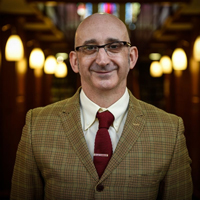
Noel ‘Dr Love’ Kavanagh
This past February saw the passing of Dr Noel Kavanagh, philosophy lecturer for nearly three decades at Carlow College St Patrick’s in Ireland. Noel was a beloved lecturer, who had an amazing rapport with the student body. Known as ‘The Mod Philosopher’, he labelled himself ‘Dr Love’ for his extensive work on the philosophy of love, including his PhD. He will be dearly missed by those who enjoyed his many radio interviews, podcast appearances, and articles in places like the Irish Philosophical Society and The Irish Times, and by all those who knew him, read him, or were taught by him.
Jay Kenny, a former student of Dr Kavanagh at Carlow College St Patrick’s
Advertisement
