



Your complimentary articles
You’ve read one of your two complimentary articles for this month. To have complete access to the thousands of philosophy articles on this site, please
You can register for a free account to have four complimentary articles per month. We will occasionally email you a newsletter, from which you can unsubscribe at any time. We do not sell personal data or otherwise disclose personal information to other organisations.
Articles
What’s the Value of Mountaineering?
Suleyman Moollan wonders why people climb mountains.
George Mallory (1886-1924), who died climbing Everest, once quipped that he attempted the mountain “because it’s there.” The line has become folklore; but it’s also an invitation to explore what the point of mountaineering really is. One might think that this isn’t a question that requires an answer, as people do many things without any obvious value. However, mountaineering is unlike most of these kinds of activities due to the risk and cost. The sport is dangerous – people die on mountains every season. Even survivors pay a heavy price, in altitude sickness, money, time, and intense physical hardship.
One reason they might do it is public esteem. Climbers are admired. Mallory is himself remembered as an icon of human aspiration. Similarly, Nimsdai Purja’s seven month sprint up the world’s fourteen 8,000m peaks in 2019 has inspired thousands.
However, I want to contend that there must be some higher value to mountaineering. In what follows, I’ll argue that this value is the development of virtue. But I’ll start with the ideas that there is either no value to mountaineering, or that the value is hedonism (pleasure). I will argue that these positions are unsatisfactory because they fail to explain why people mountaineer despite the cost and risk, or why mountaineers are held in public esteem.
Two Unsatisfactory Answers
A blunt view, suggested by a literal reading of Mallory’s quote, is that mountaineering has no value. One ascends a mountain for no particular reason other than to do it – just as toddlers knock over blocks. The object exists and one acts upon it, simple as that.
Yet this view does not make sense. First, if the undertaking had no value, why would it be celebrated by society? Even when there are occasionally cases of someone seemingly being celebrated for something arguably gratuitous and dangerous, such as running the length of Africa, that is usually because they also fundraised for a valuable cause. Secondly, a rational being would not incur risks and costs without some sort of compensation. If there is no reason to climb a mountain, there is no compensation for doing so, so a rational being would not bear the risks and costs.
The natural rebuttal is that there is some satisfaction or joy in climbing a mountain (or running the length of Africa), and that this is the compensation for the risk and effort. This takes us to some form of hedonism as the reason for mountaineering. Simply put, climbers do it because they enjoy it. Mountaineering is simply a means through which they gain happiness.
The hedonist explanation has strong claims to explaining the risks and costs, because people often do accept risk for the sake of enjoyment. Take the example of cocaine. Most people who consume it are aware of the risks, yet value the self-confidence it can procure them more than the risk. With sufficient enjoyment, it seems we’re willing to accept quite high levels of risks and costs.
However, I think this analogy is misleading. A drug-induced high generates intense effects immediately and for no effort. By contrast, the pleasures of mountaineering are rarely immediate. Most of the ascent is a long, hard slog – numb fingers, ice-encrusted boots, oxygen-deprived lungs. Does the joy of reaching the summit balance the hours of discomfort? It seems hard to argue that this pleasure alone justifies the high risks and costs.
A possible hedonistic response is to observe that mountaineering is often described as ‘type 2 fun’ by its practitioners. Type 2 fun is fun that’s only fun in retrospect – unlike type 1 fun, which is fun at the time. The insight underpinning this observation is that the pleasure of mountaineering does not come from doing it, but from having done it; in other words, from the memory and the resulting pride.
However, this is hard to accept for two reasons. First, mountaineering often involves failure, yet people still return to the mountains despite having no memories of success. Second, if the pleasure gained is contingent on reaching the summit, most hard climbs would never be attempted, as they have low probabilities of success. Therefore, it is implausible to suggest that the pleasure of mountaineering comes mainly from the memory and resulting pride, because there’s lots of failure, and memory of failure. That’s not something that usually brings people pleasure.
A different response the thoroughgoing hedonist could make is to accept both of these objections and simply argue that, for them, the pleasure, whether from the summit or just the memory of the climb, is sufficient to justify the risks. They might further argue that the mere fact that people engage in it repeatedly, at great personal cost, can only mean that it must provide enough pleasure to them. But from this point onwards we’re just talking past each other: I am convinced that the pleasure is an insufficient explanation, he is convinced of the opposite.
Since the risk and costs are apparently compatible with both positions, for the sake of argument, we can concede the point to the hedonist. Nevertheless, hedonism fails to explain the public esteem. Hedonists fundamentally seek their own pleasure, and care neither about the good of society nor about any objective moral standards. So we do not generally esteem pure pleasure-seekers as moral exemplars. Thus, public esteem for mountaineers cannot be explained by hedonism. So we must reject pleasure as an unsatisfactory explanation of the value of mountaineering.
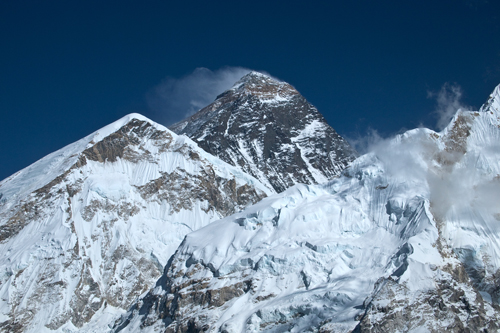
Mount Everest © Vyacheslav Argenberg 2009 Creative Commons 4
The Right Path
If it’s not for the pleasure of reaching a summit, perhaps the value of mountaineering lies in what you develop to get there – for example, certain skills or virtues.
There are two major ways of developing this thought. The first is to suggest that the value of mountaineering is found in the growth of mountaineering-specific skills. The second is to suggest that the value is in developing more general or even universal skills or virtues, which mountaineering offers a context for practising.
Mountaineering skills are practical skills; for example, evaluating the risks posed by rockfalls, avalanches and winds, or inserting nails into crevices, belaying ropes, identifying the best route. These skills must be learned but are developed through practice. However, this is not a suitable answer to our question. Fundamentally, these skills are valuable at making you better at mountaineering, and little else. Since the value of mountaineering cannot be explained by the means it employs, developing mountaineering skills cannot constitute the value of mountaineering.
We’re left with the value of mountaineering being due to the development of some general or universal virtues. These virtues by definition are not specific to mountaineering. They might include such character traits as resilience. Once an ascent has started, there is no easy opt out – helicopters back down to the valley are exclusive to affluent areas like the Alps and come with a hefty price tag. In fact, both going to the top and turning back are gruelling, hard options: there is no comfortable or simple way of quitting. Therefore, past a certain point in the climb, resilience becomes imperative rather than optional. With no easy way out, one must overcome one’s mental challenges and physical pain directly, or die. Yet, resilience is useful not only in tackling challenging peaks, but translates to other aspects of life. Generally speaking, by developing the ability to withstand pain and overcome challenges, someone is more likely to achieve their other goals, despite challenges.
Less obvious virtues are also nurtured in mountaineering, such as honesty. Mistakes, not only in terms of risk evaluation but also in terms of decisions taken with regards to the risk, are costly, so one must make an honest assessment of conditions and also an honest assessment of oneself: do I have the capacity to keep going, or is the risk of running out of steam and being left stranded between camps too large? For these reasons, out of basic self-preservation one must show total honesty in one’s assessment of the conditions, risks, and one’s own capacities. One has no incentive for arrogance: any lack of honesty increases the chance of death for oneself or one’s companions. Therefore, the intrinsic risk and self-reliance of mountaineering requires the cultivation of honesty.
In this sort of way, mountaineering has a value in requiring people to develop virtues. Therefore mountaineers might accept the risks and costs if mountaineering provides sufficient development of virtue.
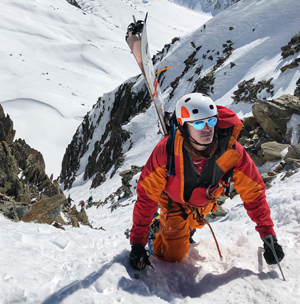
Selfie © PJSweeney007 2019 Creative Commons 4
Someone might object that the same virtues could be developed with activities that carry lower risk or cost. Marathon running breeds resilience; musical practice develops discipline; meditation develops patience. If these activities can develop the same virtues at a lower risk and cost, why then would people climb mountains?
However, this objection fails because mountaineering does not simply develop these virtues; it does so better than many alternative activities. Common, low-risk ways of developing virtues are integrated into daily life and non-exclusive: one can still lead a normal life while practicing them. Conversely, a mountaineering expedition is all-consuming. It requires months of training and, during an expedition, demands total focus. Additionally, a climber has invested money, time, and comfort, and would not want this sacrifice to be a waste. I believe it’s a fair line of reasoning that an activity which takes up more of one’s focus and attention will also lead to a greater development of associated virtues – just as it might take a month to learn French while living in France, but years in weekly classes. Furthermore, the high stakes of mountaineering also mean that, unlike a low-risk activity, there is a strong incentive to invest in the virtues necessary for success. There’s little penalty if one walks the last mile of a marathon, or skips music practice; but a bit of arrogance or complacency on a mountain could lead to death. When faced with existential risk, a rational being is likely to strongly invest in what preserves them and minimises the risk – meaning manifesting virtues such as honesty. Thus, due to the high risk, the rate of virtue development is likely to be much higher in mountaineering than with lower-risk activities.
We can see that the development of virtues can explain the risks and costs. But does it explain our public esteem for mountaineers? I believe it does. Both as individuals and as a culture, we fundamentally esteem virtue and aspire to lead virtuous lives. So an activity which develops virtue is likely to be esteemed.
Look no further than the reasons why certain mountaineers are praised. Nimsdai Purja showed outstanding resilience, completing the fourteen peaks with the attitude that “Giving up is not in the blood, sir. It’s not in the blood.” What people esteem is not his technical prowess, but his audacity and resilience. Similarly, Mallory couldn’t “see [himself] coming down defeated”. He’s not remembered just as a member of the first Everest expeditions, but as an audacious and persevering mountaineer. It seems that developing virtues is consistent with both the risks and costs of mountaineering, and public esteem for it.
Conclusion
Despite his famously flippant response, there are moments in George Mallory’s writings that suggest he saw meaning in mountaineering: “to struggle and to understand… such is the law.” Here he recognises the value of purposeful effort – which is exactly what brings about the development of any virtue, and which is also highly manifest in mountaineering. Hence I hold that mountaineering does have a value: not the pleasure it procures, but the virtues it develops.
© Suleyman Moollan 2026
Suleyman Moollan is a pupil at Brighton College and will read Philosophy at Stanford University next year.
Advertisement
