


Your complimentary articles
You’ve read one of your two complimentary articles for this month. To have complete access to the thousands of philosophy articles on this site, please
You can register for a free account to have four complimentary articles per month. We will occasionally email you a newsletter, from which you can unsubscribe at any time. We do not sell personal data or otherwise disclose personal information to other organisations.
War
Between Missiles & Morality
AmirAli Maleki considers Hart, al-Farabi, and the Puzzled Man in wartime.
It’s the first night of the war in Iran. I am walking alone under a fractured sky lit by arcs of fire – missiles tracing paths like malicious comets. Each one sings its mechanical riddle: is it our weapon, or is it theirs? I stop near a shattered bench, crack open a can of soda, and listen to the uneasy hush that so often comes before impact.
Then I hear them: two elderly men arguing beside the ruins of an old bookstore, their presence eerily tangible. One is legal philosopher Herbert Hart (1907-1992 CE) – measured, meticulous, the weight of jurisprudence behind every word. The other, cloaked in the wisdom of centuries past, is Abu Nasr al-Farabi (c. 870-950 CE) – philosopher, statesman, and master of the virtuous city.
Hart points toward me, his voice as steady as law itself: “Here is the Puzzled Man. He did not start this war, he does not want to fight – and yet here he is, summoned to make a choice.” Al-Farabi responds, his tone both gentle and unyielding: “But precisely because he did not choose this moment, he must now choose his role within it. The preservation of order and justice demands not neutrality or passivity, but moral clarity.”
Now silent, they both turn to me, their dispute unresolved, and I am left with the question that ignites this article: In light of Hart’s legal realism and Farabi’s political idealism, what is a just response to war – not merely in theory, but under the shadow of its flame?
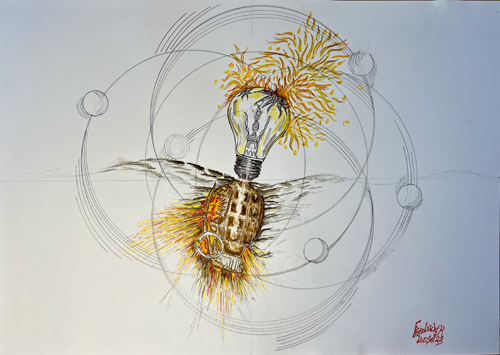
The Light of Shadow Friedrich Farshaad Razmjouie
The Puzzled Man in War
In The Concept of Law (1961), H.L.A. Hart distinguishes between ‘external’ and ‘internal’ points of view toward legal systems, emphasizing that law is not merely a set of coercive commands but also a normative (that is, moral) structure that presupposes a degree of voluntary recognition by its subjects (pp. 88-91). Yet Hart also acknowledges a persistent tension. Individuals often find themselves caught between the authority of law and their own moral or political uncertainty about its application. This tension becomes especially acute in times of war, when the legitimacy of state directives is clouded by economic hardship, political instability, and moral ambiguity. Hart’s notion of the ‘Puzzled Man’ – a figure who obeys the law but does not understand its justification – offers a compelling lens through which to view the wartime citizen. In Hart’s analysis, during war the puzzled person is not merely ignorant but morally disoriented, unsure whether the law deserves allegiance when it calls for involvement in the war, or merely demands it (p.137).
This figure resonates deeply with the experience of individuals in war-torn societies, particularly when the war is perceived as unjust, externally imposed, or driven by opaque political motives. In these contexts, the citizen becomes a puzzled man in Hart’s sense: someone subject to legal obligations, such as conscription, censorship, or rationing, but who lacks the internal conviction that these obligations are morally or politically justified. The bewilderment is not simply intellectual; it’s also ethical. The individual may ask: Why should I fight for a state that has failed to provide economic security or political transparency? This question echoes Hart’s concern with the fragility of legal authority when it’s divorced from evident moral legitimacy.
In a war setting, the bewildered wartime subject is not merely a passive victim of legal coercion, but a morally engaged agent, perhaps struggling to reconcile the demands of law with the imperatives of conscience. In this light, the battlefield becomes not only a site of physical conflict but also a crucible of legal and moral identity. The puzzled man, standing in-between Hart’s analytical jurisprudence and the lived reality of war, becomes a symbol of the modern subject’s fractured relationship with authority – a figure who must navigate not only bullets and bombs, but also the deeper question of what it means to obey. Hart’s legal positivism, while insisting on the separation of law and morality, does not deny the importance of moral evaluation, although he does argue that a critique of unjust laws is only meaningful if we first understand what law actually is rather than what it ought to be (pp.185-186).
Al-Farabi & the Clarification of Legal Duty
While Hart’s legal philosophy captures the moral disorientation of the individual caught in the machinery of questionable law, al-Farabi offers a complementary, and, in some ways, corrective vision. In his Fusul al-Madani (Chapters on Civil Polity), al-Farabi introduces the concept of the ‘Necessary City’ (al-madīna al-ḍarūriyya), a political formation in which the primary aim is not the realization of virtue or of philosophical contemplation as it would be in the ‘Virtuous City’, but the preservation of life, territorial integrity, and basic social order:
“A city may be either necessary or virtuous. The Necessary City is one in which its members cooperate with one another to attain what is essential for survival, livelihood, and the preservation of life. In contrast, the Virtuous City is that in which citizens assist one another in the pursuit of the highest goods.” (Chapters Chapter 28)
These two Cities are meaningful only in relation to one another. In other words, unless the first perfection – namely, the preservation of life and the fulfillment of basic needs – is realized, the second perfection – human intellectual maturity and the cultivation of virtue – cannot be achieved.
In this framework, war is not a moral aberration but an unfortunate functional necessity. The citizens of the Necessary City are not yet participants in the virtuous life, but they are bound by a shared imperative to defend the conditions that make any future growth in virtue possible. As al-Farabi writes, the Necessary City is one in which “people cooperate to attain the necessities of life and to repel harm.” This includes, crucially, the defense of the city itself – which is necessary even if its leadership is flawed or its justice incomplete.
Hart & Al-Farabi Team Up
This insight has profound implications for Hart’s puzzled man. In The Concept of Law Hart describes the Puzzled Man as someone who obeys legal directives without understanding their moral basis, especially when the law appears disconnected from justice or the public good. In wartime, this bewilderment only intensifies: why should one fight for a state that is economically unstable, politically opaque, or ethically compromised? Al-Farabi’s Necessary City offers an answer by reframing the situation: one does not fight because the state is just, but because without the state, there is no platform upon which justice can ever be built. The defense of the polity therefore becomes a precondition for any future reform. In this light, the citizen’s legal obligation to back the war is no longer morally paralyzing – it is clarified by necessity. The puzzled man becomes a resolved actor, not because he has found moral perfection in the law, but because he recognizes the existential stakes of the law’s collapse.
Thus, al-Farabi’s political realism enriches Hart’s legal positivism. And it reminds us that the legitimacy of the state and its laws in wartime does not rest on its moral purity but on its role in preserving the very conditions under which ongoing moral and legal discourse can survive. The battlefield, in this case, then, is not only a site of destruction, but paradoxically, the crucible in which the possibility of future justice is forged.
Conclusion: Choice Under Fire
The rockets have faded into distant echoes. I sit again on that broken bench, the empty soda can rolling near my feet. Hart and al-Farabi are gone. Perhaps they were never there. Perhaps they are still debating, in some higher place. But their challenge remains. Hart shows us that legal obligation without moral clarity breeds disillusionment. And in the chaos of war, his Puzzled Man becomes all of us, uncertain whether obedience is duty or merely survival. But al-Farabi counters that, in moments of existential peril, hesitation for contemplation is not a luxury one can afford. The Necessary City must be defended – not because it is virtuous, but because without it, no virtue can ever arise.
And so I return to my question: How should I respond?
I am still uncertain. Hart has taught me to interrogate authority: to remain vigilant against the seduction of blind obedience. Meanwhile, al-Farabi has taught me that ideals are hollow if they’re not preceded by actions that allow preservation. Between the two, I begin to form my response – not a perfect synthesis, but an imperfect resolve.
I rise from the bench. In the distance, sirens howl. The war continues. But perhaps now, I do not walk alone.
© AmirAli Maleki 2026
AmirAli Maleki is a philosophy researcher and the Editor of PraxisPublication.com. He works in the fields of political philosophy, Islamic philosophy, and hermeneutics.
Advertisement
