


Your complimentary articles
You’ve read one of your two complimentary articles for this month. To have complete access to the thousands of philosophy articles on this site, please
You can register for a free account to have four complimentary articles per month. We will occasionally email you a newsletter, from which you can unsubscribe at any time. We do not sell personal data or otherwise disclose personal information to other organisations.
Books
Helgoland by Carlo Rovelli
Peter Benson marvels at Carlo Rovelli’s relational quantum theory.
Helgoland is a small, remote island off the north coast of Germany. Werner Heisenberg retreated there in 1925 to brood in solitude over the implications of quantum theory, which he had helped create. This theory is also somewhat like a strange island, set in a rough sea, at some considerable distance from the mainland of our everyday experiences. Throwing a bridge between the two, to explain how the bizarre quantum world relates to the apparently solid world around us, has been a major concern of physicists from the pioneering days of Heisenberg, Bohr, and Schrödinger up to the present.
Carlo Rovelli is one of the latest such bridge-builders. Not only has he proposed a new interpretation of quantum theory to add to the long line of such speculations, he has also written books for the general public about these ideas. Indeed, Rovelli is rightly regarded as one of the leading authors of popular science books today, with worldwide sales running to millions. Furthermore, he has a familiarity with philosophy that’s rare among scientist. He has written studies of Anaximander and Aristotle, finding a continuing pertinence in their thoughts; he also takes a strong stand against the view expressed by fellow physicist Stephen Hawking that ‘philosophy is dead’. Hawking believed that it’s now the task of science alone to resolve all the dilemmas previously discussed by philosophers. By contrast, Rovelli believes that physicists are still confronted by questions that are philosophical in nature, which the methodologies of science cannot by themselves resolve.

Helgoland
Helgoland © Dionysos1970 2021 Creative Commons 4
Multiple Worlds
Rovelli begins Helgoland by giving a succinct account of the origins of quantum theory. He then discusses several of the best-known interpretations of the theory, each of which has implications most of us would find implausible. The ‘many worlds’ interpretation, for example, claims that new universes branch off from our own at every moment of quantum indeterminacy, meaning that all possibilities actually happen, in parallel, mutually-inaccessible realms. The appeal of this probably comes from the many science fiction stories we have all read postulating alternative histories. However, given the number of quantum events that take place every microsecond, we’d have to imagine untold billions of new universes coming into existence all the time, even as we walk down the street. This is the kind of ontological extravagance that philosophers have traditionally sought to avoid. Occam’s Razor says, ‘Do not multiply the postulation of entities unnecessarily’. The Many Worlds theory extravagantly does the opposite.
Another approach is the interpretation which says that reality comes into determinate, as opposed to merely probabilistic, existence when it is observed by a conscious mind. This seems to me to be a revival of George Berkley’s contention that ‘to be is to be perceived’, where objects are ‘the permanent possibility of perception’. However quantum observations arguably do not require a conscious perceiver, but instead happen whenever the microscopic quantum world impinges on macroscopic reality.
I find Rovelli’s consistent refusal of any subjectivist interpretations of quantum theory refreshing. As he writes: “To think that human beings, their minds, their tools, or the numbers they use, play any special role in the grammar of nature is nonsense” (p.119).
Relations
After considering the mainstream alternatives, Rovelli sketches his own ‘relational’ interpretation of quantum theory. His core idea is that single entities (photons, atoms, chairs) have no existence in themselves, but only in their interactions with each other. Hence, one cannot answer any question about an object except with regard to its relation to a specified other object. Quantum theory provides mathematically accurate predictions of the effects of quantum object interactions (electrons and photons, for example), but says nothing about non-interacting entities. So, Rovelli suggests, we should deny any existence to the latter, except as retrospectively imagined sources for the interactions.
In the final chapters of the book Rovelli seeks out precursors to this idea in the works of philosophers of the past. For instance, he turns to the Second Century CE Buddhist thinker Nagarjuna, one of the founders of Mahayana Buddhism. Nagarjuna’s texts are notoriously difficult to interpret, even within the traditions he helped to found. We now have nearly two millennia’s worth of commentaries, which do not always agree. Still more difficult is it to authoritatively interpret these texts through the framework of a completely different tradition of thinking, such as that of modern science and Western philosophy. We may indeed reasonably doubt that Nagarjuna was expounding anything like a theory of the fundamental components of the material world in the manner of a modern scientific theory. Perhaps his texts might be better understood as guided meditations for Buddhist practitioners, leading them towards progressive detachment from the things of this world, until they are at rest in emptiness.
However, even if we do approach Nagarjuna’s texts as speculative ontology, I am very doubtful they would support Rovelli’s hypotheses. It’s true that Nagarjuna denies the existence of independent objects. But Rovelli’s theory replaces objects with the relationships between objects as its ontological foundation. This is what makes it a ‘relational theory’: relations are admitted to exist, but not the postulated objects which are related except in terms of those relations. Nagarjuna, on the other hand, in a manner typical of Buddhist thought, gradually dissolves everything into the void, including relations, which have no reason to be preserved from this dissolution. As Jay Garfield writes in the commentary quoted by Rovelli on p.219: “Not only are compounded phenomena empty of inherent existence, but so is the relation among their constituents.” Nagarjuna therefore goes much too far for Rovelli’s purposes.
Not So Positive
Coming closer to our own times, Rovelli’s other principal suggested precursor is the Twentieth Century Russian thinker Aleksandr Bogdanov (1873-1928).
Though there has been a revival of interest in his work recently, Bogdanov remains best known because of a book criticizing his ideas published in 1909 by Vladimir Lenin, Materialism and Empirio-Criticism. This book was the only work of pure philosophy written by Lenin, who was subsequently distracted by other concerns, such as overthrowing the Czarist regime and establishing a communist society in Russia. But Lenin was an able philosopher.
Lenin’s main concern in Materialism and Empirio-Criticism was to establish what ‘materialism’ means in a Marxist context. Marx himself did not consider the term problematic, because he lived at a time when science was explaining the world unequivocally in terms of material particles and the forces propelling them. Today, the situation is less clear. For instance, what exactly is ‘material’ about the probability distributions of quantum behaviour described by Schrödinger’s wave equations? Bogdanov and Lenin were writing when these problems were only just beginning to come into view.
Lenin’s definition of ‘materialism’ (quoted by Rovelli on p.179), is the idea that there’s “an objective reality, existing outside our minds.” This would seem to be a fairly minimal requirement for materialism, but Lenin argues that Bogdanov’s theories fail to satisfy it. The title of Lenin’s book is Materialism and Empirio-Criticism. ‘Empirio-Criticism’ is another name for the philosophy then being propounded by the Vienna Circle, better known in the English-speaking world as ‘Logical Positivism’. It was introduced into British philosophy by A. J. Ayer in his widely-read first book, Language, Truth, and Logic (1936). At that time it seemed to many to be a brash, no-nonsense dismissal of metaphysics, in a commonsense, de-mystified view of the world; but Ayer spent the rest of his career explaining what was wrong with this initial enthusiasm of his. Today, it would be very difficult to find anyone who would admit to being a logical positivist. In philosophical circles it is generally regarded as having been thoroughly debunked. Its problems include its need to potentially verify every possible proposition by sense-data, and its dismissal of any idea not capable of such verification, including the idea of the independent existence of the external world. So we can see how, in Lenin’s terms, empirio-criticism fails to affirm materialism, since it fails to establish the existence of a world independent of our own minds.
Lenin’s criticisms of the theory belong among a substantial body of such discussions which regard the ideas of the Vienna Circle as one of the dead-ends of modern thought. And to me the experiential demands of logical positivism resembles interpretations of quantum mechanics that make conscious perception necessary for the determination of reality from probabilities. Rovelli, however, is surprisingly generous in his view of logical positivism. He calls it “the root of so much contemporary philosophy of science” (p.104). But this is true only insofar as various reactions against logical positivism were crucial in the subsequent development of the philosophy of science – notably Karl Popper’s critique of its ‘verificationist’ principle.
Bogdanov and Lenin were rival members of the Bolshevik Party, and there were political as well as philosophical differences between them. Rovelli gives an engaging portrait of Bogdanov, which could lead the reader to speculate on what might have happened if he rather than Lenin had become leader of the Party. However, when Rovelli quotes Bogdanov as having declared that “the individual is a bourgeois fetish” (p.154), it’s alarmingly easy to imagine where that line of thinking might lead.
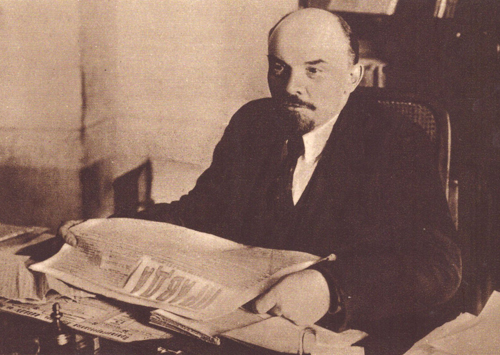
Another philosopher who went off the rails.
Lenin © Creative Commons Attribution-Share Alike 4.0 International
Making A Difference
Rovelli only mentions thinkers in the Anglo-American analytic tradition of philosophy. He does not appear to have any awareness of recent thinkers in the Continental tradition. This is somewhat surprising, given that he is Italian and in his youth was involved with radical politics. However, it does exemplify the regrettable lack of communication between these two traditions, which seem to be hermetically sealed from one another. It is particularly regrettable in this context though, because, if I had to suggest a philosopher whose work might be relevant to Rovelli’s relational theory, it would be Jacques Derrida (1930-2004).
Beginning with his investigations into the nature of language, Derrida developed the idea of a difference that precedes identity. According to Ferdinand de Saussure’s linguistic theory, language is “a structure of differences without positive terms.” In other words, words and syllables are characterizable only by their distinction from other words and syllables. Starting from this idea, Derrida developed more fundamental speculations, suggesting that difference might be characteristic of all levels of reality (see, for example, his essay ‘Différance’, 1968). Perhaps here might be a precursor worthy of Rovelli’s attention. In the meantime, Rovelli’s fascinating books continue to keep open a channel of fruitful discussion between philosophy and science.
© Peter Benson 2026
Peter Benson has been a contributor to Philosophy Now for many years. He used to work in a library, but now devotes himself full-time to writing.
• Helgoland: The Strange and Beautiful Story of Quantum Physics, Carlo Rovelli, Penguin, 2022, pb, £12.99, 208 pages, ISBN 0141993278
Advertisement
