


Your complimentary articles
You’ve read one of your two complimentary articles for this month. To have complete access to the thousands of philosophy articles on this site, please
You can register for a free account to have four complimentary articles per month. We will occasionally email you a newsletter, from which you can unsubscribe at any time. We do not sell personal data or otherwise disclose personal information to other organisations.
Articles
What is Analytic Philosophy?
Alexander Jeuk analyses philosophical analysis with a philosophical eye.
Philosophy departments, particularly in the Anglo-American world, are overwhelmingly dominated by analytic philosophy. This dominance is so pronounced that alternative philosophical approaches have been largely displaced. In fact, we haven’t seen a single paradigm dominate Western philosophy in this way since the end of the hegemony of scholasticism in the sixteenth century. Analytic philosophers often emphasize precision and clarity in their work. Yet, ironically, it is surprisingly difficult to pinpoint what exactly analytic philosophy is. This becomes apparent when we consider the history of the movement.
Early Analytic Philosophy & the Linguistic Turn
Analytic philosophy emerged in the late nineteenth and early twentieth centuries, pioneered by thinkers like Gottlob Frege, Bertrand Russell, G.E. Moore, and Ludwig Wittgenstein. What united them was their method of addressing philosophical problems through the analysis of language, particularly the analysis of analytic statements. Analytic statements are statements whose truth or falsity depends solely on their linguistic form, or as we might say, on the meaning of the words used, independent of any empirical information (such as ‘one plus one is two’). This method is what gave the movement its name.
Western philosophy before this period was primarily concerned with the nature of reality rather than language. Analytic philosophers, however, argued that many philosophical problems were, at their core, problems of language. This claim marks the so-called ‘linguistic turn’ in philosophy. According to this view:
(1) Philosophical problems are to be analyzed through analyzing language;
(2) Philosophy should ideally focus on analytic (non-empirical) statements; and
(3) Philosophical inquiry should be limited to areas where such analysis can be applied, leaving other questions to the empirical sciences.
This approach gradually supplanted a variety of other philosophical paradigms, such as pragmatism, phenomenology, and neo-Kantianism. Yet here’s the strange part: most contemporary analytic philosophers no longer view their area in these terms. In fact, many reject the idea that philosophical problems are primarily problems of language, let alone that philosophy should be concerned solely with the analysis of analytic statements. Like earlier philosophers, most analytic philosophers today believe they are examining reality (whatever that may be), not merely language.
Quine, Wittgenstein & the Shift Away from Language
The reasons for the shift away from language are varied, but a particularly influential figure in this development was Willard Van Orman Quine (1908-2000). Quine famously challenged the distinction between ‘analytic’ and ‘synthetic’ statements. Analytic statements, remember, are those that can be known to be true by virtue of their meaning alone (such as, ‘All bachelors are unmarried’), while synthetic statements (statements not evidently true or false by virtue of their meaning alone) generally require empirical verification (for example, ‘The cat is on the mat’). Quine argued that the distinction between analytic and synthetic statements could not be maintained in the simple way earlier analytic philosophers had assumed. On the one hand, he claimed that no part of our ‘web of belief’ is absolutely immune from revision: even logic, he suggested, might in principle be revised if doing so helped us make better sense of physics, as some had proposed in response to quantum mechanics. On the other hand, Quine was suspicious of meanings understood as private mental objects or fixed conceptual entities waiting to be analysed. Meaning, if it was to be scientifically respectable at all, had to be tied to public language-use, behavior, and our broader theory of the world.
Many philosophers found Quine’s naturalistic critique of the older analytic project convincing. If, as naturalists claimed, philosophy was continuous with empirical science and meanings were not fixed objects waiting to be analysed, then philosophy could no longer be understood simply as the analysis of language.
Another major shift away from language can be attributed to the later work of Ludwig Wittgenstein (1889-1951). Wittgenstein argued against the artificial use of language that many philosophers employ. For him, philosophical problems often arise when we stretch language beyond its everyday use, leading to confusion about meaning and the generation of pseudo-problems. Wittgenstein’s point was that ordinary language works perfectly well in practical contexts, but breaks down when misapplied to abstract, philosophical questions. For example, the question ‘Do I really know there’s a tree in front of me?’ seems meaningful, but Wittgenstein would argue it is nonsensical. In everyday life, the word ‘know’ functions without issue – but when we apply it in this artificial, philosophical, way, it no longer makes sense, creating a question where answers can easily go both ways.
The vast majority of Anglo-American philosophers came to agree with Quine or Wittgenstein, or came to similar conclusions. This led to a shift in focus away from the analysis of language, toward a direct engagement with reality itself.
Analytic Philosophy is Dead, Long Live Analytic Philosophy!
Given the impact of Quine’s and Wittgenstein’s critiques, one might expect that analytic philosophy would have ended in the mid-twentieth century. After all, if the whole idea of analyzing language to solve philosophical problems had been discredited, it would seem logical for philosophers to either abandon the approach or radically revise it. And yet, this isn’t what happened. Instead, something quite peculiar occurred. Rather than abandoning their methods, analytic philosophers expanded their inquiries into fields they had previously shunned, such as metaphysics and the philosophy of mind, without fundamentally changing their methods, though no longer labelling them as linguistic. What analytic philosophers seemingly took from Quine’s critique is that there should be no boundaries to the scope of their inquiry. Since all relevant concepts are seemingly both synthetic and analytic, they are no longer confined to analysing purely analytic problems. But does that make sense? Maybe not, if they continue to use a method that was developed for analyzing purely analytic concepts! Yet that’s exactly what they did.
It’s difficult to overstate how peculiar this is. Quine argued that a restriction to analytic problems made no sense because there are no (or few) purely analytic problems. But instead of reconsidering their methods, analytic philosophers concluded that, since all interesting analytic problems are also synthetic, they could now work on everything. Yet, the way in which they worked on everything remained the same as the way in which they approached analytic problems, using methods involving the analysis of concepts. In all fairness, many philosophers did start to work in a naturalistic vein. Yet, as we will see, this remained strikingly similar to early analytic philosophy. And more importantly for our purposes, if naturalism really broke with linguistic or logical analysis, why should it be called ‘analytic philosophy’ in the first place?

A very analytical philosopher: Lord Bertrand Russell (1872-1970) Portrait by Clint Inman
The Rise of Intuition-Based Philosophy
By the 1980s and 1990s some began to ask what exactly analytic philosophers had been doing for the past few decades given that only a few analytic philosophers still accepted the idea of logical or linguistic analysis. One prominent answer was that analytic philosophers had moved away from linguistic analysis, and instead begun focusing on thought experiments and intuitions.
A thought experiment is a hypothetical scenario designed to test a philosophical concept. A famous kind of thought experiment is a Gettier-style problem, which challenges the previously widely accepted definition of knowledge as being ‘justified true belief’. In one variety, that actually goes back to Bertrand Russell, someone looks at a stopped clock that coincidentally shows the correct time. Although their belief about the time is justified (because clocks usually show the right time), and true, most people’s intuition would suggest that this does not count as knowledge. Other well-known thought experiments include David Chalmers’ ‘philosophical zombie’ (which tests whether a being physically identical to a human yet without consciousness is conceivable), or Philippa Foot’s ‘trolley problems’ (which explore the moral implications of sacrificing one life to save many). In each such case, philosophers rely on their intuitions – gut feelings, if you will – to evaluate whether the thought experiment proves or disproves a particular claim.
If thought experiments about twin earths, swampmen, and thinking about ‘possible worlds’ seem to you like the brainchildren of precritical seventeenth-century rationalism, you’re not far off.
What’s Wrong with Intuitions? Not What You Might Intuit
I can’t dive into all the problems with intuitions here, nor address all the attempts by analytic philosophers to rebrand their outdated linguistic methods to appear new, such as calling them ‘experimental philosophy’, the ‘method of cases’ or ‘conceptual engineering’. However, there are a few key issues I can highlight:
(1) A Non-Critical Approach
First, using intuitions as the foundation of analytic philosophy is far from taking a critical approach to philosophical method.
Traditionally, whether in phenomenology, Neo-Kantianism, or early analytic philosophy, philosophers began with inquiries into method to justify and direct their research. But as you may have noticed contemporary analytic philosophers tend to assume that the underlying methodology is correct. At best they explain their method after the fact of its use, rather than grounding it properly from the outset.
Despite the attempts of some analytic philosophers to intellectualize them, thought experiments depend on our intuitions which are essentially gut feelings, that is to say, hunches – even though rigor and precision are qualities analytic philosophy supposedly prides itself on.
(2) Historical Revisionism
To give intuitions more credibility, analytic philosophers have constructed a rather revisionist view of the history of philosophy, arguing that philosophers have always relied on intuitions, from Plato onward. However, even if this were true, it’s hardly a genuine justification of intuitionism: if it is supposed to be one. Moreover, the historical claim is simply false. Thinkers such as Descartes, Locke, Kant, Husserl, or Heidegger, did not use intuitions in the way claimed. I don’t mean they avoided the term. Rather, they employed methods where they analyze their own experience, like phenomenological or proto-phenomenological approaches. Other thinkers, such as Marx, Nietzsche, Dilthey, or Heidegger (again), used historical-genealogical methods, and the German Idealists such as Hegel employed dialectical methods. The notion that intuitions played a central role in their work arises only from the limited philosophical framework of many analytic philosophers, who rely on a simplistic dichotomy between conceptual knowledge (which includes intuitions and analytic knowledge) and empirical knowledge (synthetic or scientific knowledge). From this false dichotomy, they infer that if past philosophers did not use empirical methods, they must have used analytical or intuitive ones. However, that inference says more about analytic philosophy than about philosophical approaches.
(3) What’s Analytic About Intuitions?
Analytic philosophy, at its core, was based on linguistic analysis, ideally of analytic statements, so it is unclear why contemporary philosophy that heavily relies on intuitions should still be considered ‘analytic’. Perhaps the persistence of this label is due to the fact that the various branches of analytic philosophy, including naturalism, share common assumptions. But analytic philosophers are not really aware of these common assumptions, since, as one of my professors in graduate school said, discussing the presuppositions of your work is “what undergraduate students do, not philosophers.” This common mindset has certainly not enhanced clarity.
The assumptions shared by different branches of analytic philosophy often exhibit a kind of what Wittgenstein called ‘family resemblance’. Classical analytic philosophers share with naturalists a belief in intertheory reduction – the idea that one set of concepts or theories can be fully reduced to another. Both are also deeply concerned with abstraction – whether they’re focusing on basic naturalistic entities to which everything could putatively be reduced (such as the mind being reduced to the brain’s activities), or categories of existence that mirror our language use. Both traditions also held, for a long time, the idea that human thought works like language, to represent the world. Many analytic philosophers also have deep admiration for formal methods of thinking and the mathematical sciences.
Finally, and importantly, it indeed seems that most cases analytic philosophers ‘analyze’ with their ‘intuitions’ are indeed linguistic hunches, that are, as mentioned, more or less indistinguishable from linguistic analysis. For example, the intuition about knowledge that the person looking at the stopped clock does not really know the time looks very much like a judgment about how we are inclined to use the word ‘know’ in the exact same case. If we can simply replace ‘knowledge itself’ with ‘our concept of knowledge’, and ‘analysing our intuition about knowledge’ with ‘analysing our concept of knowledge’, this seems like switching a label instead of a method. Likewise, naturalists basically accept the story above and add some just-so story that is ‘in accord’ with the natural sciences on top of that. For instance, knowledge is justified true belief because our knowledge-generating abilities evolved to reliably track truth. Knowledge exists because it enhances survival, and so on.
For all these reasons, it perhaps never felt necessary to change the name of the paradigm, despite its claim that it has moved beyond mere language analysis.
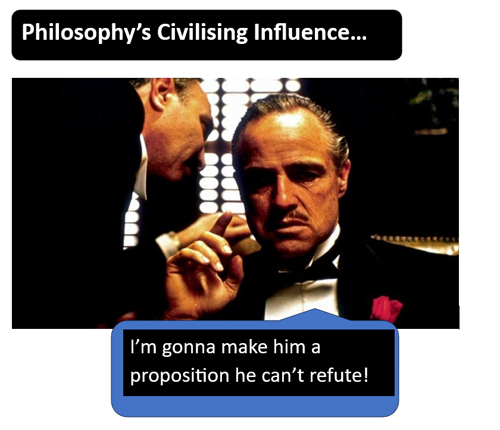
Joke from Colin Stott
Godfather image © Paramount Pictures 1972
Concluding Remarks
Whatever one may think of contemporary analytic philosophy, it is clear that it’s beset by methodological problems and conceptual ambiguities. Perhaps its biggest issue is that it is unclear why it is still called ‘analytic philosophy’ at all – a problem that only became worse with the rise of naturalism. It suffers from false assumptions about its place in the history of philosophy, and a lack of rigor in its methods. What began as a movement aiming to critically limit philosophy to the analysis of problems through a linguistic lens, has now transformed into a baroque discipline where philosophers speculate on the logical possibility of nonconscious zombies – something even Leibniz, when discussing possible worlds, could not have dreamed of.
Whether analytic philosophy will address its methodological issues seems doubtful. Given its dominant position in English-language philosophy there is little external (or internal) pressure for change. Fortunately, however, promising philosophical approaches already exist where philosophers engage seriously with methodological debate, such as phenomenology. Whether this will lead to greater pluralism in Anglophone philosophy departments remains an open question.
© Alexander Jeuk 2026
Alexander Jeuk is an independent researcher writing on philosophy, economics, politics, and the institutional structure of science.
Advertisement
