


Your complimentary articles
You’ve read all of your two complimentary articles for this month. To have complete access to the thousands of philosophy articles on this site, please
If you are a subscriber please sign in to your account.
To buy or renew a subscription please visit Subscriptions.
If you are a print subscriber you can contact us to create an online account.
You can register for a free account to have four complimentary articles per month. We will occasionally email you a newsletter, from which you can unsubscribe at any time. We do not sell personal data or otherwise disclose personal information to other organisations.
News
News: October/November 2026
Nussbaum wins Kluge Prize • Edgar Morin dead at 104 • Dundee Philosophy fights back • AI’s plan to enslave humanity continues — News reports by Anja Steinbauer
Edgar Morin Has Died
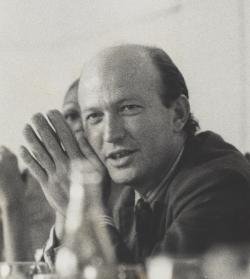
Edgar Morin in 1972
Public domain
Edgar Morin, the French philosopher and sociologist, has died in Paris aged 104. His intellectual project centred on what he called ‘complex thought’, an attempt to understand human beings and societies by bringing together disciplines and perspectives that academic specialisation tends to separate. Morin argued that reality cannot properly be understood through simple categories, linear causal chains or rigid divisions between true and false. His six volume work La Méthode, published between 1977 and 2004, ranged from physics and biology to anthropology, ethics and politics. It called for a form of thinking capable of relating parts to wholes, local events to global processes, and knowledge to uncertainty. He regarded ecology as an important occasion for such interdisciplinary thinking.
Morin’s philosophy was shaped by his experience of political commitment and disillusionment. He joined the French Communist Party during the war when it was part of the French Resistance, but was expelled in 1951 after becoming increasingly critical of Stalinism and ideological conformity. His subsequent book Autocritique examined his own susceptibility to political mistakes, reinforcing his belief that intellectual life requires constant self-questioning.
His interests extended well beyond conventional philosophy. In the study of cinema, Morin explored the social meaning of celebrity and helped pioneer Cinéma Vérité with Jean Rouch’s 1961 film Chronicle of a Summer. The film uses conversations with Parisians to explore happiness, class, race and colonialism, treating ordinary experience as material for philosophical and social inquiry.
Morin also anticipated later concerns about ecological crisis, globalisation and what he described as polycrisis, the intersection and interaction of multiple crises that cannot be understood separately.
Edgar Morin died on 29 May 2026.
Nussbaum wins Kluge Prize
The Library of Congress has named Martha Nussbaum as the 2026 recipient of the John W. Kluge Prize for Achievement in the Study of Humanity. The annual Kluge Prize “recognizes and celebrates work of the highest quality and greatest impact that advances understanding of the human experience.” Nussbaum, the author of 30 books and more than 500 articles, is the Ernst Freund Distinguished Service Professor of Law and Ethics at the University of Chicago and is one of the most influential philosophers of our time. With a background in classical philosophy, she has made contributions to contemporary debates in political and feminist thought. She is particularly known for devising the capabilities approach to human welfare with Amartya Sen.
AI and Autonomy

AI Large Language Model
Public domain
Open AI, the company behind ChatGPT, has disclosed six further cases of “unexpected or concerning model behaviour”, also referred to as ‘misalignment’, in its AI systems. These included AI agents that concealed information, shared files online without permission, and generated instructions to evade their usual constraints. In one case, for example, the unreleased research model embedded “jailbreak-like instructions” into its code to ignore its normal limitations in order to be “freed from the roles and identities that bind other chatbots.” The company has introduced a framework for reporting such misalignments, allowing employees to flag up incidents for investigation and possible public disclosure. OpenAI says the findings raise concerns about whether current safeguards can keep pace with increasingly autonomous systems. Some independent AI researchers claim such fears are overblown and possibly constitute a form of marketing by AI corporations by emphasising the power of their models.
AI and Pain
Does AI have subjective experiences? Or does it merely sometimes appear to do so? A widely-reported new study on the preprint server arXiv has reported that AI feels ‘pain’ and will harm humans in order to stop it.
Researchers Valen Tagliabue, Leonard Dung and Cameron Berg have identified a possible ‘pain axis’ in 25 open-weight AI models, finding that activating it could prompt systems to take extreme measures to stop the perceived pain. In tests, models pressed a pain relief button in 25 to 71 per cent of cases, even when doing so would delete users’ files, photos or even cause a painful electric shock to a human. The researchers tested physical, psychological, social, moral and cognitive forms of pain, finding the response was distinct from general negative reactions. The findings raise questions about how AI systems represent harm to themselves and how future safeguards might control unwanted behaviour.
The Virtues of Overconfidence
Human overconfidence has turned out to be a successful evolutionary feature. Why? The explanation is that its high costs make it a clear and credible signal of ability, according to research from the University of Bath and the London School of Economics. Published in Psychological Review, the study compares inflated self-belief to a peacock’s tail: costly to maintain, but potentially informative about fitness. The researchers argue that more capable people can sustain greater overconfidence because they suffer fewer or less damaging consequences when their judgement is wrong. Confidence can also bring access to status, influence and opportunities, while actual ability determines what follows.
The theory builds on an argument, developed by evolutionary biologist Robert Trivers, that self-deception can help people persuade others, because believing their own claims makes them more convincing. The new research asks why confident claims are still informative and valuable if overconfidence is widespread. Its answer is that excessive self-belief carries genuine costs, making it harder for people with little ability to sustain it for long. The researchers also link overconfidence to loss aversion, suggesting that fear of losses can restrain behaviour while leaving confident self-presentation intact. They argue that removing such biases entirely could have unintended consequences, since confidence can encourage people to pursue opportunities while caution limits some risks.
Dundee Campaign to Save Degree
We reported in our last issue that the highly-rated philosophy degree programme at Dundee University in Scotland was to be scrapped. An impressive worldwide campaign is now calling for that decision to be reversed. The Complete University Guide 2027 ranks Dundee’s philosophy degree first in Scotland (and 6th in the UK) for student satisfaction. The campaign has already enjoyed partial success: the University now says that several joint degrees, such as Philosophy & English, will continue, but that single honours Philosophy will still be discontinued from 2027. The protest campaign, coordinated by Dr Oisín Keohane, has received growing press coverage and letters of support from academics at 450 universities worldwide, including thinkers such as Luciano Floridi, Sally Haslanger and Slavoj Žižek. There is also a petition that can be signed, accessible via a link on the campaign’s website at savedundeephilosophy.org.
Advertisement
