


Your complimentary articles
You’ve read one of your two complimentary articles for this month. To have complete access to the thousands of philosophy articles on this site, please
You can register for a free account to have four complimentary articles per month. We will occasionally email you a newsletter, from which you can unsubscribe at any time. We do not sell personal data or otherwise disclose personal information to other organisations.
Articles
To Philosophize is to Learn How to Say Goodbye
Scott F. Parker reflects on philosophy as a preparation for death.
The first day I visited my dad in the care facility where he was recovering from a serious infection in his prosthetic aortic valve, I got the clear impression that he was trying to feel out whether I would support his decision to stop treatment. “You people don’t know what it’s like in here,” he said more than once, allowing for a certain ambiguity as to whether ‘in here’ referred to the facility or to something more metaphysical. ‘You people’ included my mom and sister, both of whom lived in Portland, saw him frequently, and were understood in advance to be unreceptive to his appeals for mercy, no matter how subtle. In me, I gathered, he saw his hope for someone who wasn’t so sentimental as to prolong suffering by denying death, or, to put it another way, someone who would be willing to relieve suffering by hastening death. He was not wrong. Based on what I’d been able to discern from daily phone calls with my mom, herself a retired physician, it wasn’t unlikely that his decline would be permanent. Knowing what I knew of my father, it seemed cruel to ask him to go on in a state of dependence, unable to walk, unable to feed or wash himself, unable to carry on a coherent conversation or distinguish between people, days, or ideas. A man who strived for independence and clarity his whole life, the one time he’d had the energy to talk to me on the phone, he had sounded like a stranger – disoriented, confused, helpless.
Yet if I was ready to play my part in facilitating my father’s death, it wasn’t only from a sense of wanting to preserve his dignity, but also in the confidence that a lifetime of dedicated preparation had readied him for this moment. He was a philosopher both by nature and by application. For far longer than I’d had the chance to know him, he had been engaging with questions of meaning, truth, and reality as if his life depended on it. His commitment to philosophy was mysterious to me when I was young, but as a teenager I began to appreciate that it was born of necessity. Knowing what it meant to be human was life or death for him. As a child, my father suffered from severe OCD before such a diagnosis was available. His suffering was compounded by the notion of sin he internalized from his Catholic upbringing. The only treatment he was offered beyond prayer came in the form of heavy tranquilizers that consigned him to bed for long stretches of his adolescence. Things didn’t really improve for him until he began reading philosophy in his teenage years. He found, in its sober naturalistic attempts to discern the nature of reality, a sense of equanimity. In a calm moment, his obsessive thoughts and compulsive behaviors could be relaxed, even released. The world wasn’t the problem, he could see: thinking about it the wrong way was the problem. String enough calm moments together, and it’s possible to achieve something like a life.
After his most acute suffering had been relieved, he could see clearly that the reality of the human condition still remained: he, like everyone, and like everything living, was going to die. How was it possible to live in the face of that fact without terror, without comforting oneself with the promise of an afterlife? His answer to this question isn’t one I can succinctly summarize here, but it involves a constant engagement with the question itself. Philosophy, for my dad, is conducted with the human condition in mind as a preparation for death. In taking such an approach, he joins a venerable tradition that runs through Socrates, Cicero, Montaigne, and the existentialists. In Plato’s Apology, for instance, Socrates concludes his speech just prior to his unjust execution by the Athenian state with these words: “Now it is time that we are going, I to die and you to live, but which of us has the happier prospect is unknown to anyone but God.” Soon after, he will willingly drink the hemlock, leaving it to antiquity to make sense of his story.
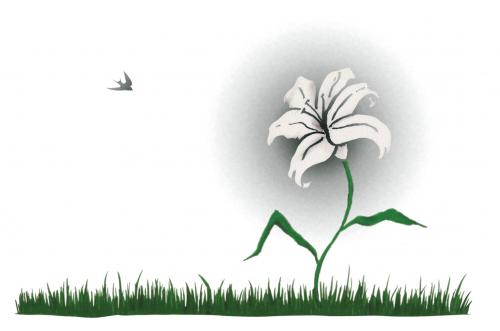
Image © Susan Auletta 2026 Please visit instagram.com/sm_auletta
Since my dad introduced me to philosophy when I was a teenager, I have apprenticed myself in the same tradition. So, was I ready for his death? That was the question my dad’s health put to him directly, and indirectly to me. A lifetime of philosophy was being put to the test, I thought. And, I thought, I knew what the test demanded. Accept finitude. Don’t pursue every measure to extend life simply out of a terror of death. Welcome death, when it arrives, like an old friend, whose visit to paraphrase Montaigne, we have been expecting: “Ah, so today is the day you have decided to drop by. Come in!”
Easy enough to say, harder to achieve. But while there is a temptation to cling to life, there can be an opposing temptation to escape from it, and the line between accepting death and pursuing it can be quite thin. Like the suicide that might have earlier provided the most immediate (and permanent) relief from his OCD, the death now looming before my father promised him something he’d always desired: freedom from worldly entanglements. The needful body had asserted its absolute demands, but in so doing had exposed its limits. On the other side of the failing body was its complete absence – whether into pure mind or pure oblivion made little difference; any escape from the physical and its psychological overflow was preferable to the chronic pain and suffering that living entailed.
But was it a noble philosopher before me in the hospital bed, or a feeble old man?
My dad’s complaints were less metaphysical, I noticed, than personal. Like a Woody Allen joke, the food was both terrible and served in small portions. There were also too many pills, too many blood draws, too many visits from nurses, whose speech patterns were too bright and bubbly. Physical therapy was a waste of time. Come to think of it, the failures of the entire American medical system were on full display in this suburban care facility, “I’m not going to make it six weeks here,” he said – whether as a threat to leave or a promise to die was, once again, open to interpretation.
Am I giving an impression of a kind of immaturity? I mean to. He wasn’t here contemplating death with careful and wise detachment, but out of an immediate and reactionary frustration. Not that I wasn’t sympathetic. He had been sick for weeks and was not thinking clearly. He was confused about basic things, like what time of year it was or how long he’d been sick; how he’d arrived at the hospital and what exactly was wrong with him; how to check his email or treat people with kindness. Lost like this in time, neither could he understand the recovery he stood to make, nor indeed the recovery he was already making. In the four days I spent with him, he showed marked improvement physically, mentally, and emotionally. He still refused physical therapy, and sometimes, maddeningly, his antibiotics (it was important to him to affirm his autonomy however he could). But he could sit up longer, talk with more focus, smile briefly at his situation. If the recovery continued, where might he be in six weeks? Where might he be like after six months of home recovery? Was it wishful thinking on my part when I saw glimpses of recognition in him? Perhaps. But in those moments I read on his face an acceptance that life is as unpredictable as death, and that no one, not even he, controls the future. Call it God or call it life, the teacher was laughing, and the student could either be resentful, or join in the laughter.
The cruel irony of my father’s particular decline was that when he was closest to death he was least able to draw on the preparations he’d made for it. So philosophy went only so far: in his extremis, he was revealed to be not a disembodied thinker, but an embodied one – in a body that would fail and rot, and become, as Cornel West says, the stuff of terrestrial worms. Compromised as he was cognitively, he could not reason as to whether or not it was his time to go, and couldn’t see that it was not yet.
Maybe philosophy’s true consolations belong to the survivors. Had my father died suddenly from his infection, his death in a way would not have happened to him, as there would have been no more him to whom things happened. It would have happened to me and my mom and my sister, and whoever else was touched by his life. So maybe to philosophize is to learn how to witness death and proceed in life?
Had my dad died when he almost did, I would have been left to wonder about the meaning of his death. While I can’t know with anything like certainty what I would have thought and felt, I suspect gratitude would have played a part: gratitude for the inherited practice of holding death close in my consciousness and steeling myself against its various eventualities, which I found to be invigorating and life-affirming, the very opposite of morbid. Memento mori (the old admonition to ‘Remember that you must die’) is to me the sound of beauty and wisdom and, yes, love.
Everyone I or you meet is a corpse in the making. It is utterly clarifying and strangely consoling to remember that we – me, yes, but also you – are the stuff of terrestrial worms or the fuel for fire. The fact that we’re here is a source of wonder, especially given the fact that so soon we won’t be.
© Scott F. Parker 2026
Scott F. Parker is the author of Time Again: An Essay on Zhuangzi, Fatherhood, and Other Matters of Life and Death (Shanti Arts), amongst other books.
Advertisement
