


Your complimentary articles
You’ve read one of your two complimentary articles for this month. To have complete access to the thousands of philosophy articles on this site, please
You can register for a free account to have four complimentary articles per month. We will occasionally email you a newsletter, from which you can unsubscribe at any time. We do not sell personal data or otherwise disclose personal information to other organisations.
Happiness
Ancient Indian Wisdom for a Restless Age
Jahnvi Borgohain looks at a variety of approaches to happiness.
Across many centuries and all continents, philosophers have wrestled with a deceptively simple question: ‘What makes human life happy?’ Aristotle called his version of happiness eudaimonia and said it was achieved through virtue and reason. Epicurus saw happiness as tranquillity (ataraxia) – a life free from unnecessary pain and full of simple pleasures. Today, we might equate happiness with comfort, success, or even a perfect image on social media. But once we step beyond this, we discover many older and deeper traditions that invite us to think differently about it.
In India, from about the sixth century BCE on, a dazzling variety of philosophical schools or darśanas emerged, with each offering a distinctive answer to this very question. These schools debated with, critiqued, and enriched each other in a lively intellectual culture. Together, they revealed not just a single path to happiness, but many diverse and intersecting ones. Some of these schools placed happiness in knowledge, others in detachment, others in ethical action, and others in pleasure or unity; but an underlying theme in all of them was seeing happiness as a union with the ‘ultimate’.
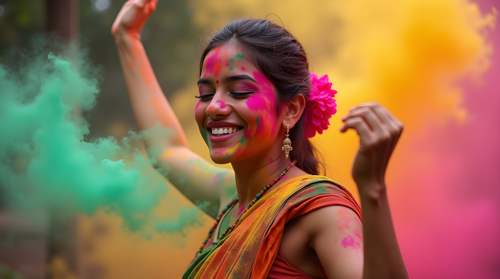
Celebrating the festival of Holi
Woman © Dr Partha Sarathi Sahana Creative Commons 4 2025
In the following, I will take you on a journey through some of the orthodox Indian schools of thought, pausing along the way to explain how these ancient ideas tie into modern ideas of happiness. We will see that these schools offer not merely abstract theories, but maps for living. I’ll finish by sharing the vision of happiness that feels most meaningful to me in today’s restless world.
Nyāya and Vaiśeṣika: Happiness as Knowledge that Frees
The Nyāya (or ‘Justice’) school of Indian philosophy, flouished between the 6th and 2nd centuries BCE. Known for its rigorous logic, it begins with the stark diagnosis that suffering arises from ignorance. When we misunderstand the self or the world, we live in error, and this error ultimately breeds pain. The cure for such error is pramnāna or knowledge, gained through reasoning and perception. Pramāna leads to liberation, or mokṣa, the state of being free from all forms of suffering, which according to Nyāya is the highest form of happiness.
Vaiśeṣika, often considered Nyāya’s sister school, shares this goal, but focuses on analysing reality into categories such as substance, quality, motion, universals etc. Understanding the categories that shape the world and our place within them leads to detachment, and eventually, to a happiness beyond suffering.
For instance, imagine that you lose a cherished object, such as a precious ring passed down in your family. Instead of being consumed by grief, a Nyāya or Vaiśeṣika thinker would reflect on the idea that the ring is merely a substance, composed of qualities like shape and shine, subject to change and decay. By seeing it not as an extension of the self but as one among countless impermanent objects in the world, one tends to loosen one’s attachment to it. That shift in understanding softens the sting of losing it, and opens the way to a steadier, deeper happiness that goes beyond fleeting possessions.
Sāṃkhya: Happiness Through Discernment
The Sāṃkhya school of philosophy (circa 4th century BCE) is India’s great dualist system, distinguishing between puruṣa (pure consciousness) on the one hand and prakṛti (matter) on the other. Suffering arises when consciousness wrongly identifies with the ever-changing play of matter. The highest happiness, known as ‘kaivalya’ or isolation, dawns when we discard the idea that we are passive witnesses and embrace the idea that we actively shape the turbulent world we observe.
To understand this idea practically, imagine yourself scrolling endlessly through social media posts. You see curated snapshots of other people’s lives, such as their recent vacations or promotions. Without realizing it, you begin to feel inadequate, as though your worth depends on matching those images. In that moment, your sense of self has merged with prakṛti, the material world, which brings with it the swirling, ever-changing world of appearances. But through a Sāṃkhya lens, you pause and remember: you are not these shifting stories, likes, or judgments. You are puruṣa, a pure awareness, who observes the world without being entangled, yet actively shapes its trajectory. The posts, the emotions they stir, even the urge to compete, all belong to prakṛti. When you come to this realization, the turbulence loses its grip. A quiet, steady happiness arises; not because the world changed, but because you stopped confusing yourself with it.
Yoga: Happiness Through Discipline & Stillness
If Sāṃkhya is theory, Yoga is practice. Earlier ideas about Yoga were collected by the scholar Patañjali in his book the Yoga Sutras, which offers an eightfold path, a step-by-step discipline to quiet the mind and uncover happiness. It begins with yama – the ethical restraints that guide how we treat others. These include non-violence, truthfulness, non-stealing, moderation in desires, and non-possessiveness. Alongside these are niyama, the personal disciplines that shape our inner life. These include purity, contentment, self-discipline, self-study, and devotion to something greater than oneself (that is, God). Then come āsanas – the postures Westerners associate with yoga today – designed to make the body steady and comfortable for long periods of meditation. Prāṇāyāma, or breath control, teaches us to regulate and calm our life force through rhythmic breathing. Pratyāhāra, sense withdrawal, is the art of gently drawing the senses inward instead of being constantly pulled outward by stimulation. Dhāraṇā is focused concentration, training the mind to rest on one point. Dhyāna is meditation, or a steady flow of awareness beyond distraction. And finally, samādhi is absorption, or a state where the distinction between observer and observed falls away, and one rests in pure being. The purpose of yoga is to complete this eightfold path and achieve the final state of samādhi, which is a state of pure bliss and transcendence. It consists of those rare moments, as when watching a sunset or playing music, when the boundary between you and the experience melts away.
But reaching samādhi is the final goal of yoga. One can find true happiness even during some of its initial steps. Setting aside time each morning for journalling, and feeling genuine gratitude for what you have, are both examples of niyama, the personal discipline that shapes our inner life. When we cultivate daily habits to support our spiritual growth, there is no striving or comparing, only pure presence. The Yoga school of Indian philosophy says that this happiness, attained through mediation and self-discipline, is the purest form of bliss and liberation.
Mīmāṃsā: Happiness in Righteous Action
The Mīmāṃsā school (2nd century BCE onwards) is often overshadowed by flashier systems, but its message is refreshingly practical. It emphasizes that happiness is sustained through ethical action, which involves following Vedic injunctions, including performing one’s duties (dharmās) and rituals correctly, thereby maintaining cosmic harmony or Rta. It values this-worldly happiness as well as the long-term merit that shapes future births. In some ways the theory is similar to Aristotle’s, who saw happiness not as a fleeting state but as a lifelong flourishing in accordance with virtue. Mīmāṃsā reminds us that happiness can be woven into daily life by simply doing what is right sincerely and consistently.
Think of a schoolteacher who may not earn much nor receive much praise, yet shows up every day with sincerity. She prepares her lessons carefully, treats her students with fairness, and goes out of her way to help those who struggle. Her actions uphold a sense of order and care in her community, which becomes her greatest source of pride. Therefore, even without grand recognition, she experiences a quiet, lasting happiness, because she knows she is fulfilling her duty with the utmost integrity.

Adi Shankara with disciples Raja Ravi Varma 1904
Vedānta: Happiness as Our Innermost Nature
The Vedānta school is rooted in the ancient text known as the Upaniṣad, and offers a luminous answer to the quest for happiness.
In the case of Advaita Vedānta, the non-dualist philosophy developed by Śankara (c.788-820 CE), the ultimate reality of this world is Brahman or pure being, which is pure consciousness and bliss. Our true self or ātman is not separate from this. The apparent world, with all its ups and downs, is māyā, or an illusory appearance. Unfortunately, māyā is not something like dirt on a window that we can just wipe away: it is a veil of ignorance that makes us see separation and limitation where there is in fact only oneness. Because māyā is a type of ignorance, the only way to remove it is through knowledge. When we attain this knowledge, the ignorance brought by māyā falls away, and we realize that we are already what we seek – in that we are happiness itself.
A good analogy to understand the Advaitin notion of happiness is found in The Matrix (1999). Neo lives his life believing the world he sees. He believes that its struggles and hierarchies are the ultimate reality. Then he is provoked to question this, and learns that the world he thought was real was only a projection, and that his true power lies beyond it. Advaita Vedānta offers a similar revelation about happiness. We spend our lives chasing happiness through promotions, possessions, and pleasures, believing that these shifting experiences are ultimate. But like Neo waking up from the matrix, the moment we see through māyā or illusory appearance, we discover that happiness was never ‘out there’ to be won. Happiness is our very essence, already present, just waiting to be realized.
Cārvāka: Happiness in the Here and Now
In a bold contrast to these schools, the materialist Cārvāka school scoffs at otherworldly speculation. It holds that only perception is valid, only this life is real, and therefore, happiness is found in wise enjoyment of the here and now. “While life is yours, live joyously; none can escape death’s searching eye” says one Cārvāka verse. This idea resembles that of Epicurus, who counselled a life of measured pleasure and freedom from fear of gods or death. Both perspectives hold that happiness is not hidden in distant heavens but available in simple present joys.
Imagine that long-distance friend you’ve been meaning to meet for years. Both of you are so buried in work and deadlines that you keep postponing the meeting, always talking about how one day you’ll plan a grand trip together. But that day just never seems to come. Then, on a whim, you both clear an evening and meet at a tiny café halfway between your cities. No big plans, no perfect itinerary; just coffee, laughter, and a couple of hours catching up. In that simple, unpolished moment, you feel a happiness deeper than any imagined ‘someday’. This is just what the Cārvāka school tells us: real joy doesn’t wait in some distant future, it lives in the small, real moments that we choose to embrace now.
Why Advaita Speaks to Our Age
Of all these visions, the one that resonates most deeply with me is Advaita Vedānta. Its core teaching that happiness is not something to be pursued but something we already are, feels like a lifeline in the modern world. We live in an age of constant striving, as social media feeds urge us to curate perfect lives, and consumer culture tells us that with one more purchase or one more achievement we will finally be happy. Yet beneath all the glitter and shine, there is a quiet ache that tells us a different story. The rising rates of anxiety, depression, and that gnawing sense of not being good enough make us run ever faster toward a horizon of happiness that’s always receding. Advaita Vedānta turns this pattern on its head. It tells us that the deepest layer of our being is ā nanda, or bliss itself. So happiness isn’t something to be accumulated, it’s something to be uncovered. When we recognize our essence as whole and complete, we are no longer trapped by comparison, the fear of missing out, or the endless chase for validation.
A beautiful story from the Chāndogya Upaniṣad captures this essence. A sage by the name of Uddālaka sends his son Śvetaketu to learn the highest form of knowledge. When the boy returns proud but unsettled, the father asks him to dissolve some salt in water. The salt disappears, yet its taste remains everywhere in the water. “So too,” the father says, “you may not see the self, my child, but it is in everything. That is your essence.”
Advaita Vedānta’s vision of happiness feels more urgent now than ever. It’s not a philosophy that denies the world, but one that frees us to live in it with serenity. Amid the frenzy of modern existence, Advaita Vedānta feels like standing by a still, clear lake. It whispers a simple, profound truth: You are already what you seek. And in that recognition, happiness stops being a pursuit. It becomes something that’s already present within us.
© Jahnvi Borgohain 2025
Jahnvi Borgohain is a postgraduate in Philosophy from the University of Delhi. She is fascinated by Gender Justice, AI Ethics, and Classical Indian philosophy.
Advertisement
