


Your complimentary articles
You’ve read one of your two complimentary articles for this month. To have complete access to the thousands of philosophy articles on this site, please
You can register for a free account to have four complimentary articles per month. We will occasionally email you a newsletter, from which you can unsubscribe at any time. We do not sell personal data or otherwise disclose personal information to other organisations.
Articles
A Very Short History of Critical Thinking
Luc de Brabandere summarises a long history through key figures of thought.
In Greece in the fifth century BC, some public speakers who were certainly cultured but who were also unscrupulous, made the most of their oratorical talents by turning them into a particularly lucrative profession. Armed with misleading arguments and fallacious reasoning, they were called Sophists. They were so good at arguing any case they were able to simultaneously demonstrate something and its opposite. To be a sophist is to argue in a way that appears to be valid, but where the argument has been deliberately manipulated to distract or mislead the listener. Sophism is not a way of thinking; it’s a way of arguing designed to dazzle and trick an opponent; or if they should suspect foul play, to cause them logical embarrassment. It then proves hard to refute the argument because the flaw is subtly concealed. A sophist cares not about ethics or justice. They have little regard for truth. What they’re interested in is power. If it takes a lie to win, then go ahead and lie! If cheating is necessary to get through, then go ahead and cheat! In the end it doesn’t matter, because the goal is not to prove, but to be approved, regardless of the route used. Whilst a good debate often starts with ‘May the best man win!’, according to sophists, the opposite is true: whoever wins is the best man.
In this article I’ll highlight eighteen key players in the history of critical thinking, in chronological order. These main players of critical thinking throughout the centuries are shown in fresco.
Convinced that ‘man is the measure of all things’, Protagoras (c.490–c.420 BC), the first of the sophists, would have loved using X (Twitter), whose very structure makes the development of an argument almost impossible. For how can one develop an argument in 140 characters? In these and similar conditions, politics can only be controversial, as convictions are turned into injunctions. The truth is being harmed because the desire to retweet (re-x?) seems to be even greater when the information being put forward is false. Yet what we nowadays call ‘post-truth’ is only the modern-day expression of an indifference to truth for which the Sophists were notorious. The internet provides sophists with a tool that they could never have dreamed of 2,500 years ago.
Socrates (c.470-399 BC) tried to trip up these masters of fallacious discourse, who, rather despite themselves, ended up at the origins of critical thinking.
There are many definitions of ‘critical thinking’, but they all agree on one point: the necessity of intellectual rigour. Critical thinking is not linked to a particular discipline or a specific body of knowledge. Rather, it must operate through all disciplines and should aim to preserve the advantages of skepticism without having to pay the price of ignorance. Thinking in a critical manner means trusting with caution while being wary of four elements: the reliability of a source, the strength of the argument, the medium, and our own ability to judge the matter at hand. The emergence and subsequent rise of ChatGPT and other so-called ‘generative’ AIs make critical thinking more essential today than ever before.
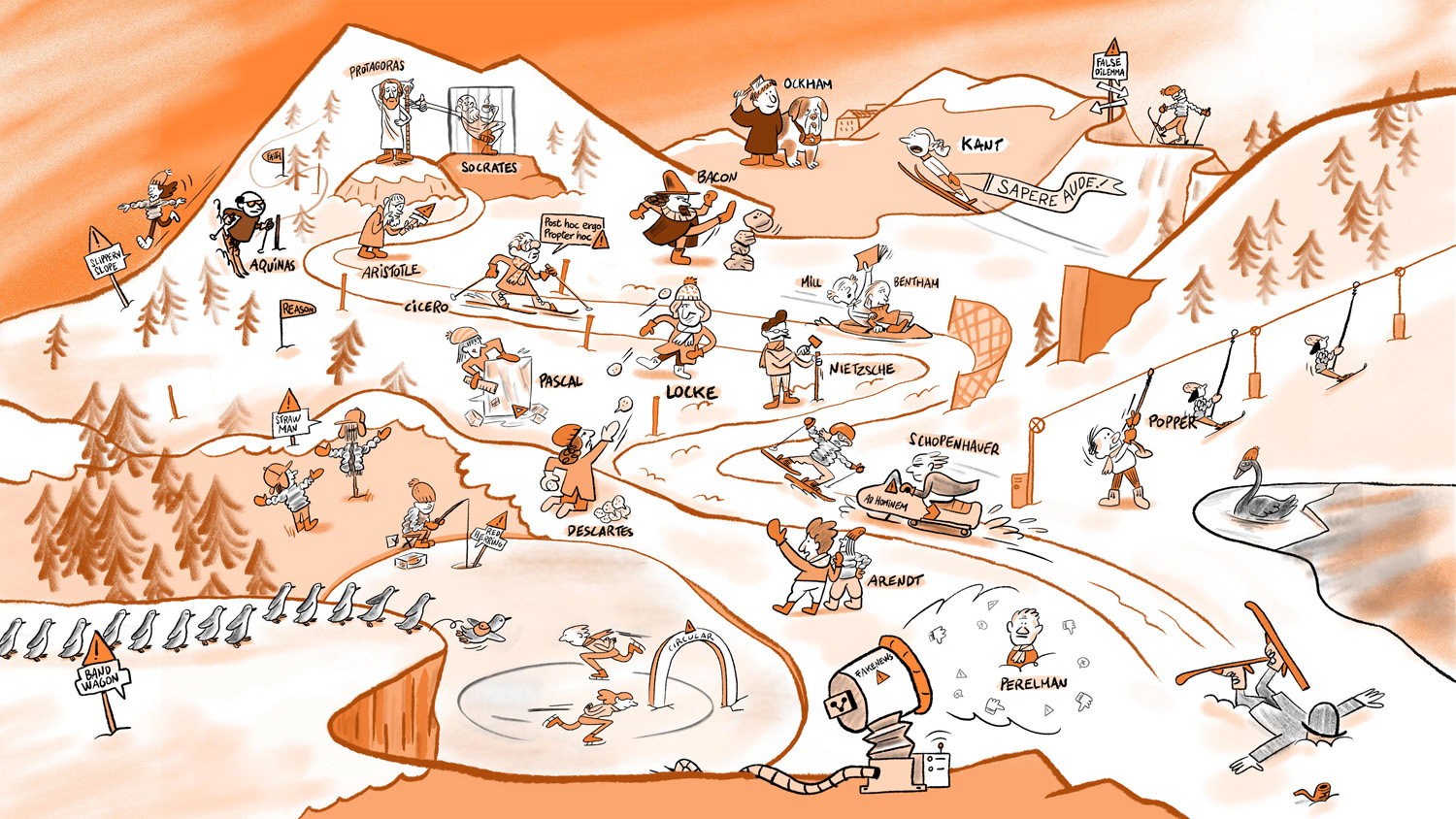
Critical Thinking fresco © Rodolphe Duprey 2026
Formal or Informal?
The attentive reader will have noticed eight fallacies dotted round the scenery on the diagram. They have strange names: the slippery slope, the strawman, the bandwagon, the circular, the red herring, post hoc ergo propter hoc, ad hominem, and the false dilemma. A fallacy can be defined as an instance of logically faulty reasoning. A fallacy:
• Is often an invalid argument that can easily be mistaken for a valid one.
• Can be very persuasive, sometimes more than sound reasoning.
• Violates one or more of the principles that make an argument sound, such as good structure, consistency, clarity, order, relevance, or completeness.
• While all invalid arguments are fallacious, not all fallacies involve arguments.
I’ve divided fallacies into two groups (see the boxes for more):
1) Formal fallacies maintain some relationship with the laws of logic. These arguments are not valid because their formal structure is faulty. The chain of reasoning itself is defective.
2) Informal fallacies are ones where logic is irrelevant – such as fallacies based on personal attacks or which digress from the subject. These arguments are invalid because of their content and context rather than their logical structure. Informal fallacies deal with every kind of reasoning mistake other than the formal ones.
Into History
Plato (c.428 BC-348/347 BC) wrote many critical dialogues featuring Socrates. In his dialogue Gorgias, for instance, Plato pitted Callicles, a pretentious, maybe even violent, young aristocrat who argued that the strong should recognize no moral boundaries to their pursuit of success, against Socrates, for whom it was more moral to suffer injustice than to commit it. Socrates dismantled his opponent’s arguments one by one, just as he does in all Plato’s dialogues.
The first to study the structure of both sound and fallacious arguments was Aristotle (384–322 BC). He identified thirteen types of invalid arguments or syllogisms, which he illustrated with luminous examples, and grouped into two sets:
Those built on the ambiguities of language, such as:
5 is 2 and 3
2 is an even number, and 3 is an uneven number
Therefore 5 is even and uneven
Those built on invalid reasoning, such as:
A man with a fever is hot
Therefore, a man who is hot has a fever
Aristotle also wrote the first treaty on rhetoric, in which he demonstrated the importance of ethos (morals) and pathos (emotion) alongside that of logos (reason) for making good speeches and plays. Cicero (106-43 BC) drew inspiration from him, and his speeches influenced the history of Rome. He remains to this day a reference in the art of oratory [see the article on him in this very issue, Ed].
Do we gain access to truth via reason or via faith? Thomas Aquinas (c.1225-1274) suggested a way of accessing the Christian worldview using reason, and so became the leading philosopher of the Catholic Church. Meanwhile the monk William of Ockham (c.1287-1347) fought against useless words and ideas, and wanted to remove all ‘superfluous entities’ from arguments. This is called Ockham’s razor.
During the Renaissance, the critical mind was at the heart of early scientific debates. Francis Bacon (1561-1626) first suggested the empirical method for philosophers and scholars, telling them to destroy their ‘idols’, in other words their prejudices. In contrast to empiricism, René Descartes (1596-1650) recommended a rationalist approach to discovering truth, coupled with ‘methodical doubt’, a posture of systematic mistrust towards everything that we think.
John Locke (1632-1704) is to England what Descartes was to France. In An Essay Concerning Human Understanding, among many other things he reveals the hollow side of Aristotelian logic, since any complex idea can only be the result of an argument, that is, the combination of simple ideas (that is, memories of direct sensory experiences), so ‘pure rationality’ is a bit of a chimera.
In 1658, Blaise Pascal (1623-1662) wrote ‘The Art of Persuasion’ as a preface to a surprising treaty about geometry. It was never published, but this unexpected association of mathematics and rhetoric demonstrates the rigour that the French philosopher and theologian wanted to impose on the construction of discourse.
Despite being a fan of the Age of Enlightenment, Jeremy Bentham (1748-1832) dreamt of a science of politics. He was convinced that if logic can be faulty, then people are too. His godson John Stuart Mill (1806-1873) developed Bentham’s utilitarianism and gave it his own twist.
The Critical Hammer
Etymologically speaking, the word ‘critical’ comes from the Greek kriterion, which can be translated ‘the rule by which one judges’. So a criterion can be defined as a rule or a principle that is used to judge something; and this is how Immanuel Kant (1724-1804) used it, placing principles of judgement front and centre on the philosophers’ workbench. His motto for the Age of Enlightenment was Sapere Aude. This Latin postulate comes from Horacius, and means ‘Dare to know’, but perhaps is better translated as “Have the courage to use your own reason!”
Arthur Schopenhauer (1788-1860) took a great interest in the logic of discourse. An eternal pessimist, he recommended always being initially suspicious of bad intentions from one’s interlocutor. His classic of argumentation and of spotting bad faith, The Art of Being Right (1831) is a must for whomever takes an interest in sophism.
According to Friedrich Nietzsche (1844-1900), ‘philosophizing with a hammer’ means testing the idols or fake gods (that is, conventional moral values) to reveal their true natures. You could say it’s like tapping a wall to see whether it’s hollow.
Moving now into the twentieth century, Sir Karl Popper (1902-1994) believed that disciplines such as psychology or economics could not be considered scientific as they can not be refuted by being falsified, falsification for him being the hallmark of scientific theories.
Born in Warsaw, Chaïm Perelman (1912-1984) emigrated to Belgium in 1925. His 1958 work The New Rhetoric: A Treatise on Argumentation became a reference for all matters relating to argumentation. He defined argument as “a discursive technique used to provoke or increase the adhesion of an audience to a thesis presented for their assent.”
Following the disaster that was Nazism, Hannah Arendt (1906-1975) defended the need for all strata of society to be capable of clear thought, not just an elite.
Now & The Future
The internet remains a violent world where opposites collide. What is necessary is next to what is superfluous, what is false is next to what is true, and good intentions rub shoulders with the worst intentions. With the internet, the sophists have a weapon of mass persuasion. They’ve always played on words, but today they can play on images too. So let’s stop saying that “the internet isn’t good or bad, it depends how you use it.” No, the internet is good and bad: at the same time, at the same moment, for the same users. It contains what is manageable and what is uncontrollable, the poison and the cure. We don’t use the internet: together we are the internet. And in the face of cybersophists, let us become cyberphilosophers!
© Luc de Brabandere 2026
Luc de Brabandere is a corporate philosopher. His latest book, The Art of Thinking in a Digital World: Be Logical, Be Creative, Be Critical (Peter Lang International), puts the history of thought into perspective to better understand today’s world.
The fresco of the history of critical thinking is by Rodolphe Duprey, a Cartoonbase illustrator. It can be downloaded from cartoonbase.com.
Formal Fallacies
Some arguments are fallacious despite their undisputable internal logic. For example: “It is acceptable to consume farm animals since they’ve been bred to be eaten.” This is an example of what we call begging the question, or a circular argument, where the conclusion is assumed in the premise. Reasoning can be plagued by circularity; for example, “People wishing to study logic must be intelligent people. If they weren’t, they wouldn’t want to think logically.”
Despite being logically useless, tautology – a proposition which is always true – is nevertheless often used in argument. We can all agree with the quote “It is not good to have too much freedom”, since it would be impossible to disagree (similarly, too much camembert is never good, too much football is never good, and too much travel is never good, either). “Too much X is never good”, is true, regardless of what X is, since by definition, ‘too much’ means it is not good.
By contrast, the proposition “These two companies are incomparable” is an oxymoron, or a contradiction in terms, meaning it’s always false: in order to make the statement, both companies would have had to undergo a comparison. They are therefore comparable.
One of the sophists’ most recurring practices is to ignore their implicit hypotheses or assertions. In the case of a false dilemma, for example, certain options in a choice are hidden. A true dilemma is a situation which offers only two possible options. For instance, during a referendum, voters usually only have one choice: yes or no. This forces them to choose between two options, and that inevitably leads to the rejection of the other. But cases of true dichotomy are not that frequent, and a false dilemma involves presenting as simple a choice which in reality allows several options. Indeed, the phrasing of the issue usually hides other possible options. For example: ‘If you’re not with us, then you’re against us’, when you may be neither for or against. Even Nietzsche uses the false dilemma, when he states, ‘“What doesn’t kill me makes me stronger.”
Another formal fallacy is called post hoc ergo propter hoc – translated as ‘After that, so because of that’. Imagine someone sneezing just before a gas explosion nearby. That person could, for a second or two, imagine having been the cause of the blast. This fallacy references the fact that we have a tendency to establish a causal link where there is nothing more than a sequence in time. It’s what some people call ‘the achoo effect’. Also consider this: “I joined the Boston Consulting Group in 2001, and revenue has since quadrupled.”
Informal Fallacies
Sophists like to exaggerate, caricature, and twist the counterarguments put to them, and they’ve developed a broad spectrum of methods aimed at dismantling their opponents’ ideas. Let’s leave behind the formal stratagems, for which the tools of logic are useful to detect traps, and move on to those others, such as the ad hominem (‘against the man’) attack, which consists in saying “you’re wrong because of what you are.” For example: “You don’t have kids, so don’t talk about education.”
Attacking someone is not the only fallacious argument used to distract from the subject. Another sophism with the same objective is called the red herring. This name is said to be derived from a practice used in the past by prisoners on the run, who were said to have left smoked or even rotten herring behind them to distract the dogs hunting them down. During a discussion, the purpose of this trick is to make you suddenly change topic – to set you on another path than initially planned by introducing irrelevant considerations:
“The budget has exploded; we cannot afford to buy this building.”
“But our website has more hits than ever!”
Craftsmanship is necessary to choose a red herring that’s capable of fooling an interlocutor without them noticing. In order to do this, you will need some true information, and the impression of it being directly related to the original subject.
When the argument presented has nothing to do with the original subject, it’s described as a non sequitur, literally meaning, ‘It does not follow’. The French President and general Charles de Gaulle once said during a debate: “How can one govern a country with 258 varieties of cheese?” We are still looking for the argument here over sixty years later.
The straw man fallacy caricatures or distorts an opponent’s own argument:
“I’d like to take a few days off just to be fresh before starting on that new project.”
“So, you think the best way to accomplish things is by not working?”
A sophisticated variation of the straw man argument has been called the slippery slope. This is an attempt to discredit a proposition by arguing that accepting it leads to a sequence of one or more undesirable events. For example, “Never forgive anyone. If you forgive one person, then the others will expect the same. Pretty soon, people will be walking all over you.”
A lot of our decisions are based on decisions made by other people. We cite those whom we assume are an authority on the matter. This can be done by:
A. Appealing to Experts
Subjects are so complex nowadays that we often need help, so we need to call on experts. But these experts can disagree. There are three major cases where calling on an expert becomes fallacious:
1) The mentioned area of expertise does not really exist, or isn’t developed enough.
2) The expert is unreliable because they have a vested interest in what they’re talking about.
3) The expert is discussing a subject outside their area of expertise.
B. Appealing to Authority
This is a common fallacy, as everyone recognises. For one instance: “Do you not believe in alchemy? Even Newton researched it!” Or we can appeal to the majority, also known as the Bandwagon fallacy. If there is no expert to act as an authority figure, our instinct would be to find out what ‘most people’ think. This is a type of sophism much preferred in advertising: “Venice is the most beautiful Italian city. It is visited by more tourists than any other city.”
Advertisement
