


Your complimentary articles
You’ve read one of your two complimentary articles for this month. To have complete access to the thousands of philosophy articles on this site, please
You can register for a free account to have four complimentary articles per month. We will occasionally email you a newsletter, from which you can unsubscribe at any time. We do not sell personal data or otherwise disclose personal information to other organisations.
Roman Philosophy
Ancient Synergy
Yolanda De Iuliis looks at how Roman Mithraism incorporated Stoic philosophy.
Mithraism’s adoption and integration of Stoic virtues is compelling and noteworthy. These virtues not only shaped the religious and spiritual dimensions of Mithraism, but also played a pivotal role in the social and cultural fabric of ancient Roman society itself.
Mithraism emerged in Rome during the first century CE. It had a complicated history, originating from earlier Persian traditions, but taking on new iconography and ideas as it spread westwards. Famously, Mithraic temples usually featured depictions of Mithras slaughtering a bull, often while turning his head away, perhaps in pity. In the Roman world, the Mithraic mysteries began to flourish shortly before the time of Christ’s crucifixion, and expanded rapidly across the Empire, though the traditional Roman paganism centred on Jupiter, Mars, Minerva and other gods remained dominant. Roman soldiers in particular, though, were drawn to Mithraism, viewing Mithras, often associated with Sol Invictus (the Unconquerable Sun), as a divine protector and symbol of loyalty, courage, and order.
The philosophical school known as Stoicism had its roots some centuries earlier in Greece, having been founded by Zeno of Citium in about 300 BCE. It eventually become popular among influential Roman writers and thinkers (who loved Greek philosophy). They loved its emphasis on the virtues of wisdom, courage, and self-control. Wisdom, or sophia in Greek, was a cornerstone of Stoic philosophy, particularly the wisdom needed to distinguish those external problems we can solve from those we must simply learn to live with gracefully. It also stressed the importance of understanding the nature of the universe. This last principle was mirrored in the teachings and rituals of Mithraism, which encouraged adherents to seek knowledge and understanding, not just in spiritual matters but in all aspects of life. This emphasis on wisdom allowed Mithraic adherents to navigate the complexities of life with a clear and informed perspective, by aligning their actions with the greater good and the natural order of the universe. This quest for wisdom also helped Mithraic followers to make ethical decisions, live upright lives, and maintain a balanced relationship with their environment.
Courage, or andreia in Greek, was another vital Stoic virtue adopted by Mithraism. It involved facing challenges and complexities with bravery and resilience. Mithraic initiation rituals were designed to instil this virtue in its followers. For example, a Mithraic initiation could involve blindfolding the worshipper, subjecting them to heat and noise, and requiring them to swear oaths of secrecy and devotion before being welcomed into the brotherhood. These rituals, often intense, were meant to prepare initiates for the rigours of life and the responsibilities of their faith. By enduring such trials, Mithraic adherents demonstrated their strength and commitment, embodying the courage necessary to uphold their values in the face of adversity. This courage was not just physical, but also moral and ethical, reinforcing the importance of standing firm in one’s convictions and principles.
The Stoic virtue of self-control, or sophrosyne, was also crucial for maintaining discipline and ethical behaviour. In Mithraism, this virtue was reflected in its strict moral code, secrecy and the disciplined lifestyle expected of its followers. Adherents were encouraged to exercise self-control in all aspects of life, from personal desires to social interactions. This discipline was essential for creating a cohesive and harmonious community, as it encouraged individuals to treat one another with integrity and respect. The focus on self-control helped Mithraic followers develop a strong sense of personal responsibility and accountability.
Mithraism’s emphasis on masculinity and group identity was also heavily influenced by Stoic principles. The male-only nature of the cult mirrored the Stoic focus on masculine virtus and the ideal of the virtuous man (virtus literally means ‘manly’). Mithraic rituals and teachings promoted a sense of belonging among its followers, who viewed themselves as part of a unique brotherhood. This sense of community was reinforced by the aforementioned shared values of wisdom, courage, and self-control, which help to create a strong bond among the adherents.
This synthesis of religious and philosophical elements helped create a sense of unity and purpose among followers, contributing to the stability and cohesion of Roman society. Yet the cultivation of these virtues not only shaped individual behaviour but also contributed to a collective identity that resonated with the broader values of the Roman Empire. Mithraic followers saw themselves as part of a larger Roman tradition of ethical living, which was integral to their sense of self and their place in society. This identity was further strengthened by the rituals and ceremonies that marked important stages in a follower’s spiritual journey, creating a shared experience that unified the Mithraic community. Initiates in the Mithraic mysteries progressed through a series of grades (Corax, Nymphus, Miles, Leo, Perses, Heliodromus, Pater), each marked by symbolic tests and teachings. As mentioned, these could include being blindfolded to symbolise the move from ignorance to enlightenment, or enduring the heat of ritual flames during initiation into the Leo grade, to represent purification and inner strength.
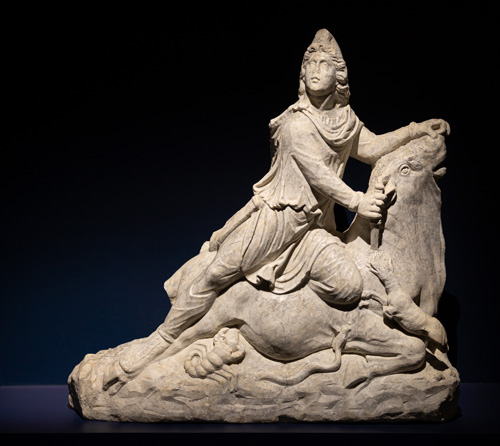
Mithras slaying bull, Cabra, Spain, 2nd century CE
Mithraism & Stoicism in Society
The integration of Stoic virtues into Mithraism had a profound impact on the cultural identity of Roman society. For instance, as a religion that attracted many soldiers, Mithraism played a crucial role in shaping the ethical and moral framework of the army. The rigorous training and self-discipline required by both Stoicism and Mithraism were well-suited to the demands of military life, fostering qualities such as resilience, loyalty, and a strong sense of duty. Furthermore, Mithraism’s emphasis on community and brotherhood provided a source of solidarity for its members. In a society characterised by frequent religious shifts and diverse beliefs, Mithraism also offered a stable and cohesive path of self-discovery, which aligned with the philosophical ideals of Stoicism.
The ethical framework established by Mithraism with Stoicism also had broader implications for Roman society. By promoting virtues such as wisdom, courage, and self-control, these traditions encouraged individuals to lead lives of moral integrity and social responsibility. This emphasis on virtuous living was reflected in the public life of Rome, where leaders and citizens alike were expected to uphold these values in their decisions and actions. The integration of Stoic philosophy into Mithraic practices thus played a significant role in shaping the moral fabric of Roman society.
The synthesis of Mithraism and Stoicism in ancient Rome offers a compelling example of how religious and philosophical traditions can intersect and enrich one another. By integrating Stoic virtues into their religious practices, Mithraic adherents were able to create a structured and meaningful intellectual approach to both the personal and societal ethics within their religious system. This blend of spiritual and philosophical elements contributed to a rich cultural heritage. Through the integration of Stoic virtues such as wisdom, courage and self-control, Mithraism also provided its adherents with a structured approach to ethical living and self-awareness. The emphasis on virtue in both traditions helped create cohesive communities of individuals committed to living morally upright lives.
While Mithraism disappeared by the end of the 4th Century, eclipsed by Christianity, Stoic philosophy has had more of an enduring appeal, and has recently enjoyed something of a popular revival. Its core principles and the virtues which it shared with Mithraism remain relevant to life today. By pointing out the connections between Mithraism, Stoicism, and the formation of cultural identity, I hope I’ve highlighted the important role of religious and philosophical synthesis in shaping societies both ancient and modern. As we reflect on the contributions of Mithraism and Stoicism to Roman society, we should also recognise the appeal of these traditions and their continued relevance in discussions of ethics, identity, and cultural heritage. The lessons they offered remain timeless, offering valuable guidance for individuals seeking to navigate the complexities of modern life with integrity and resilience.
© Yolanda De Iuliis 2026
Yolanda De Iuliis is a PhD student in archaeology specialising in Mithraism, heritage, and identity.
Advertisement
