


Your complimentary articles
You’ve read one of your two complimentary articles for this month. To have complete access to the thousands of philosophy articles on this site, please
You can register for a free account to have four complimentary articles per month. We will occasionally email you a newsletter, from which you can unsubscribe at any time. We do not sell personal data or otherwise disclose personal information to other organisations.
Roman Philosophy
The Post Paralysis Peace Paradox
Cassandra Brandt offers the reflections of a sedentary Stoic.
“It is a paradox that we encounter so much internal noise when we first try to sit in silence.
It is a paradox that experiencing pain releases pain.
It is a paradox that keeping still can lead us so fully into life and being.”
– ‘The Paradox of Noise’, Gunilla Norris
Later, you’ll write books about this,” my thirteen year old daughter assured me. She was always wise beyond her years, so I had to trust her that I would survive, maybe even write somehow. But would mine be a story worth telling? My tale was a tragedy, a life upended, a career cut short, a vertebrae crushed. What was left but a ghost in a shell, a crashed SUV, the four walls of a room? I was thirty-two when I broke my neck. I had lived loud, fought my way up in a man’s trade, and led with an ego. I was impulsive, bordering on careless. I was a mess of volatile emotions. But for all the time I spent working my body into shape and making it attractive, I didn’t have a lot left over to work on my interior self. I was entitled and wore a chip on my shoulder with pride. Losing my able body meant letting go of everything that had defined me. No one wants to read that story.
Five years later I wrote it anyway. Iron Girl: Tomboy, Tradeswoman, Tetraplegic (2020) was a book that allowed me to lose myself in the past, wrap it around me like a warm blanket. The project also challenged me to consider what was left. I couldn’t give my readers nothing. But I was exhausted too. The challenges of complete quadriplegia kept coming: compromised care, secondary health complications, strained relationships with family who felt forced into caregiving roles, institutionalization, inaccessibility, ableism… Embracing Stoic philosophy changed my whole perspective about life. But the change didn’t happen overnight.
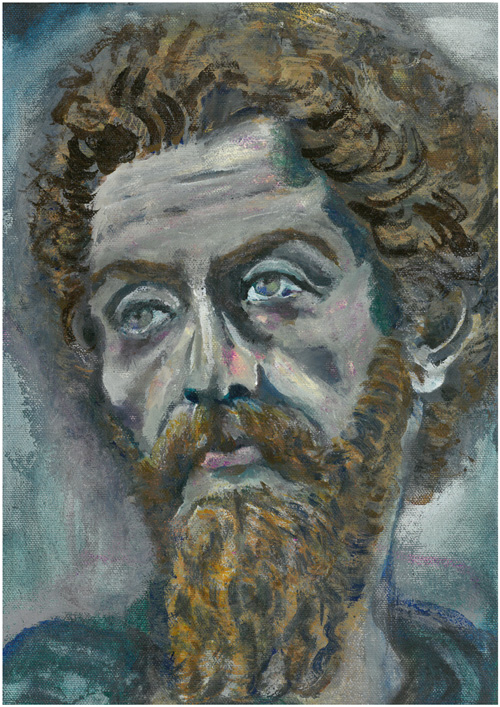
Marcus Aurelius by Gail Campbell
A Stoic Introduction
My brother had begun reading the Stoic Marcus Aurelius’s Meditations to me from as early as the acute days post paralysis. Aurelius was Roman Emperor from 161-180 CE, but his words were my lifeline as much as the ventilator keeping me alive.
Training the mind takes time and dedication, though. Mine was a disaster zone, colored with pride and ego and entitlement tinged with occasional contradictory self-loathing. “The soul becomes dyed with the color of its thoughts,” Aurelius warned. My way of thinking had to change. “Very little is needed to make a happy life; it is all within yourself, in your way of thinking,” Aurelius wrote. Cultivating a strong and positive perspective would require committing to that practice every day – sometimes a dozen times a day – following each instance of falling apart.
Later, I wrote a significantly slimmer memoir. Seven Secrets of a Sedentary Stoic (2023) takes readers into the broken body yet mindful mind of an aspiring Stoic, discussing concepts within the philosophy and breaking down the intimate self-talk it inspired, noting ways others can use the tools, too. Full of quotes, the most widely used being from Marcus Aurelius, Seneca the Younger, and Epictetus, Seven Secrets focused on the concepts of Stoicism that held a critical role in my mental health recovery following my catastrophic injury and permanent disability.
I wrote, “Seneca said that it’s an act of courage just to live sometimes. In the first months following my injury, I made the choice to keep going again and again. Seneca pitied people who have never experienced misfortune: ‘You have passed through life without an opponent. No one can ever know what you are capable of, not even you.’ Was I capable of this though? In those early days post injury how I cried that I was not. Surely this battle was meant for someone stronger!” Well, consider this from Marcus Aurelius: “Look well into yourself; there is a source of strength which will always spring up if you will always look.” I needed that strength to let go of my able body. There’s more to life than the motor function. It would be foolish to spend my days yearning for a cure. As Epictetus said: “A ship should not ride on a single anchor, nor life on a single hope.”
Drawing from Stoic concepts that help me through the challenges of life paralyzed from the shoulders down, Seven Secrets goes on to explore seven elements within Stoic philosophy that were a catalyst in building a new life. Let’s look at them briefly.
1. Acceptance
The Stoics emphasized the importance of recognizing the dichotomy of control: there are some things you can control, some things you can’t. I cannot control my central nervous system. I don’t have control of my arms or my legs. I don’t have control of my bowels or my bladder. Subsequently, I don’t have much control of my own life. But as the Stoics say, dwelling on externals is a choice, and in choosing it, I can find I’m wallowing in self-pity quickly. Obsessing about what my body cannot do does not serve me in any way. It wastes my time and energy. So I had to understand that restored function to my body probably will never happen, and sitting around hoping for it was pretty much futile. What I should dare to hope for, was to live a decent life with my disability. So I started taking agency of my life again slowly, parenting my daughter and taking control of things like my medications and my finances. After purchasing a van and training a service dog, I began to get out more and recharge in nature. Then it was festivals and concerts and pushing myself through my pain and stress to participate in life and to have happy, healthy experiences.
2. Peace
“A high-minded and sensible man divorces soul from body, and dwells much with the better or divine part, and only as far as he must with this complaining and frail portion.” – Seneca
Mental self-control is at the heart of Stoicism. For me, it means not dissolving into fits of anxiety over pain and monotonous care. It’s fighting the urge to complain and cry and snap. It’s not letting my mind go where those emotional reactions feel so inevitable. It’s okay to have a cry sometimes; but frequent pity parties don’t make life any easier. Deep breathing and redirecting my mind in those moments does. Terrorizing myself about potential health complications taking my life early are counterproductive. Instead, I adapt myself to the present. I remain mindful of the good things that can never be taken from me. I look within for peace. There’s little I can do to cure my body, but my mind can be mastered.
3. Patience
“If fate can be overcome by tears, let us bring tears to bear upon it, but if not, then our futile grief must come to an end” – Seneca
Seneca said we must train our minds to desire what the situation demands. My situation demands endurance and patience, so I train for that. How I struggle at times, voicing every ache and burn and symptom when the pain overwhelms me!
Meditation and mantras soothe my soul through long waits to have desires met – often desires which turn into needs when the wait is very lengthy. I work on not allowing my impatience to turn to anger. “It’s silly to try to escape other people’s faults. They are inescapable. Just try to escape your own”, as Aurelius wrote.
4. Perspective
“If you are distressed by anything external, the pain is not due to the thing itself, but to your estimate of it, and this you have the power to revoke at any moment.” “What we cannot bear removes us from life; what remains can be borne.” – Marcus Aurelius
My initial estimate of this horrible thing in front of me – the prospect of the rest of my life as a quadriplegic – was that it was too huge, undefeatable. To revoke that, I had to ask myself how valid that assessment was. I am still alive. I haven’t suffered a brain injury. I have a good support system. There are systems in place to get me out in the world living a productive life again. This is the perspective I had to choose. Under that scenario, I could do this thing. I should also take care to not triple the duration of the stressful/painful thing by stressing about it. I allow it to let me suffer far beyond what’s necessary by not living in the moment during intervals between stressful events. Similarly, I suffer unnecessarily and prematurely when I leave a present moment of calm to worry about a future event. As Seneca said, “He suffers more than necessary, who suffers before it is necessary.”
5. Productivity
Epictetus the (ex-)slave was the Stoic with whom I established most of an affinity. After his master broke his leg, the servant, who it was said merely smiled during the act, said later of his disability: “Lameness is an impediment to the leg, but not to the will.”
The Stoics assure me I have not been relieved of my role as a human being by having this disability. My mind is still intact, and contributions to society are still required of me. Just because I cannot jump out of bed on my own accord doesn’t mean I’m resigned to stay in it! My role is to be hoisted with a lift into a power chair by my attendants. I then do what my nature demands. I write.
Our industrious nature is so much of what makes us human and brings us peace of mind, regardless of gender, ability, or any other station in life. I push myself daily to get out of bed, and busy, always busy, with my work. Whether it has been donning my blue collar to put in a shift welding with my hands, or getting up in my wheelchair to type an article with my teeth, always I’ve preferred not to waste a day.
My place in this world is not to become irrelevant, even as inaccessibility and ableism try to exclude me. I still have contributions to make and work to do.
6. Virtue
Marcus Aurelius said not to waste time discussing what a good person is, just be one, while Epictetus challenges:
“Now is the time to get serious about living your ideals. How long can you afford to put off who you really want to be? Your nobler self cannot wait any longer. Put your principles into practice – now. Stop the excuses and the procrastination. This is your life! You aren’t a child anymore. The sooner you set yourself to your spiritual program, the happier you will be. The longer you wait, the more you’ll be vulnerable to mediocrity and feel filled with shame and regret, because you know you are capable of better. From this instant on, vow to stop disappointing yourself. Separate yourself from the mob. Decide to be extraordinary and do what you need to do – now.”
I have never wanted to be vulnerable to mediocrity. Ambition hadn’t previously applied to my character like it does now, though. Now I want to know in my heart that the work I’ve done is worthy.
7. Joy
“True happiness is to enjoy the present, without anxious dependence upon the future, not to amuse ourselves with either hopes or fears but to rest satisfied with what we have, which is sufficient, for he that is so wants nothing. The greatest blessings of mankind are within us and within our reach.”
– Marcus Aurelius
Yes, the greatest blessings are within my reach. My beloved daughter and precious family. My ability to communicate important truths and produce creative works. The sunshine on my face and the gentle breeze in my hair. My acquired wisdom and fight for peace. My ability to exist in my own company, bear my suffering, and live in each moment.
“A wise man is content with his lot, whatever it may be, without wishing for what he has not” wrote Seneca. I’d take my able body if it were an option. Seneca would have chosen health, and Epictetus wouldn’t have chosen his injury either. But our fate is sealed. Wishing and wanting for unattainable things just causes unnecessary suffering. Instead, I master my mind.
“Authentic happiness is always independent of external conditions”, wrote Epictetus. My external conditions are severe. They cannot be ignored. I still marvel at times that this tumultuous journey is my fate. But then I have these moments - terrific experiences of appreciation for nature and literature and life; bursts of creativity that produce material I’m so proud of; incredible opportunities to help other people in tangible ways despite my own fate; precious time with my dear family; and this soothing calm that reminds me in the darkest times that I’m my own light.
I am not immune to suffering as a result of Stoic wisdom, but I am learning how to suffer less, and as Seneca said, “There is no virtue in putting up with what one cannot feel.”
Conclusions
I can honestly say that Cognitive Behavioural Therapy works, because the Stoics taught me all its skills. Mindset is everything, and not just when it’s all you’ve got left. I wish I’d figured that out sooner. Helping others do so heals my heart. The most rewarding part of this whole journey, has been the opportunity I’ve been afforded to pay the peace I have found forward. Seven Secrets of a Sedentary Stoic challenges readers to think and act like Stoics in the face of their own obstacles. Each chapter includes journal activities for reflecting on one’s own character and journey. At just eighty pages, it’s an easy read. The book is available for free download on Kindle Unlimited, and there’s an Audible version too, which I highly recommend.
Perhaps it is a paradox – the way found within the obstacle, the gem polished by the fire, the life lived without legs. Yet the peace and perspective I’ve found are no fabrication, but are instead a testament to the timeless power of philosophy and literature.
© Cassandra Brandt 2026
Cassandra Brandt is an Arizona based author and advocate for marginalized communities. A scholar with a background in Sociology, she has four published books. She has been published in multiple literary magazines and her work has been nominated for a Pushcart Prize. She lives with spinal cord injury and is passionate about mental health.
Advertisement
