


Your complimentary articles
You’ve read one of your two complimentary articles for this month. To have complete access to the thousands of philosophy articles on this site, please
You can register for a free account to have four complimentary articles per month. We will occasionally email you a newsletter, from which you can unsubscribe at any time. We do not sell personal data or otherwise disclose personal information to other organisations.
Roman Philosophy
Cicero & the Ideal of Virtue
Abdullah Shaikh explores Cicero’s ideas about the core Roman principle of virtus.
Marcus Tullius Cicero (106-43 BCE), one of Rome’s greatest orators and philosophers, placed the concept of virtus or virtue at the heart of his moral and political philosophy. For Cicero, virtus was the quintessential Roman ideal, encompassing courage, moral integrity, and civic responsibility. Understanding Cicero’s conception of virtus is essential for grasping how Roman thinkers fused traditional Roman values with philosophical reasoning to shape personal conduct and political action. (We shall consider this attempt particularly through the lens of Benjamin Straumann’s interpretation in ‘From Individual Virtue to the Just State: Cicero and the Legal Nature of Roman Political Thought’, The Journal of Roman Studies, 2025.)
Cicero’s books were an attempt to provide a necessary moral anchor in an age of tyranny, especially De Officiis (On Duties, 44 BCE). Writing it during the tumultuous final years of the Roman Republic, when the state was facing profound political and ethical crises (Julius Caesar was assassinated in 44 BCE), Cicero sought to reaffirm the foundations of public life by redefining what it meant to be a good Roman citizen and leader. Here I want to examine how Cicero defines and applies virtus, particularly in De Officiis, and how his interpretation is influenced by earlier philosophical traditions, including the teachings of Socrates and Plato. I aim to demonstrate how Cicero developed a distinctly Roman framework for ethics, rooted in both civic duty and philosophical reflection. I will argue that Cicero’s notion of virtus offers a unique synthesis of Greek moral philosophy and traditional Roman values, establishing an ethical ideal that is at once philosophically founded and an active, rational duty essential for political leadership and for the survival of the (doomed) res publica.
Cicero’s conceptualization of virtus was a pragmatic response to the political and moral collapse of the late Roman Republic. This context is vital for understanding why he undertook the monumental task of writing De Officiis. In the turbulent period of the late Roman Republic traditional Roman values that emphasized loyalty (fides), piety (pietas), and duty to the state and the family, were being systematically challenged by the rise of ambitious strongmen like Caesar and Pompey. Their pursuit of power had begun to fracture the constitutional order, threatening the very existence of the Republic. In this milieu, Cicero’s writings sought to reaffirm virtus not only as personal excellence but as essential for effective leadership and civic responsibility. Virtus thus served as both a moral ideal and a practical guide for Roman citizens seeking to uphold the common good against corruption and tyranny. Cicero’s subtle articulation of virtus elevates it to the peak of Roman ethical and political thought.
The Synthesis: Greek Theory Meets Roman Praxis
Cicero was an eclectic philosopher, drawing upon various Greek schools, notably Stoicism, Platonism, and Skepticism, to create a system suitable for the practical, action-oriented Roman temperament. By integrating Greek ideals with traditional Roman values, he crafted a conception of virtus that balanced personal moral integrity with the demands of public service.
First, Cicero’s conception of virtus was deeply influenced by the moral teachings of Socrates and the political theory of Plato. Socrates’ emphasis on self-knowledge and the pursuit of moral excellence provided a foundation for understanding virtue not merely as a set of actions, but as an internal disposition toward goodness. Plato’s political philosophy, with its focus on the just society and the role of the philosopher-statesman, helped shape Cicero’s vision of virtus as inseparable from civic responsibility and leadership. Cicero also relied on the ‘Middle Stoicism’ of Panaetius of Rhodes (c.185- c.110 BCE) for the structure of De Officiis. Stoicism provided the intellectual concepts of duty under a universal law of nature (lex naturae). This Stoic underpinning allowed Cicero to elevate virtus beyond mere cultural convention, framing it as an objective, rational obligation accessible to all people.
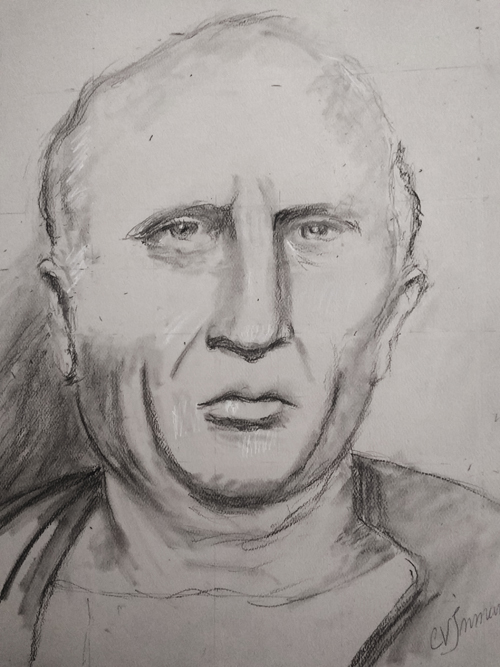
Cicero by Clint Inman
The Nature of Virtus: Duty and Deliberation
In De Officiis, Cicero’s analysis of virtus is deeply intertwined with his discussion of duty. His central argument is that moral responsibility is foundational and must be applied universally.
Cicero first establishes that moral responsibility applies universally across every aspect of human life – public, private, and professional. In De Officiis Book I, Paragraph 4, Section II, he emphasizes the scope of this obligation: “For no phase of life – whether public or private, whether in business or at home, whether one is attending to one’s own concerns or dealing with others – can be without its moral duty. The proper discharge of these duties is the foundation of all that is morally right, and their neglect leads to all that is morally wrong in life” (trans. Walter Miller). This passage asserts that moral duty is the essential mechanism through which virtue is demonstrated. Virtue is thus defined as the steadfast commitment to fulfilling one’s universal moral duties in every area of life – consistently acting with integrity and responsibility, thereby embodying ethical excellence and uniting personal integrity with public responsibility.
To bridge the abstract ideal of virtus with the reality of daily life, Cicero structures his discussion of duty in two parts. As De Officiis Book I, paragraph 7, section 3 states: “Every treatise on duty has two parts: one, dealing with the doctrine of the supreme good; the other, with the practical rules by which daily life in all its bearings may be regulated… But as regards special duties for which positive rules are laid down… they seem rather to look to the regulation of everyday life.” So the first part establishes the highest ethical ideals – the principles that define the ultimate good, which in Cicero’s case, is virtus as idealized excellence. The second part deals with the practical application of these ideals in everyday life through specific ‘positive rules’, that is, concrete prescriptions.
Cicero’s key ethical innovation lies in his expansion of the moral deliberation model inherited from Panaetius. Panaetius’s framework involved three stages: discerning right from wrong, assessing expediency, and resolving conflicts between the two. Cicero found this structure deficient, as it failed to address cases of competing moral or expedient options. So in De Officiis I.10 he critiques and refines this idea by introducing two new sub-categories: “two points have been overlooked in the foregoing: for we usually consider not only whether an action is morally right or morally wrong, but also, when a choice of two morally right courses is offered, which one is morally better; and likewise, when a choice of two expedients is offered, which one is more expedient… Thus the question which Panaetius thought threefold ought, we find, to be divided into five parts.” This expanded, five-part division of moral considerations reflects Cicero’s broader project of adapting Greek ethical theory to the complex demands of Roman political life. It means that for Cicero, virtus is not merely adherence to duty, but includes the rational discernment required to prioritize among competing goods and moral claims – a skill especially relevant in statesmanship, where practical wisdom must temper moral clarity.
Virtus as a Rational and Legal Duty
Building on the Stoic ‘Natural Law’ framework, Cicero made a critical philosophical move when he reframed virtus as a universal duty grounded in rationality and law. Indeed, this duty had these characteristics:
• Universal and Enforceable: Cicero’s concept of virtus is deeply connected to the idea that all humans, by sharing reason, are subject to natural law and its demands. This means virtus ceases to be a private, individual excellence, and becomes a public, enforceable moral obligation.
• Legal Intertwining: Cicero reframes virtus as inseparable from the juridical framework: moral duty becomes enforceable by law. The ideal citizen’s virtus supports and sustains the just state, in which good law governs and binds the community.
• Social Cohesion: Unlike the Greek ethics that emphasized individual flourishing (eudaimonism), Cicero universalizes virtus into duties that uphold the communis societas – the common partnership of humanity – forming the foundation for social cohesion.
• Rejection of Voluntarism: Like Immanuel Kant, Cicero rejects voluntarism – the idea that political consensus arises from individual will or character. Instead, virtus is embedded within and subordinate to laws prescribing duties universally and impartially. This is critical because it ensures political order does not depend on the personal, fickle virtues of rulers, but on law as an institution.
• Quasi-Judicial Imperative: Cicero’s virtus commands action according to rational principles of justice. This quasi-legal conception of duty again frames virtue as enforceable rather than merely aspirational.
The Fourfold Nature of Virtus
Cicero further articulates virtus as composed of four distinct sources of moral rightness, which correspond to the cardinal virtues. These sources form a comprehensive framework deeply embedded in Roman civic ideals.
He identifies the sources in De Officiis, Book I, para. 15:
“That which is morally right rises from one of four sources: it is concerned either (1) with the full perception and intelligent development of the true; or (2) with the conservation of organized society, with rendering to every man his due…; or (3) with the greatness and strength of a noble and invincible spirit; or (4) with the orderliness and moderation of everything that is said and done, wherein consist temperance and self-control.”
Together these four sources of virtue form an integrated moral framework in which intellectual discernment and practical action (justice, courage, temperance) converge. Let’s look at them.
1. Wisdom (Sapientia): The Intellectual Mandate
Wisdom for the Romans, as for the Greeks, is primarily concerned with the pursuit and discovery of truth through reasoned inquiry. Cicero claims that the knowledge of truth “touches human nature most closely” because the rational mind is the highest and most distinctive human faculty. So the intellectual dimension of virtus insists on an active pursuit of truth as the basis for moral conduct, providing true understanding for decision-making. Cicero aligns this point with Stoic anthropology, where reason is the essence of human nature, but he stresses its moral use.
2. Justice (Iustitia): The Civic and Social Bond
Justice, or ‘rendering to every man his due’, is focused on the conservation of organized society, highlighting Cicero’s profound commitment to social order. By invoking the principle of ius (law), he affirms that moral virtue is inseparable from fulfilling one’s societal roles and obligations, whether legal, familial, or political. Justice thus elevates virtus to being a pillar of the res publica.
3. Courage (Fortitudo): Greatness of Spirit
This source of morality is the strength of a noble spirit. This ideal refines traditional Roman ideas of valor, which were often related to warfare, into an internal moral fortitude. Virtus here is the inner strength to uphold honor and integrity, resist corruption, and scorn personal danger, reflecting the martial and aristocratic values of Cicero’s time. This is the virtue that enables a leader to prioritize the public good even in the face of death (as Cicero himself did when confronting Roman authorities about their corruption).
4. Temperance (Temperantia): Order and Decorum
Temperance focuses on the orderliness and moderation of everything said and done, embodying self-control. This aspect advocates the disciplined management of passions and desires, ensuring that actions and speech are consistent and appropriate to one’s station and dignity. This quality guarantees the reliability of the virtuous citizen, again essential for maintaining social order.
The Supremacy of Action Over Contemplation
Cicero places a critical restriction on the first source, sapientia, that reflects the dominant Roman ethos that the intellectual life must be subordinated to civic duty: that the desire to seek knowledge must not lead to withdrawal from public life. Indeed, he warns against two specific errors in the pursuit of truth: 1) Dogmatism/Laziness: “we must not treat the unknown as known and too readily accept it”; and 2) Useless Pedantry: devoting too much industry to matters that are “obscure and difficult and useless as well.” Instead, the highest use of reason is to guide the state. This conviction culminates in his famous assertion: “to be drawn by study away from active life is contrary to moral duty. For the whole power to be drawn from reason is in action” (Tota igitur in ratione vitae trahenda virtus est in actione). While study has its place, it must ultimately be disciplined, socially oriented, and directed toward ethical action that contributes to the common good. This position contrasts sharply with the ideal of Epicureanism to withdraw from the bustle of politics, and aligns more closely with the Stoic principle that moral worth is measured by action in accordance with reason.
Virtus as the Foundation of the State
Cicero wants to use virtus as a direct political tool to defend the Republic against corruption, establishing it as the only viable foundation for civic life and effective governance.
First, he directly challenges those philosophical doctrines, particularly Epicureanism, which define the highest good in terms of pleasure or personal interest rather than virtue. He argues that anyone who consistently places personal interest above moral principle becomes incapable of upholding fundamental ethical values such as justice, generosity, and friendship. In De Officiis (I.23), he writes: “He who posits the supreme good as having no connection with virtue and measures it not by a moral standard but by his own interests… could value neither friendship nor justice nor generosity; and brave he surely cannot possibly be who considers pain the greatest evil, nor temperate who declares pleasure the highest good.” For Cicero, the consequences of such an Epicurean worldview are not only personal but deeply political. Virtus is the necessary foundation of civic life, and a republic cannot endure without citizens willing to prioritize duty, justice, and the common good, even at the cost of personal suffering. Bravery requires facing pain; temperance demands restraining pleasure. Therefore, those who embrace self-interest as their guiding principle are unfit for public life. This critique was a direct response to the moral collapse of the late Republic, in which powerful figures like Caesar and Catiline disregarded traditional Roman values for their personal power, undermining the very institutions that sustained the state.
Cicero further asserted that virtus was earned through personal merit and illustrious deeds, and was not an inherited trait. He was seeking to expand the Roman elite to include men who had earned their position through demonstrated excellence. As a ‘new man’ – the first in his family to achieve the Consulship, a leading Roman government position – Cicero naturally held that a man’s worth should be measured by his virtus rather than his family history. Virtue is described as a ‘greatness of the soul’, signifying an inner excellence that encompasses a constellation of good characteristics. It is transformative, capable of elevating individuals toward honourable conduct and public glory. Critically, this moral elevation is deeply connected to the health and stability of the Roman state, the res publica. Virtus functions as the “support of the republic”, the “bond of society”, and the “guardian of peace”, implying that the very survival of Rome depended on its citizens’ adherence to virtue.
Critical Reflections on Cicero’s Virtus
Cicero’s articulation of virtus marks a pivotal moment in Roman philosophical tradition, yet its application presents significant tensions rooted in the political and social realities of the Republic.
Tension 1: Universality vs. Exclusivity
While Cicero frames virtus as a rational and universal obligation accessible to all who have reason, this inclusive ethical claim stands in tension with the exclusive political and social realities of the Roman Republic. Roman society was highly stratified, and full political participation was restricted to a narrow elite of free Roman males. In this sense, virtus, although theoretically extended to all rational beings, was in practice confined to this elite. The purported universality of virtus is therefore arguably rhetorical, functioning as a philosophical aspiration that did not reflect actual civic equality or legal inclusivity.
Tension 2: Law and Character vs. the Mos Maiorum
The idea of integrating virtus into a legal framework grounded in ius naturale or natural law risks overstating the coherence of Cicero’s system. Rather, his conception remains deeply entangled with old Roman aristocratic ideals of honor, military valor, and public service. Even as he moves toward a rationalist and juridical model, Cicero still relies on a vocabulary steeped in the mos maiorum or ancestral custom, where personal dignitas, public gloria, and the defense of the res publica define virtuous conduct. This hybrid moral concept serves the ethical, political, and cultural imperatives of Rome’s governing class. Moreover, Cicero’s attempt to define virtue as an enforceable duty, akin to a legal norm, may obscure the character-based dimensions of his moral philosophy. His account presumes that the virtuous person acts not merely in obedience to law but in accordance with an internalized sense of honor (officium) and propriety (decorum). So law, for Cicero, does not replace virtue; it presupposes it. Therefore, interpreting virtus primarily through the category of enforceable legal obligation flattens the moral texture of Cicero’s thought.
Tension 3: Philosophy vs. Political Instrumentality
The integration of virtus into a framework of rational law can be seen as having a conservative function: by anchoring Roman political authority in supposedly eternal and rational laws of nature Cicero legitimizes the hierarchical structure of the Roman civitas and shields elite rule from democratic challenge. So the ethical appeal to universal duty masks the political consolidation of senatorial power under the guise of justice. This suggests that Cicero’s virtus also functions ideologically to reinforce the status quo.
Legacy and Enduring Influence
“All the ages of the world have not produced a greater statesman and philosopher combined than Marcus Tullius Cicero.”
– Thomas Jefferson
Cicero’s philosophical project failed to save the Roman Republic from becoming an Empire, but his systematic articulation of virtus ensured his profound and lasting influence on Western ethical and political thought. He established a definition of moral excellence that was uniquely Roman, where internal virtues were active forces dedicated to the stability of the political community. The paradigm established in De Officiis resonated across history in a few ways:
• Roman Law: Cicero’s legal-rational framing of virtus and formulation of Natural Law became the intellectual foundation for Roman jurisprudence, integrating duty into the legal framework.
• Medieval Thought: De Officiis was adopted as a core text in Medieval Christianity. Figures like St Ambrose and St Augustine adapted Cicero’s ethical structure, integrating the concept of virtus into Christian moral philosophy.
• Renaissance Humanism and the Enlightenment: Cicero’s work was central to the revival of classical learning, inspiring Civic Humanism, which promoted the ideal of the active citizen who achieves fulfillment through public engagement. Later, Cicero’s legal-rational framing of virtus also influenced Enlightenment thinkers, including Immanuel Kant, by highlighting the importance of grounding political authority in universal law rather than in personal moral qualities.
Summary
I’ve outlined Cicero’s redefinition of virtus from a traditional Roman ideal of personal excellence associated with honor, courage, and elite public service, to a universal moral duty grounded in natural law and accessible to all rational beings. According to Straumann, Cicero’s virtus becomes a quasi-legal, rational obligation rather than relying solely on the moral character of individuals or political leaders to support social cohesion, civic responsibility, and the rule of law. I then critically evaluated this transformation by highlighting key tensions. So while Cicero promotes a universal concept of virtus, its practical application remained confined to elite Roman citizens. His ideal of rational universal morality is therefore compromised by social and political realities.
© Abdullah Shaikh 2026
Abdullah Shaikh is an independent researcher with a deep interest in classical philosophy and Roman history. He focuses on understanding how thinkers put Greek philosophical ideas into Roman life.
Advertisement
