


Your complimentary articles
You’ve read one of your two complimentary articles for this month. To have complete access to the thousands of philosophy articles on this site, please
You can register for a free account to have four complimentary articles per month. We will occasionally email you a newsletter, from which you can unsubscribe at any time. We do not sell personal data or otherwise disclose personal information to other organisations.
Roman Philosophy
The Educational Philosophy of Quintilian
Philip Vassallo learns from a classic of Classical education.
What could be more important for the future of any society than the education of its children? Innovative theories abound. Educators are constantly presenting groundbreaking new paradigms for improving a child’s academic achievement. In the past quarter century or so, these have included:
• Expanding educational opportunities for preschoolers
• Selecting the best teachers for a child
• Making instruction more relevant
• Establishing or strengthening character education
• Providing a multidisciplinary education
• Defining the boundaries for student-teacher relationships
• Approaching literacy from a whole language perspective
• Fostering critical thinking skills
• Engendering independent learning
• Teaching politically incorrect content
Not so fast. Marcus Fabius Quintilianus (35-95 CE) would say to all this noise: “Been there, done that.”
Quintilian, as he is now better known, was born in Spain and raised in Rome at a time when education had a far narrower scope. Schooling was for oratorical purposes, that is, to train men to give good speeches – and it was reserved for an elite political class; females, slaves, and non-citizens of Rome need not enroll. Yet this major educational figure of Roman antiquity, who is now unknown to all but classical scholars, authored a voluminous and comprehensive reflection on educating children, Institutio oratoria (The Education of an Orator). By the time he penned Institutio in 88 CE – at the urging of friends so that he would leave a record of his philosophy and techniques of instruction – Quintilian had become well known for his extremely successful career as a teacher of young children and an occasional pleader in the Roman courts. (The twelve books of Quintilian’s masterwork are available in English in five volumes as The Orator’s Education, edited and translated by Donald A. Russell, 2002.)
Institutio stands remarkably fresh as a primer for modern educators interested in learning what matters most in teaching children and how to give it to them. Quintilian fashioned an educational theory that still has credibility because it holds fast to the time-honored insistence that the cultivated person be taught in philosophical and rhetorical disciplines. Indeed, among other things, this masterwork provides ideas for raising children before they reach school age, selecting their teacher, training students properly, assessing the structure of speeches, and engaging an audience. Excellence in these areas meant that one would speak, think, and live properly. Institutio has been described as “a landmark in the history of Roman education: it is the culmination of a long development and it had no successor” (Roman Education from Cicero to Quintilian, Aubrey Gwynn, 1926), and as “perhaps the most ambitious single treatise on education which the ancient world produced… four major works blended into one: a treatise on education, a manual of rhetoric, a reader’s guide to the best authors, and a handbook on the moral duties of the orator” (Quintilian on the Teaching of Speaking and Writing, James M. Murphy, ed., 1987). And modern educators miss the point if they see Quintilian as an elitist, as he strongly believes that everyone could benefit from instruction.
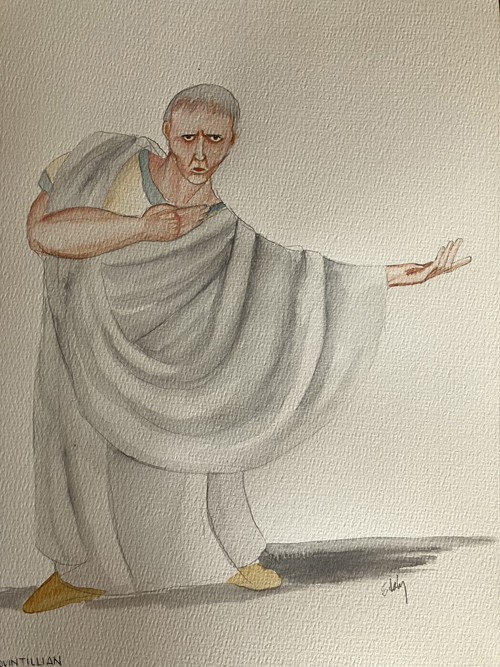
Thanks a million, Quintilian
by Stephen Lahey 2026
Oratory as Way of Life
The notion that rhetoric or speech-making is at the center of public life and therefore should be at the center of public instruction, was championed by the ancient Greeks – particularly Plato, Aristotle, and Isocrates – on whose writings the Romans modeled their educational system. What most distinguishes Institutio is Quintilian’s conviction that he saw oratory not only as a skill, as his predecessor Cicero did, but as a way of life. Quintilian’s mantra is this: oratory is the good man speaking well. This sharply contrasts with Cicero’s definition, which was, “oratory is the art of speaking so as to persuade.” Indeed, Quintilian begins his thesis by writing, “The first essential for (the perfect orator) is that he should be a good man, and consequently we demand of him not merely the possession of exceptional gifts of speech, but of all the excellences of character as well” (Book I, Preface, Part 9). He expands his aim by stating, “if oratory be the art of speaking well, its object and ultimate end must be to speak well” (Book II, Chapter xv, Part 38), which he then frames in a tautological premise: “Oratory is the art of speaking well, and the orator knows how to speak well” (II, xvii, 37). He also proclaims oratorical excellence a virtue: “the orator (is) a good man skilled in speaking” (XII, i, 1). Finally, he asserts that the aim of his opus is to achieve such excellence: “The oratory I endeavor to teach… must be regarded as a virtue” (II, xx, 4).
One can read Institutio not only for the possibility of acquiring virtue but for enjoying Quintilian’s style. He frequently peppers his discourse with aphorisms rich with metaphors and analogies, such as “The voice of a lecturer… is like the sun which distributes the same quantity of light and heat to all of us” (I, ii, 14), or “Vessels with narrow mouths will not receive liquids if too much be poured into them at a time, but are easily filled if the liquid is admitted in a gentle stream… similarly you must consider how much a child’s mind is capable of receiving: the things which are beyond their grasp will not enter their minds, which have not opened out sufficiently to take them in” (I, ii, 28).
Speaking to Our Times
Seeing education from Quintilian’s viewpoint – as an integration of schooling, speaking and conduct, to form a virtuous citizen – we can quickly see how his theory intersects with so many pedagogical issues today. Below are ten that resonate in Institutio.
Expand educational opportunities for preschoolers
With such an awesome task ahead, an orator must be educated as soon as life begins. Quintilian begins his exercises for the orator with infancy, calling for ‘continuous application’ and the “best of teachers and a variety of exercises” (I, i, 10). He’s concerned with all those who influence the infant: “See that the child’s nurse speaks correctly” and “be of good character” (I, i, 4), and “I should like to see [parents] as highly educated as possible, and I do not restrict this remark to fathers alone” (I, i, 6). He expects parents and guardians to speak well, “for it is the worst impressions that are most durable”, and warns, “you will never turn vice into virtue” (I, i, 5).
Quintilian’s message here is unequivocal: start teaching children when they’re very young. They are ready to learn by nature, and have great retentive skills for literary training.
Select the best teacher for the child
Quintilian continues with a provocative discussion of whether the child should be educated publicly or in the home. He points out that morals can be corrupted at home as well as in school, and that too much intervention can stifle the child’s performance. Therefore he opts for a public education in which the teacher is well educated, friendly, and intimate with his students, unburdened by the pressures of having too many students, and particularly sensitive to the extraordinary learner.
Make instruction relevant
Quintilian then moves from scrutinizing the child’s guardians and teachers to describing actual learning activities, beginning with well-planned, enjoyable game-like exercises for children, and continuing with formal exercises in elocution, grammar, and rhetoric for the young citizen.
Establish character education
For Quintilian, the orator cannot be good unless he is above all else a good man. So if oratorical education is the heart of Quintilian’s system, then moral education is its soul: “No man, unless he be good, can ever be an orator. To an orator, discernment and prudence are necessary” (XII, i, 3). His method to cultivate this goodness includes the introduction of topics that elevate the mind of “what is really good, what allays fear, restrains cupidity, frees us from the prejudices of the vulgar, and raises the mind towards the heaven from which it sprung” (XXII, ii, 28). Reading lessons, for instance, should be combined with moral lessons.
Oratory itself was also a conduit for achieving moral goodness. Quintilian lashes out at a prevailing notion of his time that the orator should learn to speak persuasively to either side of an issue: “Oratory does not contradict itself… [does not] destroy what it has done… [nor] teach what we ought not to say” (II, xvii, 33-35). In essence, by making oratory synonymous with a mastery over every form of speech and a moral good, he gives oratory the status of a virtue, and oratory becomes more than just a subject or an action, but rather a behavior and end in itself – a way of life. The natural result of such an orator engaging in public life would be a general improvement of society.
Provide a multidisciplinary education
Quintilian’s orator must possess many skills. Grammar and rhetoric are the primary tools of the orator, but he also must have knowledge of the other arts, such as architecture, sculpture, medicine, and music. Quintilian even approves of gymnastics because it facilitates movement for the speaker, and the study of comic acting to learn tips on delivery, facing the audience, and pleading. Yet the orator should not study arts to the point that it adversely affects the ability to speak well: “It is sufficient that the orator be acquainted with the subject on which he has to speak. He has not a knowledge of all causes, and yet he ought to be able to speak upon all” (II, xxi, 14-15). The orator is distinguishable from other artists by achieving three aspects of the arts: the theoretical, when studying the art or planning the speech; the practical, when actually speaking; and the productive, when committing the speech to writing. (For more on this, see Educational Theory as a Theory of Conduct: From Aristotle to Dewey, J.J. Chambliss, 1987).
Set boundaries for student-teacher relationships
No one, even parents, but especially teachers, should have absolute authority over the child. Teachers should not always hover over the children, and should never beat or insult them. They should teach poetry without encumbering the student by overanalyzing it, paraphrase Aesop’s Fables in “simple and restrained language” (I, ix, 2), and then let the children write their own interpretations. They should allow freedoms to students (much in the way progressive educators today view teachers as facilitators), yet be caretakers of the student’s complete oratorical education, including breathing, movement, diction, organizing presentations, analyzing a debate, and the like.
Quintilian sets clear standards for the teacher’s personal relationship with his students. These include developing a parental attitude, serving as a representative of the student’s guardians, expressing moderation, rejecting vice and speaking continually on moral goodness and honor.
Employ a whole language approach
Despite his structured methodology to teaching oratory, Quintilian today would likely favor a whole language approach to literacy. A whole language approach teaches reading and writing by focusing on meaningful experiences and treating language holistically, not by dividing it into isolated parts like phonics. While Quintilian’s expectation that students learn syllables early may seem like the antithesis of a whole language approach, he does not want the child to suffer an exclusively phonetic approach to learning to read. He sees reading, writing, and speaking as interdependent skills, and even prefers that students learn the shapes of letters rather than their alphabetical order.
Foster critical thinking skills
In recent education debates, the idea of teaching critical thinking skills has had both supporters and detractors. Those who favor teaching critical thinking might argue that it helps students analyze situations and subject content. Those who oppose it might claim that to think is to be critical, so the term ‘critical thinking’ is nothing more than a redundancy. Or they might say that any subject already requires a high level of critical thinking, and students will learn critical thinking by learning the course content.
If, however, we view ‘critical thinking’ as ‘enhancing thinking skills’, then Quintilian has plenty to say in its favor: “It will… be the duty of the rhetorician not merely to teach [the art of speaking], but to ask frequent questions as well, and test the critical powers of his claim” (II, v, 13). In fact, Quintilian is disdainful of the façades and airs of the all-style-no-substance speeches that were as common in his time as they are today:
“We have come to regard direct and natural speech as incompatible with genius, while all that is in any way abnormal is admired as exquisite.… There are even some who are captivated by the shams of artifice and think that there is more beauty in those who pluck out superfluous hair or use depilatories, who dress their locks by scorching them with curling irons and glow with a complexion that is not their own, than can ever be conferred by nature pure and simple, so that it really seems as if physical beauty depended entirely on moral hideousness” (II, v, 11-12).
Engender independent learning
Students learning for themselves is “the chief aim of this method of training” (II, v, 13). Of course, their independent learning must come from a classical approach to teaching. In this, we see a reiteration of Isocrates’ three-part approach to the teaching of rhetoric: theory, study of models, and applied exercises.
While he does not necessarily create new methods of learning or teaching, Quintilian systematizes and criticizes the prevailing methods, thereby providing “an explicit rationale for an educational program in literacy culture which was already under way” (Quintilian, George Kennedy, 1969, p.xiii).
According to Kennedy, the five main teaching methods Quintilian employs are: precept – a set of rules for each aspect of speaking, namely invention, arrangement, style, memory, and delivery; imitation, which includes reading aloud, memorization, and recitation of model speeches to learn how masters use language; composition, beginning with simple retellings of fables and episodes from literature and history, and proceeding to progressively more difficult tasks, such as amplification of a moral theme, use of commonplaces, refutation or confirmation of an allegation, and arguing for or against an answer to a general question or to laws; sequencing, or ordering the student’s activities to master his movement and elocution, from simple to more complex exercises; and declamation, or giving speeches of two types: sausoria, or deliberative – arguing that an action is to be taken or not taken; and controversia, or forensic – prosecuting or defending a person’s actions. Finally, the student must reinforce his skill by reiterating each previous exercise as new ones appear.
Once he has learned this systematic approach to writing and delivering speeches, the student now has a foundation from which he can explore writers and orators independently and critically.
Teach controversial content
Quintilian would not have been on the book banning bandwagon. For instance, in some academic circles these days, teaching the traditional Western literary canon has become taboo because of its Eurocentric focus. By contrast, Quintilian was beholden to his classical predecessors, on whom he lavishes praise throughout Institutio. He suggests which Greek and Roman writers should be read by the student of oratory, creating a veritable canon for his time. But he also wants them to learn from speeches that are mired in corrupt and faulty styles, yet still achieved prominence, because he wanted students to understand “the perversity of modern tastes” (II, v, 10-12). For Quintilian, even the imperfect would reveal volumes about the mores of the popular culture.
An Enduring Legacy
Institutio oratoria has survived two millennia as a highly readable practical guide for the teacher, especially of public speaking. What we have added to presentation skills training since the first century CE seems relatively minor in comparison. Institutio also makes for excellent reading for literary scholars interested in critiques of classical authors and for historians looking for insights into ancient Roman education. Augustine and many other educational philosophers who followed Quintilian are indebted to this masterwork. And many school administrators, teachers, and others in education today equally benefit from learning from Quintilian’s teaching advice.
© Philip Vassallo 2026
Philip Vassallo, is a corporate writing consultant and the author of How to Write Fast Under Pressure. He dedicates this article to Charles Lynch for his career as an influential educator.
Advertisement
