


Your complimentary articles
You’ve read one of your two complimentary articles for this month. To have complete access to the thousands of philosophy articles on this site, please
You can register for a free account to have four complimentary articles per month. We will occasionally email you a newsletter, from which you can unsubscribe at any time. We do not sell personal data or otherwise disclose personal information to other organisations.
Roman Philosophy
Machiavelli’s Roman Empire
Sam Spound explains why the author of The Prince thought about Rome so much.
In late 2023, on social media, many women expressed surprise to discover how often their boyfriends thought of ancient Rome. This collective realization became a meme and ensconced the term ‘Roman Empire’ into the popular lexicon as a great historical ideal about which one often daydreams. Had Niccolò Machiavelli (1469-1527) been alive today, he would have been guilty of a similar infatuation, as ancient Rome was his ideal too. But what was the Roman Empire?
During its millennia-spanning history, Rome was many things. According to the Baron de Montesquieu, the great French Enlightenment thinker, at one time or another Rome satisfied all three of his ‘natures of state’ – it was in turns, monarchical, republican and despotic. Friedrich Nietzsche, who loved Cæsar, thought Rome was most grand and masterly with an Emperor on the throne. One would assume that Machiavelli, so often associated with his unscrupulous, prudent, and deadly classic work of political thought, Il Principe (The Prince, 1513), would have admired the bloody conflicts of Rome’s imperial succession and the power of the imperial purple, too. In actuality, Machiavelli was personally removed from The Prince’s philosophy. Rather, that treatise was written as a gift and de facto job application to Lorenzo di Piero de Medici, Duke of Urbino, and ruler of Florence, for the position of court advisor. Machiavelli was not granted the position, nor did he completely align with The Prince’s ethos of amoral cunning and selfish power-lusting. He was far more attracted to the selfless, classical virtues and civic duty of the Roman Republic that preceded the Roman Empire. He explored this in his Discorsi, or Discourses on the First Ten Books of Titus Livy. In 1517, disillusioned with the indignity of modern Italian times, Machiavelli looked back to the Romans with nostalgic longing and set out to explain why the Roman Republic was great.
Italy’s contemporary subjugation to “barbaric invaders” provided an external impetus for the work’s authorship: twenty years prior, Charles VIII of France invaded the Italian Peninsula, inaugurating a decades-long period of war and conquest by France, Spain, and the German principalities. Simultaneously, Machiavelli’s native Florence, once the gold standard of medieval republicanism, came under the yoke of corrupt oligarchs, the Medicis most of all. Machiavelli blamed Italy’s sorry state on the “church and to no one else”, as the Papacy lacked the virtù (that is to say, the manliness) to unify all of Italy itself, yet prevented any other actor from properly doing so. Machiavelli also claimed church doctrine made men timid, “effeminate”, and cowardly, while rampant corruption only furthered Italy’s decline. In this context, the Discorsi nostalgically investigated both Republican Rome’s politics, religious culture, and civic grandeur, in the hopes of one day restoring such virtues to Italy.
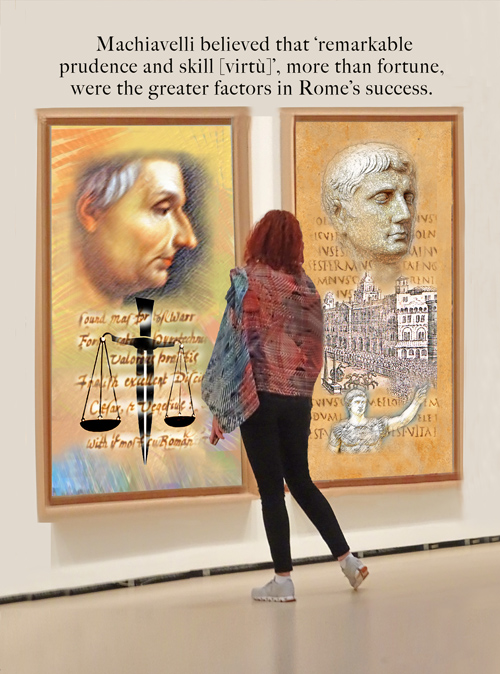
Image © Miles Walker 2022 Please visit mileswalker.com
Political Virtù
According to the Discorsi, the merits which enabled Rome’s expansion and glory were cultivated through both virtù (valour, prowess) and fortuna (luck). Unlike Livy or Plutarch, Machiavelli believed that “remarkable prudence and skill [virtù]”, more than fortune, were the greater factors in Rome’s success over the centuries. Luck, however, was of near-equal import, as early Rome’s first four kings just happened to be great creative men. The first of them, the (semi?) legendary founder of Rome, Romulus, commenced Rome’s exceptional political traditions.
When describing Rome’s political history, Machiavelli effectively used Aristotle’s three basic forms of benevolent government and their malevolent perversions. According to Aristotle, monarchy devolves into tyranny; aristocracy into oligarchy; and democracy into anarchy. Most states fail because their political organization, originally aimed at one benevolent form, naturally slips into its opposite. The Romans were long an exception to this rule since their mixed constitutions of monarchy, aristocracy, and democracy ensured against the inevitable degeneration into one of these malevolent forms.
Machiavelli cites the Roman historian Livy, who wrote that the mythic lawgiver Romulus founded Rome in 753 BC after killing his brother Remus. Seven kingships transpired from then until 509 BC, when the monarchy – now tyrannical – was overthrown by Brutus (the ancestor of Caesar’s Brutus) and the Senate was founded, giving power to the foremost hundred patricians. Prudently, the Romans also established two consulships who retained executive authority in conjunction with the body of the senators. Centuries later, the common people revolted at Rome’s aristocratic control, and, so as not to lose their power completely, the Senate ceded some authority to the masses. From here, the plebeian Office of the Tribunes was created to represent the people in the legislative process. Afterward, Machiavelli tells us, the Republic stabilised, as each form of government and, likewise, each class of man, had been integrated into the Roman constitution. Over the Republic’s long existence from its mythic antiquity until after the days of Julius Caesar (assassinated 15th March 44 BC), no branch ever wholly seized power from another. Rather, a spirit of cooperation and patriotic identity underwrote its political development.
Most important to Machiavelli, though, was “the conflict between senate and people”, which he controversially identified as the primary element to Rome’s political success. A contentious and unpopular assertion for the time, Machiavelli saw utility in the fervent protest of the plebeians, and the open debate between senators and commoners:
“Every city ought to have practices that enable the populace to give expression to its aspiration, especially those cities that want to be able to rely on the populace at times of crisis… The demands of a free people are rarely harmful to the cause of liberty, for they are a response either to oppression or to the prospect of oppression. When the populace is mistaken, then there is a remedy to hand in the open-air speech. Some sensible man has to get up and harangue them, showing them how they are wrong. The populace, as Cicero says, although they are ignorant, are capable of recognizing the truth, and it is easy for a man whom they have reason to respect to persuade them to change their mind by telling them the truth.”
Because Republican Rome’s political culture necessitated that the plebeians air their grievances, the demands of the people were often considered by the Senate. This dynamic largely eliminated the threat of a coup. In turn, the decrees of the Senate and the Consuls who presided over them were respected by the masses. What came of this contentious relationship was a free society that drew strength from its process of vehement deliberation. Machiavelli believed early Rome’s republican political culture, a foremost reason for her prosperity, was formed on the bedrock of these bodies and their uniquely disagreeable dynamic, which was inherent to the messy ethos of Republican Rome’s mixed constitution.
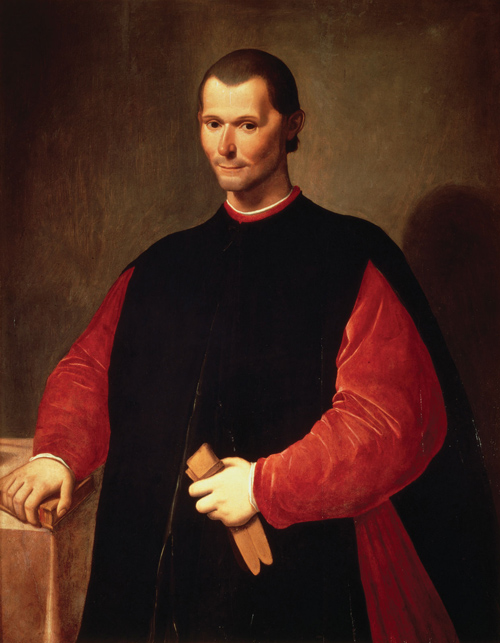
Machiavelli by Santo di Tito
Earthly Religion
While Machiavelli credited Rome’s first king with inaugurating her political evolution, he credited her second, Numa Pompilius, for establishing the vital religious traditions that he believed were the foundation of the greatness of Rome. Unlike the Christianity he so disliked, the mythology of the Greco-Roman pantheon was unabashedly virile, life-affirming, and intrepid. The wrath of Jupiter, the fervour of Mars, the heroism of Hercules – all of these sentiments encapsulated a religious validation for Roman conquest, militarism, and valour. Such masterly sentiments were displayed in the Roman proclivity to revere great commanders: Rome’s great men were not paid in riches, but in glory, with triumphs, and their statues stood in the Forum for posterity.
Machiavelli praised the public morals of the Romans, concerned more with earthly glory than with pure hearts. Their values were quite different to those of his own day, during which, according to him, Christians fixated upon the afterlife and regarded “humility, self-abasement, and contempt for worldly goods as the supreme virtues.”
In terms of religious customs, the rites established by Numa were based around oracles accessed through divination and augury, such as reading the entrails of slaughtered animals to foretell of victory or defeat in battle. These prophecies exercised a beneficial influence across Roman society, not least over the morale of the military, as they often yielded convenient evidence that the gods foretold Roman victory. Machiavelli cites one such example from Livy, which took place in 396 BC, ten years into the siege of the Etruscan city of Veii:
“That same year the Alban lake had expanded remarkably. The Roman soldiers were weary with the lengthy siege and wanted to return home. Their commanders discovered that Apollo and some other oracles had declared that the year that Veii would be taken would be the year that the Alban lake overflowed its banks. This made the soldiers willing to put up with the frustrations of the siege, for they were seized with the hope that they would be able to take the town. They were willing to go on with the task, with the result that Camillus, once he was made dictator, took that city after it had been under siege for ten years. So religion, skillfully employed, helped the Romans seize Veii.”
The oracle had imbued the soldiers with confidence that the end of the siege was near, empowering them to take the city and expand Rome’s borders; one of many similar cases.
Furthermore, within civil society, the wrathful gods inspired fear in the religious republicans; and their partial and furious vengeance sculpted the citizens into a gods-fearing culture, thereby forming the basis of Rome’s renowned civic duty. The devotion of her citizenry, Machiavelli tells us, sustained the Roman Republic throughout its vast expansion just as much as the prowess of her legions. These virtues were derived from religion, and he consequently concluded “that the religion introduced by Numa” – his favourite king – “was one of the primary reasons for the success of Rome.”
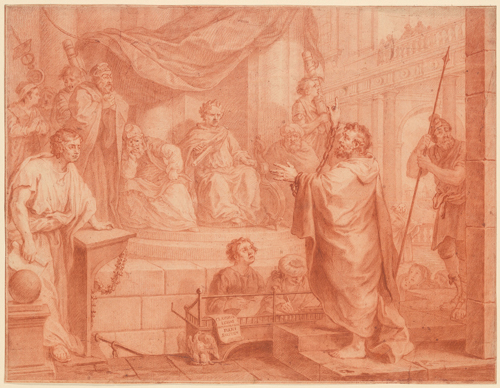
Roman court in session by William Hogarth
Civic Duty
These political and religious customs of the Republic, as endorsed by Machiavelli, produced a brave and selfless people who emerged from a tiny city-state to conquer much of the known world, amassing even more territory than they would under the dictatorship. Most valuable to Machiavelli, these virtues converged to produce the civic duty that characterised Rome’s Republic. Indeed, such virtue, absent from his own time, was cited by him as the primary reason for the success of the Republic. Resulting from the religious fear mentioned, Roman citizens honoured their oaths to the death. Machiavelli details instances of both individual citizens and entire groups who nobly kept their word, even when it cost them their lives. The Republic’s political institutions demanded selfless and disciplined leaders (Machiavelli recognised that states which “depend entirely on the strength [virtù] of a single individual do not last long, for his strength cannot outlive him”). Since the Republic depended on the competence, honesty, and civic duty of hundreds of its most powerful citizens, the political process demanded a collective dedication to unselfish virtues. Hence, Republican Romans were impelled to pursue “the interests of the community as a whole”, rather than those of the individual. So in sharp contrast to what he says in the Principe, Machiavelli argues in the Discorsi that ambition and avarice are undesirable qualities in a republic’s political process. The survival and glory of greater Rome trumped care for the self in all spheres of society, and the Roman heroes that the republicans (and Machiavelli) admired most were brave, incorruptible men who sacrificed their lives, their kin, or their personal benefit for the good of the state. Among them, Machiavelli named Brutus, Horatius, Scævola, Fabricius, Regulus Atilius, and many more, whose “remarkable… examples… had almost the same effects on their fellow citizens as good laws.” To Machiavelli, these Republican Romans made the decadent and selfish emperors of Rome’s future Empire look abject in comparison. Despite popular belief, it seemed infinitely more desirable to Machiavelli for one to live “as a Scipio rather than a Caesar.” (Scipio Africanus, 236-183 BC, was the Roman Republic’s greatest general, famous for his mercy and self-denial).
Thus, to Machiavelli, the Roman Republic’s political institutions and religious values called forth a courageous, unselfish, and steadfast people whose patriotic dedication propelled Rome to the heights of glory. He concluded, where “the individuals are not corrupt, conflicts and other crises do no harm; where they are corrupt, the best-planned laws are useless.”
Conclusion
To summarise, virtù and fortuna enabled the Roman Republic to possess an ideal mixed constitution and intrepid religious beliefs. These institutions birthed a selfless culture of “personal virtue in the citizens”, enabling their city to enjoy the zenith of political success. Thus, during a period of Italian humiliation, Machiavelli looked to the glorious and politically participatory character of the Roman Republic as an ideal standard, and hoped a future republic might one day deliver Italy from corruption and subjugation by regaining Rome’s original merits.
Despite his pessimism about his own time, some ideals Machiavelli distinguished in the Discorsi were rather fulfilled during his own century. Indeed, the Renaissance itself can be well characterized as a Roman reawakening. Many date its commencement to Petrarch’s rediscovery of Cicero’s letters in 1345, and the movement flourished in the republican centre of Florence. Anyone who has marvelled at the frescoes of the Palazzo Vecchio, the paintings of the Palazzo Pitti, or the colonnades of the Uffizi, peopled with statues of great Florentines, has seen the spirit of Roman grandeur reincarnated. In this, Florence remains a living tribute to the classical humanism, earthly virility, and civic virtue of the Senatus Populusque Romanus, as channelled during the Renaissance.
If Machiavelli could have watched modern history unfold, he might have esteemed Florence for its world-historic feat of reinserting the Roman element into the canon of Western civilization, an achievement in which he played no small part. However, five centuries on from the Discorsi, the future seems bleak for the republican tradition. While our democracies are quite different from those of antiquity, Machiavelli teaches us that republics invariably cannot survive when public virtue has eroded, when the national interest is superseded by the faction, or when civic duty is undermined by hostile, alien cultures. As the fate of our own parliamentary democracies and constitutional republics appears uncertain, we would all of us do well to revisit the timeless and virile virtues of ancient Rome, celebrated by Machiavelli’s Discorsi, and seek to cultivate them in our own societies.
© Sam Spound 2026
Sam Spound is the Editorial and Research Fellow at the American Affairs Journal in Washington, DC. He recently graduated with distinction in his MPhil in Political Thought and Intellectual History at the University of Cambridge.
Advertisement
