


Your complimentary articles
You’ve read one of your four complimentary articles for this month.
You can read four articles free per month. To have complete access to the thousands of philosophy articles on this site, please
Books
Facing Down the Furies: Suicide, the Ancient Greeks, and Me by Edith Hall
Manisha Sarade on suicide’s meaning for the Greeks and for us.
Is there any problem more quietly present, and more awkwardly evaded, than suicide? Philosophy asks us to look squarely at the question that Albert Camus called “the only serious philosophical problem” – to ask, not only why people live, but why some choose not to. Edith Hall’s Facing Down the Furies (2024) does exactly this, drawing on her own family’s troubled history and the massive shadow of the ancient Greeks, whose tragic dramas crackle with suffering but never quite snuff out hope. Camus, ever the philosopher of both daylight and shadow, stares unblinkingly at darkness: he writes, “To decide whether life is worth living is to answer the fundamental question of philosophy” (The Myth of Sisyphus). Hall does not answer for us, and does not try. Instead, she reminds us (as Camus does), that there is defiance in remaining, and sometimes, perhaps, in departing.
Hall’s approach would have pleased the French essayist Michel de Montaigne, who recommended that we philosophize always among people, not just with ideas. She narrates the suicides of her great-grandfather, her grandmother Edith, and her cousin Alex, never with sentimental display, but in the spirit of candid confrontation. Meanwhile the classical world, she claims, gives us permission to place pain on stage, to honor it not as an aberration, but as an element of life. “We are all, at times, pursued by the Furies,” she writes, referencing the Erinyes, the relentless goddesses of guilt who stalk the characters in Aeschylus’s dramas, and who perhaps stalk the rest of us too.
It’s easy today to react to suicide through the lens of medicalised psychology or to surround it with a hush of embarrassment. The Greeks responded differently. Ajax, shamed and defeated, schose to fall on his sword with the same gravitas as Hamlet asking “To be, or not to be?” Antigone the theatrical heroine weds herself to the grave out of conviction; while Socrates sips hemlock serenely, taking leave of life for reasons both social and philosophical. With the ancient Greeks, suffering is not hidden away, but invited, in chorus and verse, into the center of the conversation.
Hall’s gift is an ability to thread these ancient stories into the fabric of her own. When she speaks of her great-grandfather fallen from respectability in a small Scottish town, we recall Ajax undone by dishonor. With her grandmother Edith – withdrawn, depressive, ultimately lost to the silence of suicide – Hall finds kinship with Euripides’ Phaedra, fighting against shame and inner agony. It’s striking how the Greeks, despite their distance, seem to know our troubles intimately.
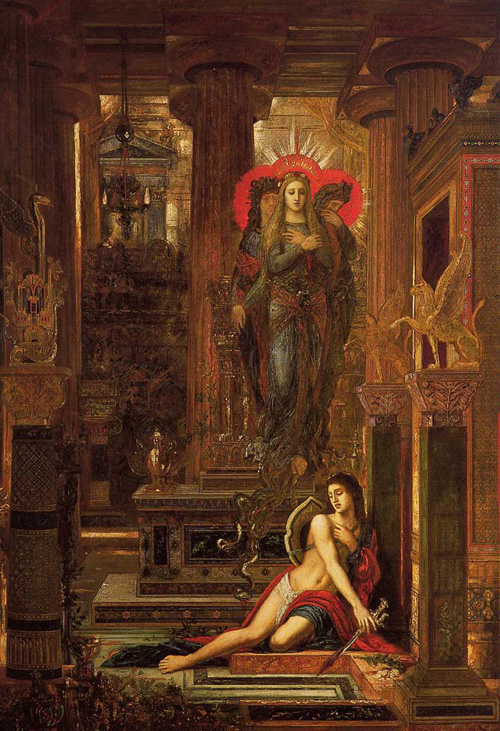
Orestes and the Erinyes Gustave Moreau 1891
There’s a poet’s touch here, too. As Hall turns to Sophocles and Euripides to unravel suffering, the echo of W.H. Auden’s “Stop all the clocks, cut off the telephone”, Sylvia Plath’s raw “Dying / Is an art”, and Leonard Cohen’s mournful song Bird on the Wire, shows how Hall’s questions of choice, despair, and endurance shine brightest in lyric rather than in dry argument. The Greeks, too, would have recognized the power of poetry to frame our pain, to hold it tenderly, even, sometimes, to laugh at it.
Hall isn’t interested in solemn rules or neat answers. Instead, she brings the great philosophers into her unsolvable questions, treating them as conversation partners. In the dialogue Phaedo, Plato finds suicide a trespass against the gods – an idea that has echoed for centuries in many religious prohibitions. The Stoics, though, think differently. Epictetus counsels endurance but also freedom; and Seneca, especially, recommends measuring life not by duration but by dignity: “It is not that we have a short time to live,” Seneca wrote, “but that we waste much of it” – a line that could be either an anthem for living or a permission slip for dying.
The Greeks did not treat self-destruction as straightforwardly wrong. In Greek mythology and literature, Antigone chooses death as an act of moral fidelity. Cato the Younger, a Roman deeply immersed in Greek culture, slashes his own throat as rebellion against tyranny. Hall, reflecting on these stories, finds a kind of dignity, not in the act itself, but in the serious consideration of what a life means, and why sometimes it ends.
One of Hall’s strengths is her refusal to flatten all suicides into the same category. With the Greeks, she preserves the difference between death sought for honor, protest, or principle, and death pursued out of exhaustion or mental illness. Her grandmother Edith’s story, for instance, is not treated as a failure but as a tragedy, rendered more comprehensible in light of Phaedra’s fruitless struggle with passion and despair.
In the play The Oresteia, Aeschylus invents a kind of healing for the house of Atreus: through ritual, recognition, and forgiveness, the Furies, agents of endless revenge, are transformed into the Eumenides – the Kindly Ones. Hall’s own inquiry also finds hope in this ancient solution of transformation, which neither erases pain nor dwells ceaselessly in it: “We honor suffering not because it ennobles us,” she suggests, “but because it is ours, and to deny it is to become less than human.”
There’s wisdom not only in the stories Hall tells, but in how she tells them. When she recalls her own brush with suicidal thoughts brought on by the stresses of academia and isolation, the rescue comes not from abstract theory but from connection – friends, texts, communities willing to listen rather than explain. At moments, the Greeks themselves seem to sit beside her in the darkness, offering companionship, not cure.
Virginia Woolf, who knew more than most about the ‘tumult of the mind’, and who herself committed suicide, insisted that every biography is at heart a struggle to make sense of both joy and sorrow. Similarly, Hall’s book is not a solution or a treatise, but a tapestry, in which threads of antiquity wind around the modern, until the distinction blurs and Ajax’s agony feels as fresh as last winter’s. Philosophers join in, but their pronouncements are never final: they are voices among many, of both comfort and debate.
If there is a single lesson audible in the chorus of tragedy and the whisper of poetry, it is the value of speaking, remembering, and witnessing, even the unspeakable.
The book closes with Hall’s quiet hope that the stories she has woven, both melancholy and shining, may offer not just a reckoning with suffering, but also a gentle invitation to keep living: “to face our Furies arm in arm, rather than alone.”
This review ends not with certainty but with gratitude for questions shared. In Hall’s company, we walk among the tragic heroines and heroes who have known despair and, paradoxically, help us endure it. There are no simple consolations here, but there is dignity in the struggle to understand, even in the dark.
© Manisha Sarade 2026
Manisha Sarade is a finance lawyer based out of Mumbai, India.
• Facing Down The Furies, Edith Hall, Yale UP, 2024, 256 pages, £12.99 pb
Advertisement
