


Your complimentary articles
You’ve read one of your two complimentary articles for this month. To have complete access to the thousands of philosophy articles on this site, please
You can register for a free account to have four complimentary articles per month. We will occasionally email you a newsletter, from which you can unsubscribe at any time. We do not sell personal data or otherwise disclose personal information to other organisations.
Articles
Good Grief!
Tim Madigan ponders the philosophy of Peanuts.
“I’ve developed a new philosophy. I only dread one day at a time.”
– Charlie Brown
Long before I ever dreamt of being a professional (or even amateur) philosopher, my earliest goal was to be a cartoonist. When I was a child I loved to read ‘the funny pages’ and hoped to create an entire world of my own making akin to those I found in the comic strips. I even for a time published such a strip in my grammar school paper. When I look at it now, 50 years after the fact, I truly know what the logical term ‘being charitable’ means, as my teacher who kindly accepted it for publication could clearly see that my drawing skills were most definitely subpar. I never did progress much beyond the doodling stage. But that didn’t stop me from continuing to appreciate comic art, and I still get some vicarious pleasure when I teach about this genre in my Philosophy of Art courses.
The comic strip that first inspired me was ‘Peanuts’, which celebrated its 75th anniversary in 2025. Created by Charles Schulz, it first appeared on October 2, 1950 (for further details see The Essential Peanuts: The Greatest Comic Strip of All Time by Mark Evanier, 2025). Schulz hated the title ‘Peanuts’, which was imposed upon him by the syndicate that published the strip, wishing instead to call it ‘L’il Folks’, after an earlier strip he had done for his local paper in St Paul, Minnesota. He felt ‘Peanuts’ was undignified and misleading, but by the time the strip became famous it was too late to change it, even though most of us know it primarily by the name of its lead character, Charlie Brown (who for some reason is always called by his full name by all the other characters, including even his younger sister Sally).
‘Peanuts’ ran for an astonishing 50 years, ceasing publication in 2000, just a few days before Schulz’s own death. Schulz was its sole writer and artist – he actually drew each and every strip himself, an almost unheard of state of affairs in an industry where creators usually have assistants doing much of the artwork, where most eventually lose control of their creations, and where the characters ‘live on’ long after their originators depart, willingly or otherwise.
As David Michaelis points out in his 2007 book Schulz and Peanuts: A Biography (and as his family members attest) the comic strip was central to Schulz’s life, and he put much of his own whimsical attitudes into it. It’s not surprising, perhaps, that he refused to relinquish control of it, and stipulated that, while the original strips could continue to appear after his death, no one else could take over ‘Peanuts’, as was done with other such strips as ‘Little Orphan Annie’, ‘Blondie’, or ‘Dick Tracy’. It’s significant that its central character shared the same first name as its creator, as Charlie Brown in many ways was Charles Schulz.
Perhaps it’s not purely coincidental that Schulz – a man who was very learned in intellectual issues – began to be published at almost the same time as the philosophy known as Existentialism came into the American public’s consciousness. Michaelis quotes Schulz as saying: “I’m not a philosopher … I’m not that well-educated” (Michaelis, Schulz and Peanuts: A Biography, p.394). But, as Shakespeare might say, Schulz doth protest too much. While ‘Peanuts’ was primarily a humorous ‘comic’, it was itself labeled as ‘existential’ from an early stage, as it dealt with such themes as loneliness, dread, contingency, and despair, all of which could be found in the works of such Existential thinkers as Søren Kierkegaard, Friedrich Nietzsche, Martin Heidegger, Simone de Beauvoir, and Albert Camus. In particular, one can see many similarities between Jean-Paul Sartre’s famous 1944 play No Exit and the ‘Peanuts’ world. Both seem to take place in a self-enclosed absurd setting, where characters (Estelle, Garcin and Inez in Sartre’s work, and Charlie Brown and the Little Red-Haired Girl, Sally Brown and Linus, Lucy and Schroeder, among others in Schulz’s universe) engage in endless variations of unrequited love and broken connections. Yet, unlike in Sartre’s hellish world, the ‘Peanuts’ gang do form a genuine community, and by somehow surviving the daily travails of their environment through their constant philosophical questionings they help us all to better understand the human condition. Like the eternal rock pusher at the end of Camus’s seminal essay ‘The Myth of Sisyphus’, one must imagine Charlie Brown happy.
One example, among countless others, of the ‘Peanuts’ community in existential mode can be found in the strip appearing on Sunday, September 17, 1967 (the Sunday strips, by the way, were in color and unlike the daily strips they were titled ‘Peanuts Featuring Good Ol’ Charlie Brown’ – one small way for Schulz to try to transcend the title he was stuck with but never loved). In it, Charlie Brown stands, as is his wont, on the pitcher’s mound during a typical losing baseball game for his team. “Nine home runs in a row!! Good Grief!” he intones. His catcher Schroeder comes up to the mound to ask him what the cause of his outburst is. “We’re getting slaughtered again, Schroeder”, he says. “I don’t know what to do. Why do we have to suffer like this?” It is a perfectly reasonable question – indeed, regular readers of the strip might well ask that question about the ‘Peanuts’ gang in general, as the team never wins a game, the love circles never close, and Charlie Brown never gets to kick the football Lucy holds so enticingly at the beginning of every football season. But Schroeder gives a rather perplexing response: “Man is born to trouble as the sparks fly upward.” Not surprisingly, Charlie Brown can only reply by asking “What?”
At this point, Linus comes up to the mound to inform the befuddled pitcher/manager that Schroeder had been quoting from the Old Testament’s Book of Job, seventh verse, fifth chapter. Linus – the resident intellectual, noted for his brilliance but also for his insecurity which causes him to suck his thumb and hold onto his security blanket to endure the world’s travails – starts to explain why the problem of suffering is such a profound one. But his bossy sister Lucy interrupts him in mid-sentence, as is her wont, to assert, “If a person has bad luck, it’s because he’s done something wrong. That’s what I always say.” As Schroeder reminds her, that is exactly what Job’s friends tell him when he is afflicted with boils and other unbearable sufferings, even though he knows he is a good and faithful servant to God. Unimpressed, Lucy tells him, “What about Job’s wife? I don’t think she gets enough credit!” Those who know the Book of Job will recall the advice the wife gives to her husband when he asks why he is being made to suffer so. “Curse God and die,” she suggests. A very Lucy-like response!
The rest of the panels of this strip consist of other characters discussing various reasons why suffering may occur, with a thoughtful-looking Snoopy taking in the deep discussion. It is a master class on getting across profound observations in a ridiculous setting, not unlike a play by Samuel Beckett or indeed Archibald MacLeish’s 1958 play J.B., itself a variation of the Book of Job. The final panel shows Charlie Brown, alone again on his pitcher’s mound, with a forlorn expression on his face. “I don’t have a ball team …” he moans, “I have a theological seminary.” A pessimist might say this shows the futility of the ‘Peanuts’ world but an optimist would say that, while the team never seems to win a game, it does have some great conversations.

Lee Hoffman 2011 Creative Commons Licence 2.0
There was a best-selling book in 1965 by Robert L. Short called The Gospel According to Peanuts. Schulz gave his blessing to allowing it to use examples from his work, and as is well-known he also insisted that Linus be allowed to quote the nativity story from Luke’s Gospel in the television cartoon A Charlie Brown Christmas which appeared on CBS that same year. But Schulz was loathe to proselytize and in 1989 he told his biographer Rita Grimsley Johnson that “I do not go to church anymore … I guess you might say I've come around to secular humanism, an obligation I believe all humans have to others and the world we live in” (Good Grief: The Story of Charles M. Schulz, p.137). It might be more accurate to describe him as a religious humanist, extolling the virtues of humility and tolerance. His views about the Religious Right are exemplified in a strip from 1980, when it was first becoming a political force to be reckoned with in America. ‘Peppermint’ Patty, a character who came to dominate the strip around this time, finds herself at a summer camp run by a doomsday religious group preaching the end times. She is terrified until her friend Marcie points out a drawing on the wall of the proposed new camp for which the organization is raising eight million dollars. Patty, who had been about to call her dad to warn him about the end of the world, tells the organization’s secretary, “Forget the phone, ma’am! Maybe the world will end tomorrow, but I wasn’t born yesterday!” And the ever-wise Linus says to the unseen preacher who runs the camp (adult characters are rarely seen or heard in ‘Peanuts’) “I also don’t wish to be rude … Just as a matter of curiosity, sir … Has it ever occurred to you that you might be wrong?”
Sally Brown, the aforementioned little sister of Charlie Brown, often raises equally provocative questions. For instance, in a strip from 1969 she asks her big brother “Do you think life has meaning?” Rather taken aback by this unexpected query he stammers “Well … I …” , to which she replies at the top of her lungs “I mean do you think life has meaning after you’ve failed nine spelling tests in a row and your teacher hates you?!!!” To which he replies, “That’s a different question.” Sally is famous for coming up with short and pithy life philosophies, such as ‘Why me?’, ‘How should I know?’, ‘Who cares?’, and ‘I’ve decided to put everything off until the last minute and to learn everything in life the hard way’. She proudly adds: “Some philosophies take a thousand years. I think of them in two minutes.” It’s no wonder that the song she sings in the hit musical You’re a Good Man, Charlie Brown is called ‘My New Philosophy’.
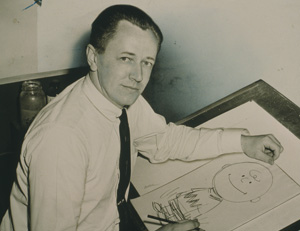
Good Ol’ Charles Schulz
Charles Schulz © Library Of Congress 1956 @ Flickr Commons
In another complicated yet typical ‘Peanuts’ scenario, Lucy – ashamed to be associated with a brother who clutches a security blanket – grabs it from Linus and tells him she’s hidden it and that he has to get used to being without his blanket. Linus begins to hallucinate, faints, and fears for his sanity – rather extreme stuff for a ‘comic’ strip – but Snoopy (usually lost in his own world of fantasy and often oblivious to the concerns of the humans around him, especially the ‘round-headed kid’ who feeds him but whose name he can never remember) saves the day. Using his beagle sense of smell, he finds the blanket where Lucy has buried it, digs it up, and returns it to its happy owner. The overjoyed and fully recovered Linus thanks him profusely, and in the final panel, Snoopy, lying on top of his doghouse, thinks: “Every now and then I feel that my existence is justified.” It’s hard to find a better example of existentialism in action.
As the examples given above prove, it would be easy to write a book called Philosophy According to Peanuts, and I – along with I’m sure countless others – have often used the comic to exemplify various philosophical positions. For instance, those with an inclination toward the linguistic turn in philosophy should find enlightenment in this panel from December 26, 1968, when Charlie Brown asks Linus “Did you have a good Christmas?” Linus contemplates the question and, in a manner akin to G.E. Moore, replies “What do you mean by ‘good’? Do you mean did I get a lot of presents? Or do you mean did I give a lot of presents? Are you referring to the weather or the Christmas dinner we had? Do you mean was my Christmas good in a spiritual sense? Or do you mean was my Christmas good in that I saw new meaning in old things? Or do you mean …” At which point Charlie Brown gives the only reasonable response: “sigh.” And speaking of language games, I must admit that for half a century now I’ve been contemplating just what exactly the term ‘Good Grief’ really means.
One of the strengths of ‘Peanuts’ was the way Schulz was able time and again to return to the same themes but give them interesting, and often unexpected, variations. This is best demonstrated by the tradition, every autumn, of having Charlie Brown rush passionately down the field to kick the football Lucy is holding, only to have it snatched away at the last second. Michaelis writes about this yearly event: “Schulz originally drew the football-kicking episode to show that Charlie Brown was incapable of combating Lucy’s shrewdness … From first (1952) to last (1999), each setup of the football encouraged Charlie Brown to one more act of determination and, ultimately, martyrdom” (Michaelis, p.510).
But Schulz, in the very last such example in 1999, threw a curve ball at his readers. Lucy is suddenly called into the house by her mother. She asks her little brother Rerun to hold the ball for her. When he enters the home she asks him anxiously, “What happened? Did you pull the ball away? Did he kick it? What happened?” To which Rerun slyly says in return, “You’ll never know…” And neither will we! Perhaps Good Ol’ Charlie Brown finally did kick one after all. As ‘Pig-Pen’ says in another strip when asked how he manages to always get so dirty, “I guess there are some things we will never know in this lifetime!” That’s an epistemological lesson we can all relate to.
As he drew the final ‘Peanuts’ comic strip just days before his own death, one hopes that Charles Schulz appreciated all the joy that he had brought to the world by creating this timeless work. Like Snoopy, he had every right to feel that his existence was truly justified. You were a good man, Charles Schulz, in every meaning of the word ‘good’.
© Prof. Timothy J. Madigan 2026
Tim Madigan is Professor of Philosophy at St John Fisher University, where the sign above his door says ‘The Doctor of Philosophy is In’. His current favorite comic strip is Pickles by Brian Crane.
Advertisement
