


Your complimentary articles
You’ve read one of your two complimentary articles for this month. To have complete access to the thousands of philosophy articles on this site, please
You can register for a free account to have four complimentary articles per month. We will occasionally email you a newsletter, from which you can unsubscribe at any time. We do not sell personal data or otherwise disclose personal information to other organisations.
Films
Nosferatu
Ștefan Bolea considers two very different artistic approaches to love and death.
Director Robert Eggers’ movie Nosferatu, released on December 25th, 2024, was a remake of F.W. Murnau’s 1922 silent German Expressionist classic, Nosferatu: A Symphony of Horror, itself an unofficial adaptation of Bram Stoker’s 1897 novel Dracula. Murnau’s unauthorised rendition led to a copyright infringement lawsuit from Stoker’s widow, and the court ordered the destruction of the movie. Some copies survived, though, making the original Nosferatu an almost mythical prototype of the horror genre.
In terms of appreciating contrasting approaches to this classic tale, it may be even more fruitful to consider Eggers’ film alongside the 1992 movie Dracula, directed by Francis Ford Coppola. Let’s compare Eggers’ Count Orlok, portrayed by Bill Skarsgård, with Coppola’s Dracula as played by Gary Oldman. While Oldman’s Dracula, with his long hair, top hat, blue-tinted sunglasses, and ceremonious manners resembles a fin de siècle dandy, the bald Orlok, with sharp fingernails and a massive moustache, dresses in furs like a medieval Hungarian provincial nobleman. If Dracula is based on Vlad the Impaler, the fifteenth-century Wallachian voivode known for his bravery and cruelty, Orlok reflects a Solomonar, a wizard in Romanian folklore, representing a primordial pre-Christian force and speaking (fictional) ancient Dacian.
The contrast between the iconic Dracula and the subversive Orlok parallels the difference between two artistic movements: Romanticism and Expressionism. This same distinction can also be exemplified through two literary references; two poems about the Moon. Consider for example the nuanced melancholy present in the poetry of Giacomo Leopardi (1798-1837), in which a Schopenhauerian conception of ‘life as pain’ is interwoven with a longing for death:
Now that the year has come full circle,
I remember climbing this hill, heartbroken,
To gaze up at the graceful sight of you…
So wretched was the life I led: and lead still…
Nothing changes, moon of my delight.
(To the Moon, 1819, trans. Eamon Grennan)
This is an example of Romanticism’s trademark linkage of nature with human emotions (in this case, persistent distress). Under the calm moonlight, the lyrical subject experiences resignation without echoes of bitterness. In the Romantic era, the Moon was not only a supersensible principle which governed over the ‘night soul,’ but also an ally to the adventurer facing the boundless sea of their own unconscious.
By contrast, the twentieth-century emergence of Expressionism is encapsulated in a poem authored by the Austrian Georg Trakl (1887-1914) shortly before the onset of WWI, which depicts the Moon as a companion to the rats that populate a barn:
The rats then quietly steal to the surface
And dart whistling hither and thither
And a horrid vaporous breath wafts
After them out of the sewer
Through which the ghostly moonlight trembles
(The Rats, 1913, trans. Alexander Stillmark)
According to this poet, the Moon is no longer the sacred natural force associated with the contemplative Romantic individual; now it is a ‘partner in crime’ for the underground (read ‘subconscious’) monsters which creep in and devour our treasures. We used to climb up to meditate with melancholy under the moonlight; now degradation waits for us in the infernal sewer.
Applying this distinction to the movies, Coppola’s Romantic Dracula is a Luciferian demon of Miltonian nobility, whereas Eggers’ Expressionist Orlok is a brutal (and brutish) predator from the lower circles of Hell. It is by no means an accident that this Nosferatu is associated with the flea-ridden rats, the bringers of plague.
Also illustrating the contrast between Romanticism and Expressionism, Coppola’s Dracula features a theme of love, as exemplified by the Count’s line, “I have crossed oceans of time to find you.” In contrast, Eggers’ portrayal of Orlok focuses on a deep, visceral desire: “I cannot [love]. Yet I cannot be sated without you.”
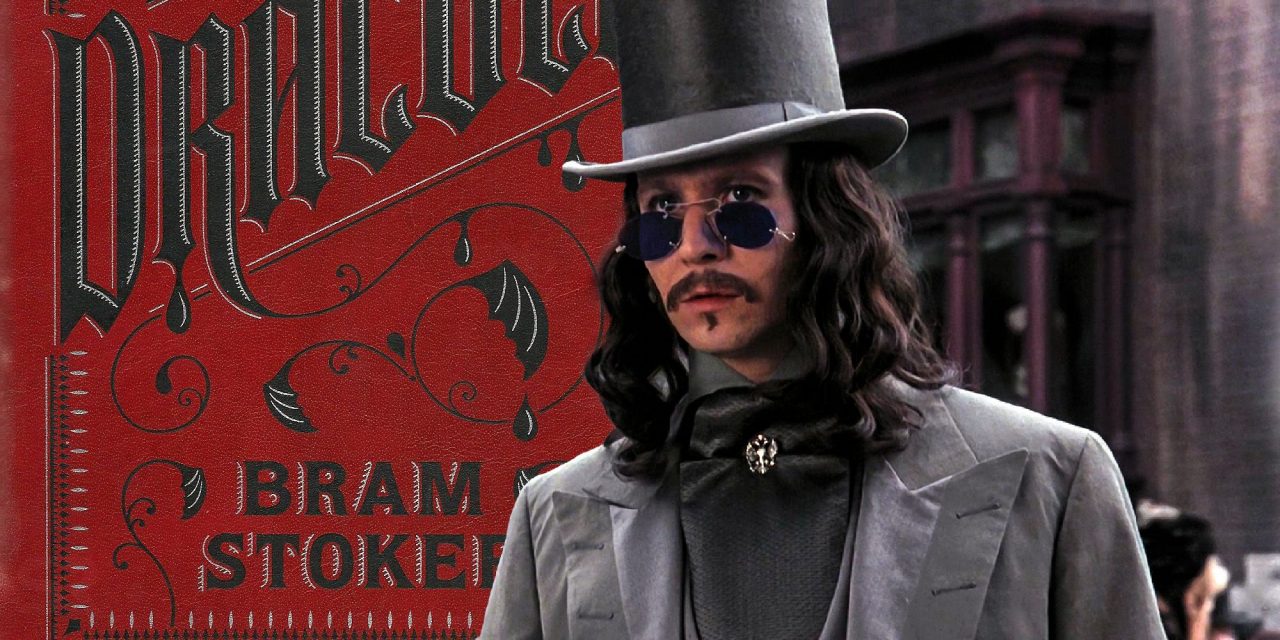
Dracula stills © Columbia Pictures 1992
Reason versus the Unknown
I’d like to briefly discuss one of the most important scenes of the 2024 Nosferatu, regarding the relationship between science and ‘occult philosophy’. Doctor Sievers escorts Friedrich Harding to the study of Professor Albin Eberhart von Franz, so that they might request his expertise in diagnosing the enigmatic illness affecting Ellen Hutter – the true source of which is Orlok’s supernatural power. Sievers informs Harding that von Franz (played by the versatile Willem Dafoe) is a contentious figure who was dismissed from his university due to his preoccupation with the occult. Indeed, von Franz’s attic apartment, filled with books, unusual artifacts, and esoteric charts, might be regarded as a nineteenth century interpretation of Faust’s study. When von Franz mutters, “Hermes will not render my black sulfur gold this evening,” Harding responds “We shall not trouble you further”, suggesting that he sees the alchemical reference as a symptom of mental derangement. Nonetheless, Sievers firmly tells von Franz, “Nolite dare sanctum canibus” – Latin for “Do not give what is sacred to the dogs.” The Professor responds, “Neque mittatis margaritas vestras ante porcos” – “Nor cast your pearls before swine.” These Biblical phrases (both from Matthew 7:6), exchanged ritualistically, imply that both psychiatrists may belong to the same esoteric society, or at least have the same intellectual leanings, adding unfathomed depth to the sober Sievers.
This scene provides some insight into our own era, shaped by the scientific revolution. From the perspective of scientism (which is an ism because it asserts that ‘science is the only way to knowledge’), any idea of the supernatural is viewed as a form of superstition, and furthermore, is not considered ‘sane’. The language and mindset of alchemy and other forms of magic are seen as prescientific, premodern, and outdated. However, from the perspective of esotericism – which asserts that there can be another, hidden way – scientism can be reductive and blinding. In particular, we developed a rational worldview by disregarding feelings, intuition, and imagination.
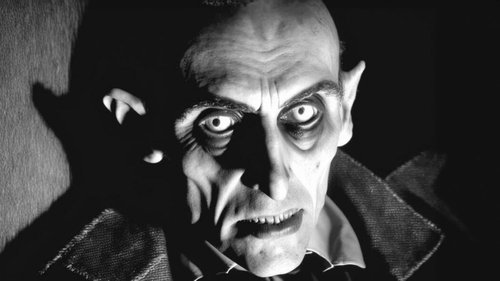
Romantic (Dracula 1992) versus Expressionist (Nosferatu 1922) vampires
Nosferatu: A Symphony of Horror 1922
In another scene, Harding asserts that a hypothesis lacking scientific basis – such as the existence of a blood-sucking monster like Orlok – is inadmissible: “Do not tell me you believe in such medieval deviltry?” Von Franz’s answer mirrors Carl Jung’s response when asked about the existence of God: “I do not believe. I know.” The psychiatrist/philosopher adds, “I have seen things in this world that would have made Isaac Newton crawl back into his mother’s womb.” (Ironically, however, that renowned physicist and mathematician, who played such a pivotal role in the scientific revolution of the seventeenth century, was also deeply engaged in the study of Kabbalah and alchemy.) “We have not become so much enlightened as we have been blinded by the gaseous light of science,” continues von Franz, claiming – again in a Jungian fashion – that the Enlightenment may have been an ‘Endarkenment’. As Jung himself writes:
“And so we can draw a parallel: just as in me, a single individual, the darkness calls forth a helpful light, so it does in the psychic life of a people. In the crowds that poured into Notre Dame, bent on destruction, dark and nameless forces were at work that swept the individual off his feet; these forces worked also upon Anquetil-Duperron and provoked an answer which has come down in history and speaks to us through the mouths of Schopenhauer and Nietzsche.”
(C.W. Jung. From a conference in 1928)
The translation of the Hindu Upanishads by Abraham Anquetil-Duperron (1731-1805) influenced both Schopenhauer’s pessimistic philosophy of the will and Nietzsche’s relativistic genealogy of morality. Both fed into Freud’s theory of the unconscious, and Jung’s subsequent development of the concept of the collective unconscious. In the movie von Franz asserts, like Jung, that we should avoid excessive rationalism. Nietzsche implied something similar in The Gay Science (1882), when he wrote: “For the longest time, conscious thought was considered thought itself.” Had we remained confined to the domain of pure reason and conscious thought, it is unlikely that all the philosophy spanning from Schopenhauer to psychoanalysis and existentialism would have emerged. Not all knowledge is reducible to reason, just as the Romantics might claim.
Von Franz also remarks, “To tame darkness, we must face and know it as we know ourselves” This highlights the Jungian theme of accepting our shadow side. And indeed the final scene of Eggers’ Nosferatu shows the Jungian clash between shadow and anima. The end of the film also celebrates the balance between libido (the drive toward life and love) and mortido (the drive toward death and destruction), or eros and thanatos in Freud’s terminology. In this scene, Ellen is both Orlok’s destroyer and his savior. Orlok dies in Ellen’s arms, feasting on her until their shared annihilation. As the German Expressionist poet Georg Heym (1887-1912) wrote in his The Death of Lovers: “Death is gentle, granting us what we’ve never had / A home…”
© Dr Ștefan Bolea 2026
Ștefan Bolea is the author of Internal Conflict in Nineteenth-Century Literature (Rowman & Littlefield, 2020). He earned two PhDs, in Philosophy and in Literature, from the University of Cluj-Napoca, Romania. He is editor-in-chief of the magazine EgoPHobia: www.egophobia.ro.
Advertisement
