


Your complimentary articles
You’ve read one of your two complimentary articles for this month. To have complete access to the thousands of philosophy articles on this site, please
You can register for a free account to have four complimentary articles per month. We will occasionally email you a newsletter, from which you can unsubscribe at any time. We do not sell personal data or otherwise disclose personal information to other organisations.
Classics
Star Maker by Olaf Stapledon
Brian Johns goes cosmic.
The 1937 science fiction novel Star Maker was written by philosophy professor Olaf Stapledon in the dark days as Europe awaited the onslaught of Nazi Germany. This casts a shadow over the whole book.
Arthur C. Clarke called the novel “probably the most powerful work of imagination ever written” and it can be found today in the Science Fiction Masterworks series, but to me it stands as a metaphysics fiction masterwork. Cosmic in its scope, Star Maker sets out the cause, evolution, history and meaning of life, including beyond our universe, including discussing the roles of God and religion. Stapledon’s narrator projects his mind across the whole of space and time, observing the evolution and death of galaxies, stars, and planets, and of the intelligence that emerges. He investigates the interaction and conflict between intelligent lifeforms through dialectics of love and hate. The tour de force conclusion witnesses the ultimate conjunction between the creator (the titular Star Maker), the created living cosmos, and the absolute spirit which ensues from their union.
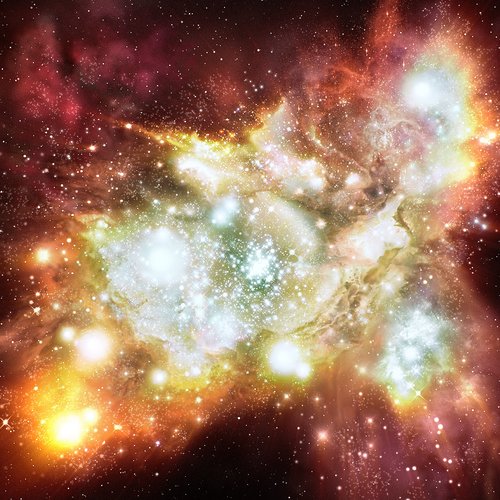
Lynx Arc Star-Formation Region © ESA, NASA, Robert A.E. Fosbury 2018 Public Domain
Although a conscientious objector, Stapledon served as an ambulance driver in the First World War, and was awarded the Croix de Guerre for gallantry. His experiences influenced his pacifist beliefs. After the war, he lectured in philosophy at the University of Liverpool. He published several academic works, but wrote fiction to try to influence a wider public. Star Maker provides a social and political commentary on humanity in the 1930s. Except, reading it now, it also paints a frighteningly real picture of our world today. Or perhaps it shows that the human condition never really changes. Star Maker is also uncannily prescient in its scientific predictions, and it’s viewed by some as an early exposition of transhumanism. It even foretells the climate crisis.
Unsurprisingly given the period in which Star Maker was written, Stapledon makes clear his hostility to authoritarianism. Early in the narrative, he also questions whether love is the essence of humanity, and whether that proves that love is the ground of the cosmos. He asks whether man has a purpose, and if so, is it love, worship, wisdom, or power?
Stapledon answers his own question in a reflection on a parallel humanity, where, despite opposition or indifference from science, religion and politics, isolated groups pursue a “world-wide community of awakened and intelligently creative persons, related by mutual insight and respect”. As with other concepts in the book, this echoes the philosophy of John Macmurray (1891-1976), whose pacifism was similarly influenced by his experience as an ambulance driver in the 1914-18 war.
Some of the cosmological concepts explored in Star Maker were ahead of the physics of Stapledon’s time, but have subsequently become mainstream, such as the idea of many universes. Stapledon’s exposition of multiverses has a pedigree going back to Ancient Greece. However, his description of how “in one inconceivably complex cosmos, whenever a creature was faced with several possible courses of action, it took them all, thereby creating… an infinity of distinct universes exfoliated from every moment of every temporal sequence” predates the formal hypothesis of a quantum ‘many worlds’ theory by twenty years. Indeed, his myth conceives the Star Maker as the creator of increasingly complex universes, each with different logical, physical, biological and psychological potentials, including variations on fundamental concepts such as geometry, space-time, gravity, nuclear forces, entropy and free will. For example, he envisages universes which are musical rather than spatial, with tonal creatures moving in the dimensions of pitch. He also speculates on the apparent expansion of the universe as being an illusion due to the actual shrinkage of its physical components. As each universe dies, the Star Maker creates a replacement.
In an evocation of, for example, A.N. Whitehead’s organic metaphysics, the Star Maker originates our universe with a substance of pure potentiality, in which all parts reciprocally pervade and influence all others. The whole is the sum of its parts, but each part is an all-pervading determination of the whole (perhaps like a hologram).
In the novel, early life exists in nebulae and stars themselves, long before planetary creatures evolve. Eventually life starts to pursue its own purposes, leading to conflict. On a more optimistic note, physical progress is replaced by mental advancement, bringing a utopia of pan-galactic peace. Stapledon also explores the idea of psychic ‘interpenetration’ of pairs of minds leading to a third ‘more penetrating’ mind, and of symbiotic intelligent races which start off simply working together, but eventually evolve mental union.
Given Stapledon’s interest in Marx, it would be easy to view his analysis of the political and economic conditions of developed planets as an attack on capitalism. However, the conditions also reflect experiences of communist societies. It’s therefore more a critical analysis of all political and economic hierarchies. Stapledon characterised the main problems with human society as he saw them in the 1930s, but they bear an uncanny resemblance to today’s world:
• All chief means of production are controlled by a small minority for private profit, with failed economies leading to unemployment, poverty, disorder, and repression for the rest.
• Competition for resources and markets builds on historic fear and jingoistic pride to threaten universal armageddon between older commercial empires and newly powerful states.
• Better health and prolongation of youth amongst the wealthy, but degenerative diseases increasing, in particular, mental health problems.
• Improved communications link all peoples, but recent scientific discoveries contain no truly great new ideas, just world-changing new applications.
• Even in democracies people begin to welcome the ruthlessness and brutish violence of the populist ‘god-sent hero’, with criticism of the tyrant either met with blind rage or not heard at all.
Similarly, Stapledon’s critique of religion across the cosmos strikes an unsettling chord today. Although religion progresses on every developed planet from tribal gods to monotheism, there is no agreement as to which God is the real one, and the general attitude to religion is one of ‘blasphemous commercialism’. Atheism and agnosticism follow religion. Indeed, one idea explored extensively in Star Maker is the cyclically fluctuating worldview of the dominant species on any planet. This might be most simply characterised as the difference between a spiritualistic and a materialistic outlook, which as often as not becomes the cause of conflict (as arguably it continues to do so on our planet). This conflict was explored in PN 164 in a review of the approach of Iain McGilchrist. McGilchrist’s study of differences in perspective between the brain’s right and left hemispheres led him to conclude that variations in the degree of influence of each hemisphere could account for exactly such a difference in worldview between individuals. Further, McGilchrist argues that the preponderance of each hemisphere’s influence varies within cultures over time. (Indeed, it’s an interesting question as to whether we’re witnessing such a ‘brain hemisphere revolution’ today.)
Stapledon explores the change in cultural outlook through several examples. For instance, the ‘Other Men’ (a barely concealed description of humanity) are subject to fluctuations of nature and mental vigour, with brilliance and sensibility in a never-ending cycle against injustice and corruption. It’s clear that Stapledon sees this as part of the trajectory of humanity, which may, but is not guaranteed to, lead to his hoped – for ‘true community’.
Stapledon is sometimes considered a predecessor of transhumanism, with Star Maker seen to contain early transhumanist ideas. For instance, he describes how genetic research is employed on some planets to evolve superior humans who eventually take over the planet. Stapledon even references the now discredited study of eugenics, which he describes as having the potential to improve memory and intelligence through selective breeding, although that potential is undermined by almost inevitable abuse. Given the recently overheard whispered conversation between Presidents Putin and Xi, Stapledon’s reference to the use of eugenics “to expand the length of life by large multiples” has a chilling modern echo.
Probably the clearest example of Stapledon’s scientific prescience, is his description of megastructures orbiting stars. In 1960, the physicist Freeman Dyson speculated that a highly developed civilisation would build structures encircling their stars to harness a significant proportion of the stellar energy to power space exploration, the energy on any individual planet being insufficient. These structures were subsequently termed ‘Dyson spheres’. However, Dyson later acknowledged that he had been inspired by exactly the same idea being described in Star Maker in 1937. Many other examples of Stapledon’s ability to predict future scientific developments are scattered throughout the novel. He describes forms of solar and wind power which are now familiar, but were non-existent in the 1930s. Similarly, he anticipates modern communication technologies, including pocket radios receiving not just music but other sensory pleasures.
Star Maker was described by Brian Aldiss, himself a giant of science fiction, as “the most wonderful novel I have ever read.” Certainly, its scope exceeds probably any other novel. Its place as a classic of science fiction is assured; but I believe the philosophical principles explored throughout it make it an entertaining, as well as enlightening, philosophical read. That’s not something you come across every day.
© Brian Johns 2026
Brian Johns is a retired chartered engineer living in Hertfordshire.
Advertisement
