


Your complimentary articles
You’ve read one of your two complimentary articles for this month. To have complete access to the thousands of philosophy articles on this site, please
You can register for a free account to have four complimentary articles per month. We will occasionally email you a newsletter, from which you can unsubscribe at any time. We do not sell personal data or otherwise disclose personal information to other organisations.
Life & Death
A Critique of Antinatalism
Deniz Kose thinks there’s good reasons to want human life to continue.
Antinatalism is the idea that bringing new human life into existence is inherently unethical. The core argument of its advocates, who have included the philosophers David Benatar, Emil Cioran and Peter Wessel Zapffe, is simple, yet radical: since life inevitably entails suffering, and since no one consents to being born, it is morally wrong to impose life on someone. However, beneath this surface-level reasoning lies a more complex philosophical and psychological posture – one shaped not just by ethical considerations but by deep-seated views on suffering, authenticity, pleasure, and even childhood emotional development. Here I want to critique antinatalism by examining its inconsistencies, its emotional roots, and its inability to accept life’s inherent ambivalence.
The Contradictions of ‘No Engineered Bliss’
Curiously, antinatalists often reject not only the imperfect world in which we live, but even hypothetical utopias. Consider a world where disease, war, poverty, and death are eradicated – where beings live in peace, comfort, and joy. In this brave new world, physical want is no more, social engineering avoids the perils of emotional pain, and any momentary sadness can be eliminated with a pill. One might expect that such a reality would make procreation ethically permissible. Not according to Benatar. Why? Because no amount of good can retroactively justify the initial imposition of existence. The child didn’t choose to be born, even into a paradise. And if there is any risk of suffering – no matter how small – then existence itself is tainted.
This stance reveals a deeper contradiction. If suffering is the root harm, and pleasure its moral opposite, then surely a guaranteed life of joy without suffering should satisfy the antinatalists’ ethical requirements? Yet many antinatalists dismiss such engineered bliss as inauthentic or false, as if chemically-induced happiness or simulated utopias or other such engineered bliss is morally or spiritually deficient. This introduces a paradox: antinatalists argue that life is too painful to be worth living, but also that some forms of pleasure are too shallow to count as worthwhile. In doing so, they set the ethical goalposts forever out of reach. Moreover, any claim that joy is just a trick of brain chemistry (dopamine, oxytocin, serotonin etc) ignores the basic fact that all experiences – including pain – are mediated by brain chemistry. To claim that joy is invalid because it is neurochemical while accepting suffering as meaningful is deeply inconsistent. Neurochemistry doesn’t only manipulate us, it constitutes us. It’s not an external deceiver, but is the very substrate through which we experience reality. To dismiss joy because of its use of a biological mechanism is like dismissing vision because it involves light hitting the retina.
Benatar argues that pleasure is the removal or absence of pain, and that pain/suffering is our default state. We are constantly in a state of lack, and when that lack is temporarily filled, we feel what we interpret as happiness. But this denies the complexity of human experience. For instance, someone might acquire a dog and feel deep joy. Before owning the dog, they weren’t suffering from a lack of companionship; yet the dog brings an unforeseen happiness. It is an additive joy, not merely the alleviation of pain.
Antinatalists might counter that all pleasure is simply filling an unrecognised void. Benatar believes joy is just a cognitive bias but somehow painful emotions are not biases. Similarly Cioran believes pleasure to be a shallow lie and suffering to be the ultimate truth, yet that interpretation is unfalsifiable and unjustifiably reductive. If every joy is interpreted as relief from a previously unknown suffering, then no experience can ever count as genuinely positive, or as having its own intrinsic value. This is merely a kind of ‘epistemic pessimism’, where negative interpretations are always favored regardless of the evidence. It becomes clear that what’s being rejected is not just suffering, but existence itself. It’s as if existence is seen as an oppressive structure that imposes harm by its very nature. This metaphysical framing elevates antinatalism from a personal ethical choice to a cosmic indictment, where existing is not just flawed but fundamentally unjust. The enemy is not merely suffering or risk, but the very fact of being.
But just because suffering exists does not mean life is inherently bad. To illustrate this, imagine you own a house in the wilderness – a beautiful, natural place full of life. One day, you find mosquitoes inside your house. Would you then wish you never had the house just because of the mosquitoes and their bites?
This analogy highlights how antinatalist thinking can be a disproportionate response to suffering. It treats the presence of pain or hardship as a reason to reject existence entirely, much like rejecting the notion that we should have houses simply because mosquitoes exist, sometimes bite, and could possibly enter those houses. Suffering is part of life; but it does not invalidate the value or beauty of life itself.
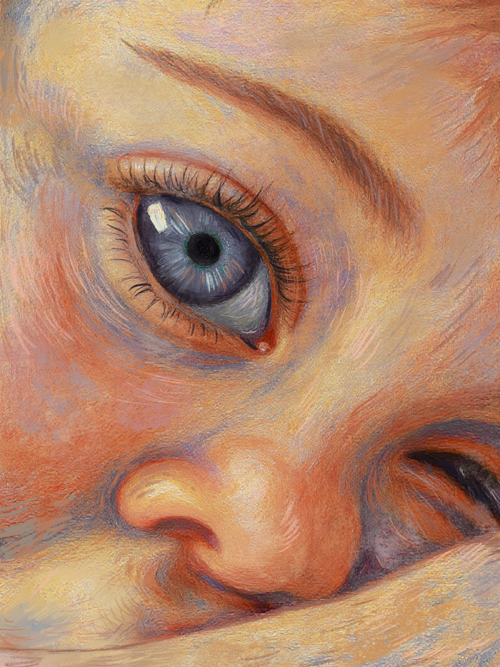
Image © Cecilia Mou 2026 Instagram @moucecilia
Ambivalence & the Psychology of Antinatalism
This brings us to a deeper psychological perspective. Melanie Klein (1882-1960), a foundational psychoanalyst, argued that emotional maturity involves the capacity to live with ambivalence – to recognize that people and experiences are rarely purely good or bad. In her framework, psychological development moves from the paranoid-schizoid position, which splits the world into good vs evil, to the depressive position, which accepts that love and loss, pleasure and pain, are often entwined. Antinatalism, particularly in its absolutist forms, can be interpreted as a refusal to accept such ambivalence. Peter Zapffe believed the human race evolutionarily doomed due to its overly-developed self-awareness. Cioran wrote: “Not to be born is undoubtedly the best plan of all” (The Trouble with Being Born, 1973). There’s no room here for duality, no space for joy that coexists with pain, or beauty that emerges through struggle. This mindset mirrors the paranoid-schizoid absolutism Klein described: suffering contaminates all existence, so the entire phenomenon of life must be rejected. These days, a psychologist might say that the antinatalist stance reflects obsessive-compulsive tendencies – a relentless striving for certainty, control, and perfection. Antinatalists often demand an ideal where all suffering and risk are eliminated, and conclude that this state of zero suffering can only be reached when humanity goes extinct. This fixation with absolute harm reduction can be seen as a compulsion to reach a hypothetical perfect state. However, such a position is difficult for most non-obsessive people to accept because it demands an extreme rigid framework that denies life’s inherent complexity and ambiguity. It asks individuals to embrace a perfectionist position that many neither seek nor find meaningful. This does not mean that antinatalists are psychologically immature or impaired, but it does suggest that their worldview may be shaped by an intolerance for uncertainty – which is a trait not universally shared. After all, if the experience of suffering were both truly overwhelming and universal, why do so many people still choose to bring life into the world? Are these individuals less intelligent or enlightened? Or does the widespread behavior of having children suggest that the assumptions underlying antinatalism may not be as self-evident as its proponents claim?
Fromm’s Human Connection
Erich Fromm (1900-1980), a prominent social psychologist and philosopher, emphasized that human beings are fundamentally social creatures whose well-being depends on meaningful connection. Zapffe believed consciousness results in isolation which results in despair, whereas Fromm argued that the acknowledgement of the pain of isolation leads us to seek connections that can enrich our lives. Without the pain of isolation people would not seek love and connection, which adds value to life.
This framework possibly sheds light on a psychological dimension of antinatalist thought. If an individual is emotionally or existentially trapped in a state of isolation, they may perceive life as overwhelmingly painful and alienating. From this vantage point, existence appears not just risky, but inherently bleak, because the alleviating balm of connection feels inaccessible. Antinatalists might, therefore, be expressing not only a philosophical objection to suffering, but also a lived experience of alienation. They may be stuck in what Fromm described as the 'escape from freedom’, where the solitude of self-awareness feels like a prison rather than a foundation for growth. If life’s beauty hinges on overcoming isolation through connection, then the antinatalist rejection of existence could reflect a failure or refusal to bridge the fundamental human divide. In this light, antinatalism becomes less a universal ethical decree and more a testimony to the psychological pain of disconnectedness. Recognizing this can open space for compassion and dialogue, and also for the possibility that fostering connection might transform how existence is perceived.
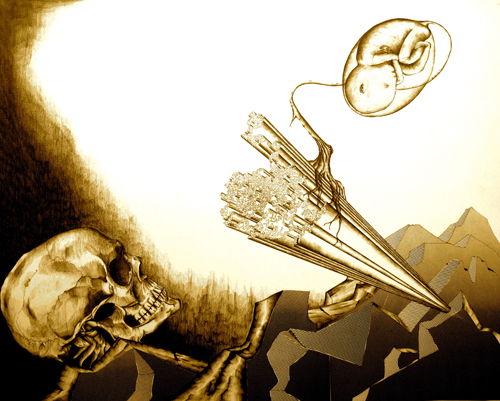
Birth & Death by Paul Gregory
A Philosophical Cop-Out?
Another crucial flaw in antinatalist thought is its lack of vision for improvement. Cioran saw existence as a catastrophic mistake and non-existence as the perfect solution to suffering. But this is a cop-out, a refusal to engage with the hard, gradual work of making life better. Consider the history of human health. It is replete with diseases once fatal, infections that could claim lives within days, and injuries that left people powerless. Before the advent of antibiotics, vaccines, and modern medicine, even what we now consider minor infections could be deadly. Yet countless illnesses that were once killers are now treatable or preventable. Why did humans bother to develop these cures and medical technologies if life were truly unbearable? If life were inherently meaningless, why would so many individuals dedicate themselves to its betterment? Was it not out of a fundamental desire to preserve, extend, and improve life? Indeed, even the average human lifespan has dramatically increased over the centuries precisely because of this tireless effort to reduce suffering and prolong existence. This is the human impulse at its best: to confront suffering, not retreat from it. Progress is slow, incomplete, and imperfect – but it is achievable. To declare that suffering renders life unworthy is therefore to deny the transformative power of human creativity, care, and resilience. Antinatalism closes the door to all this effort.
Moreover, even when antinatalists reference Buddhism to support their claim that ‘life is suffering’, they overlook a crucial point. Buddhism sees suffering not as a cosmic indictment of existence, but as a challenge rooted in the untrained mind – a challenge that can be addressed through cultivating mindfulness, compassion, and spiritual discipline. Where antinatalism sees a dead end, Buddhism proposes a path toward transcendence. This shows that rejecting life outright isn’t the only response to pervasive suffering – it is merely one among many, and not necessarily the wisest.
Conclusion
Antinatalism raises serious ethical concerns about suffering and the responsibilities of parenthood. These are not trivial questions. But the antinatalist position, as often expressed, collapses under its own absolutism. It demands a kind of perfection – a life without pain – but rejects or ignores the very pleasures that might make life worthwhile even in the midst of pain. It dismisses joy as a false positive, efforts to induce pleasure as chemically mediated, and meaning as contingent. But in doing so, it reveals a deeper discomfort, with the very texture of life: its ambivalence, its contradictions, and its refusal to be all good or all bad. A more robust (and honest) philosophy of life would accept this ambivalence, not flee from it. It would recognize that joy can emerge unbidden, that love is sometimes worth the grief it entails, and that the richness of existence lies in its imperfection. To live is to risk, yes – but it is also to discover, to connect, to create, and to care.
From the Buddhist perspective, suffering arises not from existence itself, but from our untrained minds’ attachments, and the Buddhist path to liberation is not rejection of life, but its transformation through mindfulness and compassion. Similarly, Erich Fromm reminds us that isolated existence is unbearable because we are sentient social beings. For such beings it is the experience of connection – a profound oneness with others – that makes life meaningful and beautiful. So perhaps antinatalists are so because they’re caught in a form of existential isolation, mistaking their painful state for the totality of life’s meaning. Yet it is precisely through forging connection that life’s ambivalence may become bearable, even worthwhile. And perhaps that, in itself, is enough justification to continue.
© Deniz Kose 2026
Deniz Kose is a psychology graduate with an interest in psychoanalysis, living in the UK.
Advertisement
