


Your complimentary articles
You’ve read one of your two complimentary articles for this month. To have complete access to the thousands of philosophy articles on this site, please
You can register for a free account to have four complimentary articles per month. We will occasionally email you a newsletter, from which you can unsubscribe at any time. We do not sell personal data or otherwise disclose personal information to other organisations.
Life & Death
Making Omelettes & A Future Like Ours
Jimmy Alfonso Licon wonders what’s wrong with killing – first chickens, then humans.
Imagine preparing breakfast with fertilized chicken eggs. I don’t mean the unfertilized eggs you find in the supermarket cartons, but eggs that under ordinary conditions would develop into chickens. Perhaps the chicken eggs you might find on a small working farm. You crack the eggs, whisk them with milk and seasoning, cook them, and eat them. Did you do something morally wrong? At first glance, it might seem that the answer is no, especially if the chickens who produced the eggs were well-treated. And yet, if the wrongness of killing consists fundamentally in depriving an individual of a future, then something morally serious has just occurred in that skillet. Each fertilized egg was the potential beginning of the extended life of a chicken that would likely have included social interaction, dust bathing, sunlight, an aversion to pain, and other goods that populate chicken life. Each fertilized egg stood at the threshold of experiences that, if uninterrupted, would have constituted a life. To destroy the egg is to foreclose that future, and so is morally wrong.
This conclusion may sound odd – and it is. Yet it parallels one of the most influential contemporary accounts of why killing is wrong. This is the ‘future like ours’ anti-abortion argument of American ethicist Don Marquis (1935-2022). Marquis’s central thesis is that what makes killing in general morally wrong is the deprivation of a valuable future that contains experiences, activities, projects, enjoyments, and other goods that would otherwise have constituted that individual’s life. Death is tragic because it eliminates everything that would have followed in life.
The appeal of this account lies in its breadth in explaining why killing a fetus is wrong despite its limited development; why killing the severely cognitively impaired is wrong even when they lack significant rational agency; and even why the painless, instantaneous killing of a sentient animal is a grave moral wrong. In each case, what’s lost is an entire future of goods (that is, good experiences and events). And importantly, Marquis’s argument deliberately doesn’t hinge on presently exercisable capacities like rationality or self-awareness: the moral work is done by the existence of a future that would have been valuable to the being whose future it would have been. If an entity stands in relation to such a future, then depriving it of that future constitutes a serious harm.
This argument resists confinement, in the sense that if the possession of a potential valuable experiential future grounds the wrongness of killing, then wherever such futures exist, so too does the corresponding moral protection. So the principle cannot be limited to humans without being arbitrary, since other creatures have lives with future goods too. Consider the ordinary chicken. Chickens are sentient creatures – they experience sensations, including pleasure and pain. They also engage in exploratory behavior, form social hierarchies, dust-bathe, forage, and respond to the nuances of their environment. Whatever the relative richness of their mental lives, they evidently have an experiential point of view, so their futures potentially contain goods that are valuable to them, even if they cannot articulate their value. To kill a chicken is to eliminate those future goods. So if Marquis’s ‘deprivation’ account is correct, then killing chickens, at least when not necessary for our survival, appears to be an example of the wrong his theory identifies. The chicken’s future may not be as rich or complex as ours, but the argument requires only that it have value to the being whose future it is.
Suppose then that we accept this implication of the future-like-ours argument: that eating fertilised eggs, or chickens, becomes morally problematic because it deprives them of their valuable futures. So far, the reasoning is severe but coherent. The principle has been granted broader jurisdiction, and it has exercised it predictably. A fertilized chicken egg, normally speaking, if undestroyed, will mature into a sentient chicken with exactly the future just described. The egg stands at the start of a biological trajectory that includes all the modest goods characteristic of avian life. If what makes killing wrong is depriving an individual of its valuable future, then destroying the fertilized egg appears to engage the same moral mechanism.
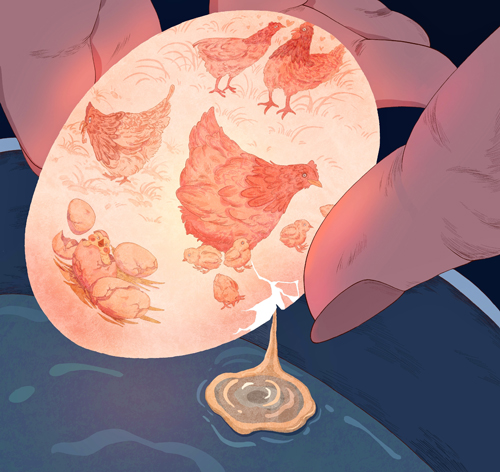
A Life Thwarted by Melanie Wu
Image © Melanie Wu 2026. Please visit her Instagram: @melaniewu_Illu
Responses
One possible response is to accept the implication. On such a view, destroying fertilized chicken eggs is indeed morally grave. The breakfast table becomes a crime scene. Each omelette prepared from fertilized eggs represents multiple foreclosed futures of chicken lives that will now never unfold. This follows from Marquis’s future-like-ours principle. Yet, many who are persuaded by his deprivation account in the context of abortion do not regard the destruction of fertilized chicken eggs as morally comparable to homicide. The disparity between their intuitions in these cases suggests that something more than the mere possession of a future is shaping their moral judgments.
Perhaps, then, what matters is actually a future of sufficient richness, complexity, or narrative unity? But this move introduces a hierarchy of psychological sophistication – which itself implies that humans who are severely cognitive disabled (for example) have less of a moral claim to protection than other humans. Not only that, but if the richness of experience becomes morally decisive, this imperils the moral standing of infants as well. Yet these were the very cases that Marquis’s appeal to ‘a future like ours’ was designed to morally secure.
Alternatively, someone might insist that there must already be a subject of experience to whom the future is meaningfully related for the argument to morally count, and a fertilized egg still lacking any consciousness lacks a present standpoint from which it can be wronged. Yet the deprivation account was crafted to explain why not-yet-conscious fetuses and even temporarily unconscious individuals are wronged by being killed. The original point of Marquis’s argument, after all, was to show why abortion is wrong. But if present consciousness is not required in this case, why should it be required in the chicken and egg case?
By identifying the harm of killing solely with the loss of potential future goods, the deprivation account indeed captures something morally profound, without sufficiently stating the relation an entity must bear to that future for its loss to constitute a grave wrong. The omelette from the start of the article, then, functions as a test case. One begins with a principle that will strike many as reasonable – namely that killing is wrong because it deprives individuals of valuable futures. Once one accepts that chickens have such futures and that fertilized chicken eggs will eventually become chickens, the conclusion that eating fertilized eggs is wrong seemingly follows with logical inevitability. Conversely, if eating fertilized eggs doesn’t seem morally wrong in and of itself, it would correspondingly seem there is either something wrong with applying the future like ours principle to chicken eggs, or that the principle itself is incomplete.
© Dr Jimmy Alfonso Licon 2026
Jimmy Alfonso Licon is an Assistant Teaching Professor in Philosophy at Arizona State University.
Advertisement
