


Your complimentary articles
You’ve read one of your two complimentary articles for this month. To have complete access to the thousands of philosophy articles on this site, please
You can register for a free account to have four complimentary articles per month. We will occasionally email you a newsletter, from which you can unsubscribe at any time. We do not sell personal data or otherwise disclose personal information to other organisations.
Life & Death
Death as Life’s Picture Frame
Joshua Clements puts us in the picture.
In his book How We Die (1995), medical doctor Sherwin Nuland noted that the people who see death the most – such as doctors and nurses – rarely write about it, and the people who rarely see it write about it the most. He listed poets, essayists, wags, and wise men in the latter group. I admit that I fall into this group, although I am not a wise man, and I am unsure what a wag is. Nuland also noted that a mythology surrounds death, which is meant to disarm the fear of the event. This myth allows us to combine “grace with a sense of closure.” It is the sense of closure that I would like to discuss here. I will look at two perspectives on death to offer insight – those of the Roman stoic philosopher Epictetus (c.50-c.138), and of Albert Camus (1913-1960), the Algerian existentialist.
The Art of Dying
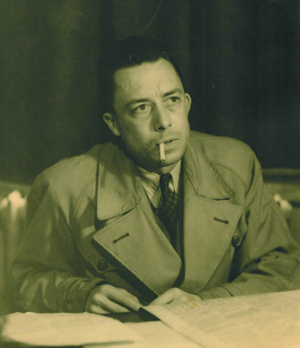
“Here’s looking at you, kid” – Albert Camus
Corey Anton wrote in his 2011 book Communication Uncovered, “Death is not simply a future event that will one day come to pass, as if our only possible relation to it is anticipation. Death is right here right now, life’s picture frame… All living things die, but awareness of death is the pre-condition for life’s meaningfulness.”
Anton’s inspiration for the idea of death being a ‘picture frame’ for life came from anthropologist and social scientist Gregory Bateson. In his essay ‘A Theory of Play and Fantasy’ (1955), Bateson suggested that we have psychological frames that help focus our attention. He wrote, “The frame around a picture, if we consider this frame as a message intended to order or organize the perception of the viewer, says, ‘Attend to what is within and do not attend to what is outside’.” In the same way, bearing our end in mind offers us a way to make meaning from the past – what we have done; the present – what we are currently doing; and the future – what we have yet to do.
For much of human history, ars moriendi, the art of dying, was a widespread concept. Ars moriendi meant human beings accepting their fate, whether it was in fealty to Fortune (like Boethius) or to God (see for instance Job 1:21: “The LORD gave and the LORD has taken away; may the name of the LORD be praised”, NIV). Nowadays we are less concerned with dying well, and more concerned with saving and prolonging life. Yet even though many of our ancestors accepted death as part of life, Elizabeth Kübler-Ross suggested in On Death and Dying (1969) that death has always, throughout human history, been seen as distasteful. The Hebrews were typical of ancient cultures in treating a dead body as unclean (see for instance Numbers 19:11). Often, Kübler-Ross argued, we think death is something that happens to others but which is not possible for ourselves. But as we age, we realize we are powerless to stop death, even if we can stave it off for a time with medicine and care. Kübler-Ross submitted that paradoxically the more science and medicine advances, the more we seem to fear death.
In my opinion, even now we often see death as an undignified event. But that’s an unhealthy perception. Perhaps there is something intrinsically valuable to death. In an essay titled ‘The Meaning and Value of Death’ (2002), Ira Byock showed that the Western world rarely searches for meaning (that is, purpose) in death, instead seeking a causal explanation for it, such as people dying due to their dietary habits or carelessness. However, even were those people to lead admirably healthy lives and survive whatever high-risk activities they undertake, they would still eventually meet death. Borrowing from and building upon Anton’s work, I want to argue that death gives life meaning precisely by becoming life’s picture frame, or as we might say, by giving focus to life. But why not use any of the other metaphors surrounding death to describe death?
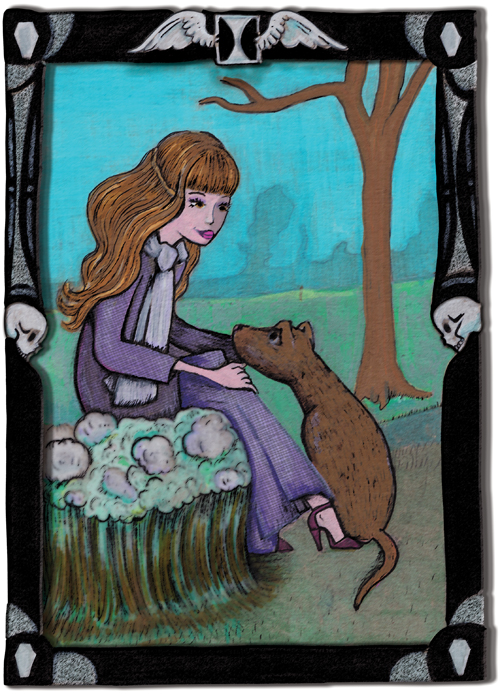
Image © Susan Auletta 2026 Please visit instagram.com/sm_Auletta/
Metaphors for Death
In their book Metaphors We Live By (1980), George Lakoff and Mark Johnson illustrated that metaphors create conceptual systems that help us define our realities. So the metaphors we adopt affect our perceptions of the world. Jeff Mason suggested in his essay ‘Death and Its Concept’ (2011) that when we imagine what death is like, “no picture comes to mind” in the way that, for instance, the concept of a horse links to experiences of actual horses. No one can recall the object of their death experience, even if they hazily remember a ‘near-death’ one. These are not the same thing. Since death is an abstraction – there’s no concrete object ‘death’ – we must approach it using metaphors.
In his article ‘The Semantics of Death and Dying: Metaphors and Mortality’ (1997), James Sexton noted that death metaphors are culturally constructed and reinforced. Sexton also noted that the discussion of death is often taboo, and that we often substitute euphemisms for the word ‘death’ to remove its sting; for instance “I’m sorry for your loss” or “she passed away”, alluding to people no longer being present, but without the clear designation of where they went. Meanwhile, ‘rest’ (as in ‘laid to rest’) implies that they have simply gone to sleep. (This last metaphor may be problematic for children when a parent tells them that grandmother was “laid to rest” or has “gone to sleep”, but then add that the children must take a nap or go to bed.) Sexton showed how death metaphors frame our way of seeing the event. But he issued a caveat, stating, “Metaphors as tools may assist us in better understanding life’s turns into unknown territory. However, metaphors may also be the bandage which prevents us from exposing wounds which may on some level require attention.” Indeed, the metaphors he discussed, and many others, do not acutely address the clear end death involves. Jeff Mason came close to doing so when he used the metaphor that “Birth and death are the bookends of our lives.” Similarly to bookends, I suggest that by adopting a ‘picture frame’ metaphor, death may still seem to be unknown territory, but it may also help us see death as closure – as a boundary to life.
Boundaries & Roads
The edges of a map tell us the end of what is known and the edge of what is undiscovered. Or in some cases, these boundaries may act to simply limit what is important to the present context. In any case, the edges tell us where to begin and where to end. Maps tell us what is included and what is not.
Similarly, much of our lives are mediated by ends and edges, and biological processes necessarily involve boundaries, limits, and checkpoints. The environment is but a system of functional boundaries. Indeed, evolution is the cumulative result of what occurs within and through semi-porous boundaries (cell walls). Life, therefore, may be defined by what can be done within an experience delineated by boundaries. However, what grieves us at the end of life is generally not what we’ve done, but the myriad things we’ve left undone. Unfinished business can often leave us with regret as we grow older. But a necessary endpoint can add salience to life.
Two veins of thought especially shed light on this: the Stoicism of Epictetus and the existentialist leanings of Albert Camus (I understand Camus didn’t like being called an existentialist, but his perspective illustrates existentialism well).
The ancient Stoics often discussed death in their writings, and they typically categorized it as a ‘dispreferred’, alongside weaknesses, illnesses, and pain. Otherwise, death to the Stoics was neither good nor bad, it was merely a fact of life. What was deemed important was how an individual approached it. The stoics thought that we associate goodness or badness with events in our lives, often regardless of the realities of the event. Accordingly, it is not the event itself that is problematic, but our judgment of it. Thus Epictetus taught that “Death and pain themselves are not frightening. It’s the fear of pain and death we need to fear… So be confident about death, and caution yourself against the fear of it” (Discourses, Book II). To Epictetus, our perceptions of death are a scary mask we wear to cover up reality. He implored us to take that mask off – to not see death as a fearful thing. Borrowing from Socrates, he suggested that the fear of death is akin to a child seeing a hobgoblin or a bugbear for the first time: the creature may be harmless but its appearance shocks us because we have not seen it before. But Epictetus says that while we cannot escape death, we can escape the fear of it. The way to escape this fear is to see death for what it is – a boundary, an edge. And upon applying the Stoic concept of negative visualization – wherein a person imagines their own death – we may inoculate ourselves against the fear of death.
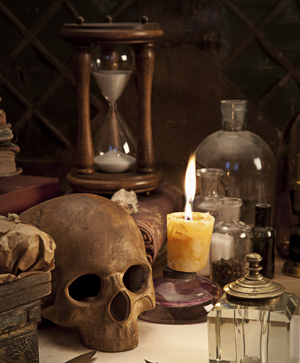
Epictetus taught that all roads to death are equal – meaning that no matter the manner of death, the outcome is the same for us all. He listed numerous ways people may meet their fate, including drowning, earthquake, illness, a weapon, etc. Incorporating this idea into the metaphor of a picture frame, the method of our death may be akin to patterns or decorations on the frame, accentuating, or grotesquely marring, the picture that lies within. Regardless of the aesthetic form, though, it is the function of the frame that matters. In this sense, all frames to life are essentially the same, just as all roads leading to death are equal.
Albert Camus held a different view of death, albeit just as noble as Epictetus’s in my opinion. Camus chose to live without appealing to an afterlife, instead seeking to live life intensely while it was available. While the Stoics promoted living life without fearing death, Camus argued that we should live without fearing eternity. He was indifferent to any future after death, thus making his search for meaning in the present an imperative. Camus opted to take eternity off the table and battle against the absurdity of life in the present, but with this comes the idea that death is the finality of everything.
For Camus, the notion of death as the end of life was an ever-present reality. (Corey Anton had similar sentiments about how non-being haunts being – how the possibility of future non-existence haunts the present existence.) Camus’ novels indicate someone who understood the randomness of death (The Plague) and the absurdity of murder (The Stranger), among other aspects. But rather than accepting a metaphysical understanding of death, Camus embraced a humanistic notion tied to the messiness of human life. Throughout his books and plays, Camus described life in all its absurdity, with death being a central theme. For example, The Plague begins with a dead rat and ends with a dead dog (never mind the many humans who perish amid the story). Or a mother’s untimely death initiates The Stranger, and an execution closes the story. These examples indicate that for Camus, death was a closure, an endpoint, without which the rest of the story would have little meaning. For Camus, death is life’s frame.
Why Adopt Death As Life’s Picture Frame?
Humans typically see things in dichotomies: light/dark, black/white, good/bad, etc. In this, death is often seen as the opposite of life. Yet according to Corey Anton’s book, How Non-Being Haunts Being (2022), life and death are not dichotomous, but a dependent hierarchy “where the former [death] is the environment for the latter [life].” He also wrote that death is a bell calling us to action, and a line in the sand forcing our hand at life. He also noted that our death does not mean the end of the world or the end of someone else’s possibilities. Rather, our death limits our personal experience, just as a frame encloses a single picture. In this way, death is not the absence of life, but an event that marks the boundaries of a life. Death, as the environment, the territory in which life exists, acts as a frame for life. Without a clearly marked end, our lives would have little meaning. It would be like looking at an endless array of activities, people, and information, and trying to find order in it. In Steps to an Ecology of Mind (1972) Gregory Bateson suggested that a picture frame “tells the viewer that he is not to use the same sort of thinking in interpreting the picture that he might use in interpreting the wallpaper outside the frame.” So without a frame, everything blends together in a meaningless mess. In this way, we need the frame to give our lives focus.
As a parting example, Jason Isbell’s song ‘If We Were Vampires’ implies that if two lovers knew they would live forever, much of their interactions would be less meaningful:
If we were vampires and death was a joke
We’d go out on the sidewalk and smoke
And laugh at all the lovers and their plans
I wouldn’t feel the need to hold your hand
Maybe time running out is a gift
I’ll work hard’til the end of my shift
And give you every second I can find
And hope it isn’t me who’s left behind
It’s knowing that this can’t go on forever
Likely one of us will have to spend some days alone
Maybe we’ll get forty years together
But one day I’ll be gone or one day you’ll be gone
And in his work on non-being haunting being, Anton wrote, “Just as one does not dance to get to the end of a song, or listen to a piece of music to get to the final beat, so, too, the meaning of life is not found at the end of life or somehow ‘after’ it, but in the living of it.” Camus agreed. Anton also wrote, “Knowledge of death is an essential aspect of existence, one that makes life meaningful.”
I understand that death as a picture frame is not a perfect metaphor, but my hope is that it offers a useful perspective on the phenomenon of death. By adopting the metaphor of death as life’s picture frame, we remove a little of death’s sting; and we change death from a decidedly negative event into something that paradoxically we cannot live truly without.
© Joshua Clements 2026
Joshua Clements thinks about talking and talks about thinking. He also blogs occasionally at thephilosophicalfighter.com.
Advertisement
