


Your complimentary articles
You’ve read one of your two complimentary articles for this month. To have complete access to the thousands of philosophy articles on this site, please
You can register for a free account to have four complimentary articles per month. We will occasionally email you a newsletter, from which you can unsubscribe at any time. We do not sell personal data or otherwise disclose personal information to other organisations.
Philosophical Haiku
Socrates (c.470-399 BCE)
by Terence Green
Question everything.
But don’t annoy gentle folk,
Lest you drink hemlock.
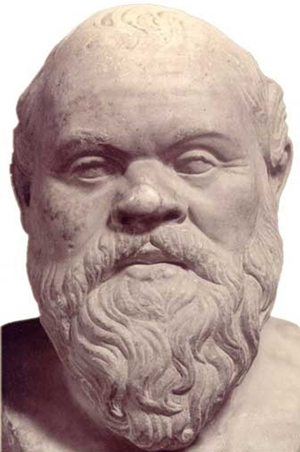
Although one of the most important of all Western philosophers, Socrates never actually wrote anything himself – partly because he was too busy wandering around the marketplace in Athens asking anyone he encountered philosophical questions. What we know of him comes to us primarily from the contemporary comic playwright Aristophanes, who lampooned him in the play Clouds, and from two younger philosophers, Plato and Xenophon, who idolised him in their dialogues. This gives rise to the ‘Socratic problem’– just who was Socrates really?
Still, despite the lack of confirmed details, we can say with some certainty that Socrates was deeply concerned with the issue of how to live an ethically good life, and that he believed we could approach the truth of the matter by questioning our most cherished assumptions about it. If we subject our beliefs to a barrage of questions, we strip from them all of our mistaken ideas, to finally reveal the truth.
That, at least, was the theory. In the end, the people of Athens grew tired of this pesky old man, seemingly without any gainful employment, who apparently spent all his time filling the heads of young men with ideas. So they did what any self-respecting citizenry would do, and arrested him on trumped-up charges of corrupting the youth and of not being sufficiently pious. Encouraged by his followers to escape from prison (they had a plan), Socrates calmly refused, superbly exhibiting the classical philosophical view that death is nothing to fear – that in fact, it’s a cure for life. Found guilty and condemned to death, he drank the hemlock and was cured.
© Terence Green 2026
Terence Green is a writer, historian, and lecturer who lives in Eastbourne, New Zealand.
Advertisement
