


Your complimentary articles
You’ve read one of your two complimentary articles for this month. To have complete access to the thousands of philosophy articles on this site, please
You can register for a free account to have four complimentary articles per month. We will occasionally email you a newsletter, from which you can unsubscribe at any time. We do not sell personal data or otherwise disclose personal information to other organisations.
Philosophical Haiku
Jacques Derrida (1930-2004)
by Terence Green
A prophet appears.
When speaking in tongues, he says,
“Deconstruct the world!’
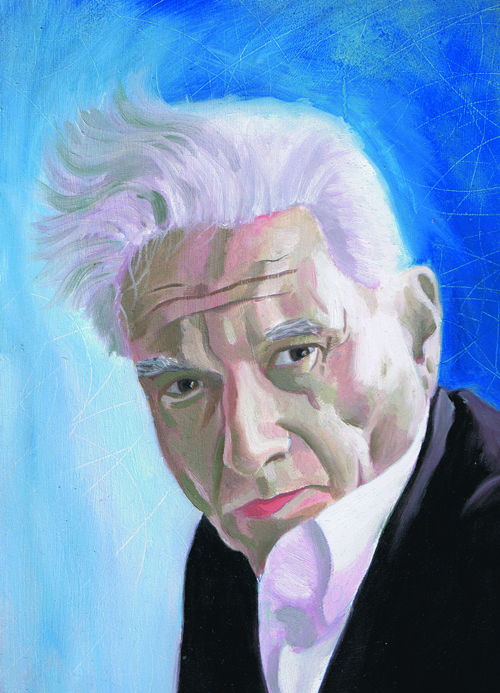
Derrida by Darren Mcandrew
Jacques Derrida was born in Algiers in 1930, into a Sephardic Jewish family. This may have contributed to his feeling himself to be the perennial outsider, particularly after he moved to Paris in 1949. Here he attended the prestigious École Normale Supérieure, and eventually become one of the most influential thinkers of his generation.
Alas, according to his critics, his influence is inversely proportional to his intelligibility – placing him squarely in a proud tradition of continental philosophers who seem to revel in obscurity. The English philosopher Roger Scruton once wryly claimed that Derrida is difficult to summarise because what he wrote is ‘nonsense’. Noam Chomsky said his scholarship was ‘appalling’. In an open letter strenuously opposing his gaining an honorary doctorate from their University, a group of Cambridge philosophers said his work did not meet “accepted standards of clarity and rigour.”
The bafflement of analytical thinkers, who famously prize precision of expression, was perhaps understandable, for it is true that Derrida’s prose is full of gnomic utterances such as, “No negation ought to be able to measure up to what is happening so as to be able to describe it.” His writings are permeated by word games, playfulness, and copious amounts of self-invented jargon. His key contribution was deconstruction, an approach based on the idea that any text contains hidden tensions and contradictions that, when brought to the surface, undermine its apparent meaning. These tensions include, among others, those within many binary pairs such as good/bad and male/female. Words, says Derrida, gain their meaning from their contrast with other words, but within such apparently symmetrical binaries one of the terms is privileged over the other. Derrida is often claimed to have said that there is nothing outside of the text. Some of his more excitable followers believed that the entire world is a text, which can therefore be deconstructed with the tools Derrida had developed.
Derrida died in 2004, and at his funeral was committed to the earth, there to undergo the final deconstruction.
© Terence Green 2026
Terence Green is a writer, historian, and lecturer who lives in Eastbourne, New Zealand.
Advertisement
