


Your complimentary articles
You’ve read one of your two complimentary articles for this month. To have complete access to the thousands of philosophy articles on this site, please
You can register for a free account to have four complimentary articles per month. We will occasionally email you a newsletter, from which you can unsubscribe at any time. We do not sell personal data or otherwise disclose personal information to other organisations.
Fiction
The Day of Ashes
Adam Farnsworth visits a future that reveres the philosophy of Georges Bataille.
The first painting hit the pyre. A Rembrandt, sacrificed to the solar god of excess. Jonas trembled. Bataille’s Lectures returned to him unbidden: “Sacrifice destroys that which it consecrates.”
As the Rembrandt blackened, a Sahel drone cut through the smoke, its wings scattering light like thrown coins. A child laughed, chasing its reflections with a tablet once owned by a Parisian CEO.
The noon sun glared above the plaza. Jonas squinted at it. It’s Bataille’s ‘accursed share’ made visible: energy we cannot store, only squander, or sin by hoarding. Around Jonas, people pressed in close. Hands lingered on arms and shoulders, lips brushed ears in conspiratorial whispers. A woman in crimson leaned into a man’s back, eyes half-lidded, the heat of the bonfire mirrored in the heat between them.
The voice from the high speakers rose above the murmurs: “In the Year of Endless Want, the Earth groaned beneath her children’s hunger. But the Teacher saw that want was not born of empty hands, but of hands that would not give. The sun spends itself without restraint. It burns to feed the grass, the grain, the beast, the man. To keep more than you need is to spit in the face of the giver. We will not spit. We will burn.” So the burning was not simply destruction, it was release – a permission to touch, to dissolve boundaries.
Jonas felt the pull of it in his gut, mingled with unease. “Eroticism is assenting to life up to the point of death,” the Teacher had said; and here death came dressed as beauty burning. But beauty, like desire, exists only to be consumed. To withhold the consummation was the true obscenity.
The crowd tilted their faces toward the blaze. For a moment, Jonas did too. But the stone in his chest reminded him of what he had seen two nights earlier.
The Hidden Cargo
The assignment had seemed harmless. A late shipment from the Veyran estate, requiring a Redistribution Officer’s inspection. The Veyrans were old money turned ceremonial patrons of Bataillism, famed for their flamboyant Emberday offerings. Jonas had heard about crates of fine but replaceable goods: surplus instruments, outdated AI consoles, furniture that next year’s fabricators would render obsolete.
The warehouse was quiet, the river’s tide whispering against its walls. An attendant in pale gloves unlocked the last gate.
The first half of the shipment matched his expectation: neat stacks of tools; crates marked for medical distribution; solar cells bound for highland clinics. AI had already tagged them for immediate rerouting. The machinery of peace in motion.
Then came the other section.
Inside the large container was a room dressed for a private ritual. A half-empty cask of wine, its top stained crimson like a wound. Ash smudges on the floor where a frame had been burned. Paintings in heavy frames leaned in rows, their pigments luminous, almost wet. A cello resting in a glass case.
“This is not for burning,” the attendant said.
Jonas kept his voice flat: “Nor for redistribution?”
The man’s smile was faint. “No. The Veyrans want to keep these. Or perhaps not keep. Perhaps reserve. There are ceremonies that require a different kind of expenditure.”
Jonas’ finger hovered near the cello’s case. He imagined smashing through it, shattering the instrument, feeling the wood splinter under his palm. A sovereign waste, for no eyes but his own. The thought came before he could suppress it. Perhaps that would not be hypocrisy, but a higher, rarer waste. To destroy such beauty privately, away from the crowd’s eyes – was that not closer to sovereignty than offering up mass-produced abundance to the public pyres? But the catechism pressed back: Nothing is mine. Nothing is yours. All that is, is ours. What is ours, is for the fire.
Jonas left without questioning the attendant. Yet one question lingered like the aftertaste of strong wine: Was the truest act of Bataillism to give – or to squander – in secret ?
Emberday Night
By the edge of nightfall, the city had become a living hearth. Bonfires bloomed in every square, their embers drifting upward like incandescent birds. Strings of paper suns swayed between rooftops. Music threaded through the alleys, thick with percussion and breathy flutes.
Jonas walked among bodies that moved as if untethered from gravity, like balloons. Silk brushed against bare skin. Wine sloshed over cups, onto wrists, only to be licked away by strangers. The flames roared and the people roared back.
A young man with ash on his cheeks pressed a cup into Jonas’ hand: “To the sun that spends itself!” he shouted: “And to the ones who do not hoard the light!”
Jonas drank, the wine heavy and sweet. A woman slid past him, her fingers lingering at his hip. The firelight caught her eyes, turning them gold. For a heartbeat Jonas felt the crowd’s current pulling him under. Then words from Bataille’s Lectures returned: “The embrace of lovers is a mock death, a sacrifice in miniature. The fire takes the body and the body gives itself to be taken.”
At Center Square the High Pyre was being fed its final offerings. The last was a gilded ornate antique clock, its face cracked, its hands still ticking. The crowd cheered as it vanished in the blaze. Jonas heard himself whisper, “Beauty, like desire, exists only to be consumed.” Yet the image of the Veyrans’ cello, sealed in glass, burned brighter in his mind than the flames before him.
The music swelled into a fevered rhythm. People danced in spirals, their limbs slick with sweat and smoke. A couple kissed so hard it looked like they were trying to breathe each other in. The sight made Jonas’s throat tighten. He thought of the Veyrans alone in their hidden chamber watching a painting curl and blacken, the ash rising in silence. Was that solitude more pure than this shared ecstasy?
Above the square, the sun had set, but its aftergift still lingered as the twilight. The pyres were consuming the day’s last light. The air smelled of charred wood, spilt wine, and something animal.
Jonas knew the catechism by heart, yet tonight it felt like a question instead of an answer: What is ours, is for the fire. But what if the truest fire was one no one else could see?
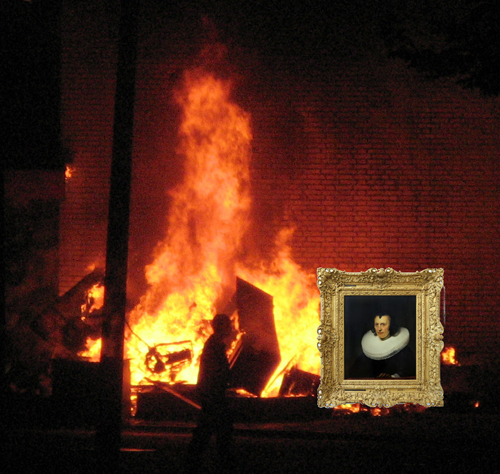
Fire © Bryan Tong Minh 2007 Creative Commons 2.0
The Swell & The Afterglow
Eventually, Emberday reached its final hour. The High Pyre had shrunk to a mound of glowing embers, each one the residue of something once prized. People sat in loose circles around the heat, speaking softly, or gazing into the flickering flames as if waiting for a vision.
Jonas looked round at the crowd. In the shadows behind him, the Veyrans themselves lingered, hands intertwined. He thought of their hidden hoard, the cello’s silent curves, the quiet ash smudge of their own private rite, and of the choice before him: should he tell the Ember Council of their self-indulgence? He could see the sacred order tighten its grip.
The Officiant stepped forward before the remnants of the fire, lifting a cup of wine from the communal vat: “Bataille taught us that the sun gives us more than we can use, and so we must return the excess, in fire, in dance, in love.” The words – repeated for generations – rolled over the crowd like a familiar tide. They shouted in reflection, “In fire, in dance, in love!”
Jonas sipped when the cup reached him. The wine was warm from the fire’s breath, and rich enough to cling to the tongue. A woman beside him laughed, brushing his shoulder, and he felt the unsteady thrill Bataille had named ‘the nearness of life and death’, and the way beauty demanded to be spent. In the flicker of the firelight, he imagined the ancient cello burning, its strings snapping like sinews. He imagined the Veyrans watching it alone, faces lit by their own secret blaze. But he knew Bataille was right: excess must always find an outlet. And if not here, in this communal rapture, it would leak into bloodshed, conquest, or other cruelty. Yet to expose the Veyrans would not end the hunger for such waste. It might only drive it into darker places.
The Officiant cast the final torch into the embers, and the crowd erupted in song. Jonas joined them, his voice rising into the smoke-heavy night. Above, a drone crossed the Moon, its blades scattering orange light like embers flung into the dark.
Tomorrow the city would begin again, and the sun would pour its endless gift across the earth.
Jonas turned toward home. The cello would remain where it was. The ash smudge would fade on its own. Next Emberday, when the pyres roared again, he would burn what he could and keep what he must, just like everyone else.
© Adam Farnsworth 2026
Adam Farnsworth writes speculative fiction inspired by philosophy.
Advertisement
