


Your complimentary articles
You’ve read one of your two complimentary articles for this month. To have complete access to the thousands of philosophy articles on this site, please
You can register for a free account to have four complimentary articles per month. We will occasionally email you a newsletter, from which you can unsubscribe at any time. We do not sell personal data or otherwise disclose personal information to other organisations.
Articles
Fraudulent Hope?
Alice Figes agrees with Ernst Bloch that hope can build worlds or destroy them, and philosophy’s task is to tell the difference.
Writing in the 1930s, the German philosopher Ernst Bloch (1885-1977) became fascinated by a lesser-known version of the Helen of Troy story that differs fundamentally from the Homeric tale. This older variant, preserved in fragments by the lyric poet Stesichorus, dramatised by Euripides in his play Helen of 412 BC, and later adapted by Strauss in his 1928 opera, has Helen never go to Troy at all. Thousands of ships are launched, ten years of brutal bloodshed ensue, an entire city is razed to the ground, all so Menelaus can retrieve what was stolen from him – the woman who had been declared the most desirable person ever to have lived. Yet in this telling the captive Helen was only a phantom. The goddess Hera, humiliated when Paris chose Aphrodite over her in a divine beauty contest, played a trick on these mere humans, fashioning out of cloud an image of Helen with the appearance of substance but nothing behind it – an eidolon. The real Helen was spirited away to Egypt, where she sat out the entire war in peace and relative uneventfulness. Menelaus knew none of this. When he finally locates the real flesh-and-blood Helen, his bewilderment gives way to deflation, because no actual woman could live up to what he had spent ten years idealising.
So, was it the woman’s fault that Troy was burned, or was it due to the gap between desire and its actualisation – in other words, to Helen’s very unattainability? For Bloch this older myth held the key to the most dangerous yet most necessary force in human life – one he would spend a career trying to understand.
Bloch fled Nazism in 1933, settling on the East Coast of America, where he moved in the orbit of the Frankfurt School. He was fascinated by the pull of the future – by our perennial orientation towards what he called the ‘not yet’. Writing through the darkest years of the twentieth century, he observed in his magnum opus The Principle of Hope (1954) how this drive towards the future can both emancipate and imperil.
His diagnosis was that the concept of the future had been dangerously neglected within Western philosophy. In the writings of the nineteenth century philosopher GWF Hegel he saw a static vision of the absolute, which he understood as a fetishization of completeness; while in Sigmund Freud’s work he saw a closedness – an understanding of the unconscious aimed merely at reconstructing what had already been, not venturing towards the unsettling novelty of the future, the horizon forever shaping human desires. Drawing on psychoanalysis, German Romanticism, Marxism, and Judeo-Christian messianic thought, Bloch then made the audacious claim that hope is not merely a feature of human consciousness but a “basic determination within objective reality as a whole” (POH, Vol 1, p7). Hope shows that the world itself is unfinished, and that humanity is oriented towards what does not yet exist.
It’s in this register that the older Helen myth does its work for Bloch. Menelaus becomes not simply a deceived husband but a metaphor for the human condition itself – a creature pulled forward by the anticipatory strength of his own desire; a force so powerful that he cannot see through the illusion. The phantom Helen is a paradigmatic example of what hope aims for when its forward pull outruns reality. Yet Bloch’s point is not to dismiss Menelaus as a fool, nor to dismiss hope as delusion. The deeper question the alternative myth poses for Bloch is whether the gap between desire and its actualisation is an innate human defect to be lamented, or potentially the very engine that drives human beings to make the world a better place.
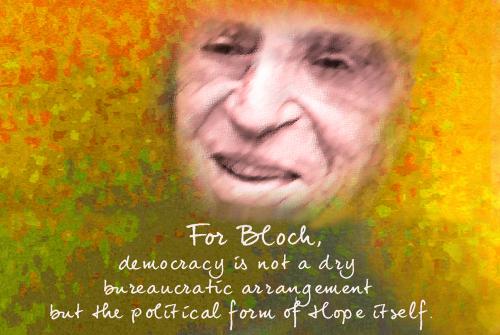
Image © Miles Walker 2026 Please visit mileswalker.com
Hope For Transformation
The Principle of Hope established Bloch as one of the most ambitious modern philosophers. In this astonishing and encyclopaedic three volume work, Bloch traces an emancipatory vision of hope across millennia. He sees it in Moses leading his people out of Egypt towards a promised land most of them would never reach; in the radical preacher Thomas Müntzer, who in 1525 mobilised German peasants behind a dream of heaven brought down to earth, and who was executed for his troubles; in the European revolutionary fervours of 1789 and 1848, when the image of a different world propelled ordinary people to fight on the streets of Paris, Vienna, and Berlin. But for Bloch the not-yet did not belong only to political rupture. He found it in the soaring vaults of Gothic cathedrals, straining upward towards something they could not quite touch; or in late Beethoven, whose private self broke free of ‘the merely inner life’ towards a shared cosmic horizon (the trumpet call in Fidelio, signalling a rescue still to come, was for Bloch the very sound of hope); and in the canvases of the Expressionists, such as Marc, Kandinsky, or Kokoschka, which registered a content not yet thinkable – what Bloch called ‘the not-yet-conscious pressing towards form’. Hope, Bloch insisted, was the ‘warm stream’ of consciousness running beneath culture itself, and the surplus of human desire that could never be fully satisfied by any present arrangement, and which therefore kept history moving. The intellectual historian Cat Moir, rejecting Jürgen Habermas’s dismissal of Bloch as a ‘Romantic Marxist’, has recast Bloch as a speculative materialist ahead of his time – a thinker for whom matter is perennially in movement, pregnant with possibility.
What’s remarkable about Bloch’s idea of hope was that he was devising it in the 1930s, as the home he had always known crumbled around him. For all he knew, the Third Reich would win the war and fascism could become the new global order, as it found support even in the United States. His extended family were either fleeing Germany or being sent to the death camps, and his closest intellectual companion, Walter Benjamin, took his own life on the Spanish border in September 1940, believing that escape from the Nazis was impossible. Bloch, who had escaped, kept writing – and what he wrote about, in the teeth of catastrophe and despair, was hope. He connected to a utopian tradition he saw as old as the writing of history itself, which he had traced in his previous works Spirit of Utopia (1918) and Heritage of Our Times (1935). In these works, Bloch had transformed that tradition, wresting ‘utopian’ from its long-standing pejorative use, and also shifting utopianism from the static blueprints associated with Plato, Thomas More, William Morris, or Edward Bellamy, towards a process-based utopianism. To Bloch, hope was a force that had always belonged to the dispossessed and those in pursuit of humanisation and democracy. Longing intensifies through deprivation, and the dream of a transformed world burns brightest where the present world is unbearable.
What’s most striking is where Bloch was willing to look for this utopian current: in religion. After the French Revolution, most materialists, Marx above all, had dismissed religion as ‘false consciousness’, the residue of a superstitious age that progress would sweep away. Yet despite his atheism, Bloch refused this dismissal. For him religion was one of the great archives of human longing, ‘’a speculative apprehension of the future” that had carried the utopian impulse across millennia. He read the Hebrew prophets, Jesus’s Sermon on the Mount, and the Christian utopianism of the late Middle Ages, not as the ideological wallpaper of bourgeois society but as registers of a desire for transformation. Moses was for him the prototypical prophetic founder, the figure who embodied his own teaching. Müntzer’s revolt early in the Reformation drew its force from a Christian idea of the ‘last days’ bent into political insurgency. Moreover, the Christian ideal of loving one’s neighbour, Bloch suggested, echoed the Marxist vision of a stateless community in which human beings might at last live as equals. To dismiss all this as mere delusion is to throw away one of the richest seams of utopian energy the human species has produced, which Bloch, employing theological language for atheist purposes, called ‘transcendence without transcendence’. Indeed, Bloch was the first to argue that Marx himself was an unwitting utopian: that for all Marx’s celebrated demolition of contemporary utopians Saint-Simon, Fourier, and Owen, the classless society at the heart of Das Kapital was unmistakably utopian in form. It was an image of a redeemed society.

Ernst Bloch by Darren McAndrew
Hope’s Darker Currents
Yet Bloch knew that the same force that propelled prophets and revolutionaries towards a more just world could easily be diverted, hollowed out, and turned against the very people it moved. This is what drew him to the older Helen myth rather than Homer’s version. In Homer, the Trojan War ends in possession. Menelaus reclaims his wife and he forgives her for her infidelity, because her supernatural beauty stuns him into forgiveness. In Stesichorus’ and Euripides’ version, by contrast, there’s no Helen to win – only a phantom that had mobilised armies for nothing. The gods who tricked Menelaus had grasped something essential: it was not Helen herself who launched the ships, but her withholding, leading to her transformation into an ideal – Hera understood that an image suspended just out of reach could mobilise armies and raze cities precisely because it could not be obtained. Drawing on existentialism and phenomenology, Bloch placed this gap between desire and attainment at the heart of what it is to be human: we are constituted by ‘lack’ – by the felt absence of what we are not yet, of what the world is not yet, and our forward motion is the perpetual labour of closing that distance. The world is on the move in search of its essence. The gap between desire and its attaintment is not a defect of human existence, then, but its structure: we are the kind of beings who yearn. And it is precisely this yearning, Bloch saw, that makes us so dangerously vulnerable to those who seek to play God.
Bloch discussed this danger under the name of abstract utopia, by which he meant the utopian impulse cut loose from any concrete mooring in the present world, instead floating free as pure imagination. In our age of economic stagnation, historic levels of inequality, and climate devastation, this delusion runs through new forms. Every day we’re bombarded with false utopian images, that is, visions of a perfect life. (I call them the eidolons of the algorithm.) False visions of perfection are also present in the contemporary cult of self-optimisation – the looksmaxxing, the wellness regimes, the biohacking and clean-eating protocols – where the body itself becomes the canvas onto which the phantom ideal is projected, and perfection is to be carved from one’s own flesh. In Vincenzo Latronico’s acclaimed recent novel Perfection (2022), a young couple curate their Berlin lives through such contemporary images of utopia – of the monstera plants, the honey-coloured floorboards, the Danish furniture – only to find that the reality behind the catalogue photographs dissolves on contact, with the dust, the food stains, and the phone chargers that have to be cleared away to make the image possible. The curated image promises a life, but the life does not arrive. What arrives instead is the deflation Bloch named – the realisation that the gap between the phantom and actual existence can never be crossed.
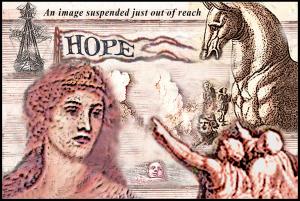
Image © Miles Walker 2026 Please visit mileswalker.com
At the more predatory ends of the algorithm the consequences are far graver. The impossibly beautiful AI-generated women who flicker through the manosphere’s videos are phantoms manufactured not to be reached by the ordinary, often vulnerable young men they appeal to, but to keep their longing permanently deferred, as the false image cannot be attained. Some such men, lured by the financial ‘advice’ the influencers push, have ended up broke, sleeping in their cars, having staked everything on an curated dream that remains forever just out of reach. And the men selling the fantasy are not even the real winners: rather, they’re digital tenants on tech platforms owned by a much smaller, much richer class, who profit from every click of the rage cycle without ever appearing on screen, while what begins as lifestyle optimisation reveals itself, in time, as a Trojan horse of false promises.
This same dynamic, at its most dangerous, is what authoritarian movements have always harnessed for power. Hera’s trick was to suspend an image gleaming with the appearance of substance just beyond Menelaus’s grasp. Bloch saw demagogues of his own day learning to do precisely this, on purpose. In Heritage of Our Times and his essay on fascism, Critique of Propaganda (1937), he developed what was for him the central diagnosis of his age: that it was the far-right, not the progressive left-wing forces, that best understood the emotional, even libidinal power of the ‘warm stream’ – the appeal of spectacle and mythology in the mobilisation of the ‘not yet’ for its own political purposes. The fascists, Bloch saw, were unrecognised heirs to the religious imagination, drawing on the same archive of longing, but stripping it of its emancipatory charge and bending it to the legitimisation of their power. They had learned to manufacture eschatology: to create a redemptive vision that drew strict lines around who counted as redeemable and who did not. Such politics find its richest soil in times of economic precariousness. When ordinary people can no longer afford dignified lives and the future feels foreclosed, the warm stream of longing becomes most politically exploitable. The demagogue who arrives at such a moment offers not so much a programme as a feeling – that you, specifically, matter; that your suffering has meaning; and that someone, at last, sees you, and offers you a path of salvation.

Pandora, John William Waterhouse 1896
Educated Hope
For Bloch, writing in the 1930s with a caution that remains relevant in our own day, any politics which reduces itself to technocracy – to government through statistics, marginal policy adjustments, or ‘economism’ more broadly speaking – perilously leaves the warm stream unguarded. This was Bloch’s charge against the social democrats and leftists of his own day. Whoever identifies the gap and fills it with a utopian image (whether the ‘thousand year Reich’ or ‘Make America Great Again’) can gain extraordinary power. Man does not live by bread alone, Bloch wrote, especially when he has none. We live as much by the intoxicating ‘violin’ as by the bread – by the warm as well as by the cold stream – for it is humanity’s cultural achievements, in the end, that make life feel meaningful and history purposeful.
Bloch’s answer was not to renounce the utopian impulse. That, he saw clearly, was neither possible nor desirable. The warm stream cannot be drained without draining us of our humanity. The task, rather, is to channel this inextinguishable force into forms that cannot be turned against the people it mobilises. This is what Bloch called concrete utopia. Merely abstract utopia is the eidolon – the gleaming image suspended just out of reach. It’s typically the blueprint of a single visionary, manufactured from above to mobilise armies for dictatorial ends. But the concrete utopia is the future built from below, by ordinary people, out of the materials of the world they actually inhabit. The eidolon keeps people passive, gazing upward at a phantom that forever elusively promises to redeem them; concrete utopia asks them to recognise that the redemption they’re waiting for is something they’ll have to build themselves. Bloch’s wager is that the utopian impulse does not have to be handed down from on high, by Hera, the authoritarian demagogue, or the tech algorithm. It can be cultivated by human beings working together to repair, improve, and extend the institutions that already half-belong to them.
The phrase ‘concrete utopia’ is a deliberate paradox. Utopia literally means ‘no-place’ in Greek: to call it ‘concrete’ is to insist, against the grain of the word itself, that the not-yet is something we can actually build in the world as we find it. This is why, for Bloch, democracy is not a dry bureaucratic arrangement but the political form of hope itself. It is a bottom-up process of yearning towards a horizon of justice, the same yearning that has stirred every great emancipatory movement in history. A parliament, a trade union, a university, a town council, a public school, a free press, a courtroom in which the powerful can be held to account – each, in its imperfect way, is a concrete utopia in the making. Each is a piece of the not-yet that human beings have wrested from the gods and placed in their own hands.
But the possibility of a concrete utopia is not self-evident. Whether hope is a force for good or for ill has divided philosophers since antiquity. The Greeks themselves were ambivalent: when Pandora opened her box and loosed every evil into the world, the one thing that remained at the bottom was hope – left there ambiguously alongside what hope might cure and what hope might delude. Recognising the difference is what Bloch called docta spes – ‘educated hope’.
Raw hope, as the Greek gods knew, is the most exploitable resource on earth. It will reach for whatever’s dangled in front of it. Educated hope, though, is hope that has learned to read the world – to distinguish the genuinely possible from the merely promised, the tendency gestating within the present from the phantom suspended above it. This hope is, in Bloch’s striking phrase, willful rather than wishful – a discipline rather than a mood, sharpened by historical knowledge, sceptical of charisma, and attentive to the grain of what people are actually doing together. To be educated like this is to become harder to recruit by the deceivers: less seducible by the strongman’s promise, less willing to bleed for someone else’s redemption story, more capable of recognising when a war is being fought on one’s behalf and when it’s merely the instrument of power. This is why, for Bloch, good hope is finally a matter of pedagogy as much as politics. It’s a faculty cultivated, like any other, through reading, argument, memory, and the daily practice of democracy itself – not merely voting in elections, but the slow work of arguing with neighbours, organising with strangers, and holding power to account. And this, finally, is Bloch’s deepest insight: that the desirable ‘not-yet’ does not live in the things we might conquer but in the relations we might build – between neighbours, between strangers, between the powerful and those they answer to. The Homeric Helen was a trophy to be seized; the older Helen, an illusion to be seen through. The phantom is always an impossible fantasy. The real horizon is always an imperfect becoming. The education of hope is what teaches us to tell them apart.
© Alice Figes 2026
Alice Figes is a PhD student in the faculty of POLIS at the University of Cambridge. She can be found on Twitter @AlicheFrancesca.
Advertisement
