


Your complimentary articles
You’ve read one of your two complimentary articles for this month. To have complete access to the thousands of philosophy articles on this site, please
You can register for a free account to have four complimentary articles per month. We will occasionally email you a newsletter, from which you can unsubscribe at any time. We do not sell personal data or otherwise disclose personal information to other organisations.
Books
Why The Ancient Greeks Matter by Reviel Netz
Helios Selvan looks back at what made ancient Greek culture distinctive.
In Why The Ancient Greeks Matter (2025) ancient historian Reviel Netz does not follow the well-trodden path of illustrating the greatness of the ancient Greeks in their passing of moral qualities onto the world or by demonstrating how they formed the bedrock of Western Civilisation. In fact, he rejects the idea that Greek ideals are special or superior to those of any other societies; he even points out that the world today is in many respects far better than ancient Greece. What Netz does do, however, is to frame the philosophical and the less-philosophical culture of the Greeks as a force that significantly shaped the early-modern era and consequently our own, particularly in the areas of science and mathematics. He does not want to run through the issue of the Greeks being admirable, but rather to demonstrate how a culture has the conditions where a form of debate, competition, a nd in turn progress, are possible.
One of the first ideas Netz introduces is how Greek culture would go on to have a huge ripple effect, as demonstrated in the field of mathematics. It’s not that the Greeks were mathematically more gifted than their Mesopotamian counterparts – in fact, they were at times doing the same sort of mathematics. But while in Mesopotamia mathematics was taught in classrooms with no formal accreditation system, Greek mathematics was firmly situated within a competitive public culture. Unlike the Mesopotamians, Greek mathematicians put their names to their work and most wrote extensive proofs of their theorems so that others had to accept they must be right. (Still, some would try to critique their proofs). This turned mathematics into a sort of intellectual competition, which subsequently produced exceptional mathematicians, such as Ptolemy and Hipparchus, whose work was used much later by Galileo and Newton. In the early modern period, the many systems of mathematics from the ancient Greeks, such as accreditation and proofs, began to gain traction and became the foundation of modern mathematics.
However, Greek culture is not presented as inherently special, but rather as a product of its political conditions. Towards the latter part of the book, Netz begins to show how the geopolitical situation was in many ways crucial to fostering the culture. Although this critical culture was always present from the fifth century BCE onwards, during the era of Democratic Athens, when debates in the assembly were common, the transition to Athens being a centre of soft power under Macedonian rule in the fourth century BCE allowed literature and science to be free from being forced to align with imperial or state ideals. In this way, the Athenians were accidentally given a sort of cultural autonomy.
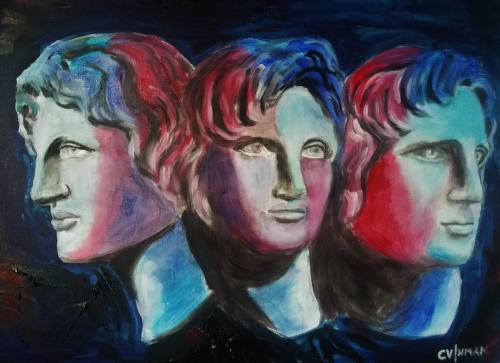
Alexander the Great by Clint Inman
The Greek ideal of competition was certainly not limited to mathematics and science. Greek theatre also embodied the competitive spirit, with plays performed at festivals such as the Dionysia being judged against one another. Netz points to a scene in Aristophanes’ comedy Frogs that encapsulates the culture. Here the tragedians Aeschylus and Euripides are envisioned as rivals in the underworld arguing over who should be considered greatest. It was this philosophical, competitive, argumentative culture that drove ancient Greece to its heights in both the scientific and literary disciplines.
Netz then connects this to the Greek canon: the body of texts and authors that was transferred to later generations. This would typically include works from well-known authors, such as Homer, Aeschylus, Sophocles, and Plato. Netz first highlights the two prevalent views of how this canon came to be, the first being that it was thought to contain timeless values that need to be preserved, and the second being that what went into the canon was chosen by certain gatekeepers. With the reader or audience being central in Greek literature, Netz takes a third option: that the canon was chosen by popular forces. His evidence for this is the fact that the canon was in many ways contradictory. For example, both Plato and Homer feature; but Plato loathed Homer’s characterisation of the gods as flawed, and also thought that poetry in general was an inferior artform. This at least tells us that the Greeks were keen to preserve contrasting ideas to fuel discussions.
Interestingly, such a canon was never compiled for the intellectual (non-fiction) fields. But this was arguably key to their development. It was difficult for a tragedian to make a name for himself when huge figures such as Sophocles and Euripides were already canonised: the intellectuals did not have that same issue. Indeed, the lack of the canon here meant that any thinker could make a name for themselves by critiquing or improving on another’s work.
Netz truly portrays the Greeks as a ‘problematic miracle’: a flawed society with a culture that has had lasting influence on future thought. He successfully shows us throughout this book that the Greeks were not special, but nevertheless, partly through coincidences of history, their culture was unusually influential, and he demonstrates how the Greeks’ argumentative, competitive, and intellectual culture with its groundbreaking science and mathematics directly led to the likes of Newton and Kepler, and thus drove humanity forward.
Netz’s work isn’t perfect: I wouldn’t describe this as a particularly easy read, and at times he dives too deep into complex mathematics or writes tangentially. But the core content is both unique and fascinating.
© Helios Selvan 2026
Helios Selvan is a final-year student at Eton studying Advanced Mathematics and Classics.
• Why the Ancient Greeks Matter: The Problematic Miracle That Was Greece, Reviel Netz, 2025 CUP, £19.99 hb, 200 pages, ISBN: 978-1009505598
Advertisement
