


Your complimentary articles
You’ve read one of your two complimentary articles for this month. To have complete access to the thousands of philosophy articles on this site, please
You can register for a free account to have four complimentary articles per month. We will occasionally email you a newsletter, from which you can unsubscribe at any time. We do not sell personal data or otherwise disclose personal information to other organisations.
Metaphysics
‘Why is there something rather than nothing?’
Andrew Brenner tries to make sense of the question.
People have wondered why there is something rather than nothing for a long time. The Rigveda, one of the world’s oldest surviving religious texts, alludes to the question, and suggests that even God might not know the answer. But it was Gottfried Wilhelm Leibniz in the eighteenth century who is credited with phrasing the question in the way we ask it in our title (in Principles of Nature and Grace, Based on Reason, §7). In the twentieth century, Martin Heidegger called it ‘the fundamental question of metaphysics’. As far as I can tell, he didn’t have much of substance to say about the answer. Yet he was right: it’s an important question for philosophy. But before we can answer it, we have to understand what we’re even asking. That’s my goal here: not to answer the question, but to understand it. The purpose is to motivate attempts to answer it, and put those attempts on a firm foundation where we’re not just talking past one another.
This stage-setting is important for a couple of reasons. First, there isn’t firm agreement about exactly what question Leibniz had in mind when he asked why there’s something rather than nothing. Much of the subsequent discussion suffers from similar ambiguity. If we’re asking different questions, then we might unknowingly talk past one another, or you might reject some potentially good answer because it isn’t a good answer to your own question. Second, some people simply reject the question, their complaint being with the question itself, not with any proposed answer to it. So clarity here would be helpful. I’m going to pick one way of understanding the question and argue that so construed it seems like an entirely sensible question to ask.
First let me stipulate that in asking ‘Why is there something rather than nothing?’ I mean to ask why anything whatsoever exists. I’m not asking why certain sorts of things exist – for example, physical things. I’m asking about it all – things both seen and unseen. In other words: Why is anything of any sort in existence? It’s hard to demonstrate that this is the fundamental question of metaphysics as Heidegger claimed, but it’s certainly an ambitious and wide-ranging one. And it’s at least the question that people often have in mind when they ask why there’s something rather than nothing.
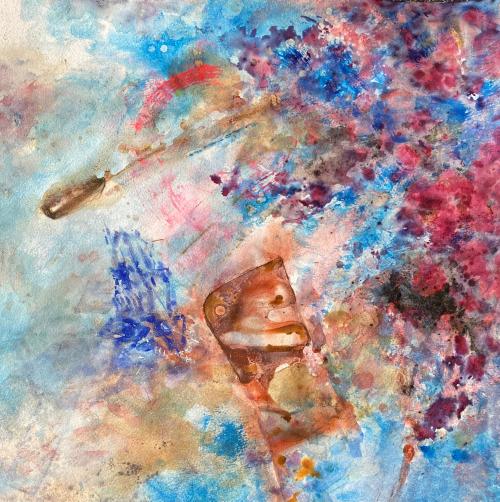
Something by Venantius J Pinto
Is It A Stupid Question?
The question can be a little head-spinning. Arthur Schopenhauer called it “an unfathomable and always disquieting riddle.” But maybe we can dispel this sense of mystery by showing that the question is really not such a sensible question after all?
There are two main ways we might go about doing that: we might claim it’s a foolish question to ask, or we might contend that it’s a mere pseudoquestion. To call something a pseudoquestion is to say that it looks and sounds like a question, but it really turns out to be something else, like a mere expression of emotion, or a meaningless string of words with a question mark at the end.
Let’s start with the first way of rejecting the question: it’s a stupid question. Why should we think that? I suppose the idea is that you’d have to be making some sort of serious error to ask the question in the first place. But what sort of error?
Maybe the error is this: those who ask why there is something rather than nothing presuppose that there is some explanation. That presupposition may be false – maybe it’s just a brute unexplainable fact that things exist. In that case we should reject the question itself, just as if someone asks “Are you still embezzling from your employer?” and you’ve never in fact embezzled from your employer you should simply reject the question rather than try to answer it.
Our question can seem like it presupposes that there’s an explanation. There might very well be an explanation for why there is something rather than nothing; or, at least, we haven’t yet seen any reason to think there isn’t an explanation – but it’s best to avoid making that assumption right from the beginning, at least without some further argument for why we should think it’s true.
Luckily, this problem is actually pretty easy to avoid, if we rephrase the question as something like “Is there an explanation for why there is something rather than nothing, and if so what is it?” That’s a more cumbersome way of phrasing it, but at least it doesn’t have any assumptions built into it about there being such an explanation. Still, I’d like to avoid that cumbersome way of speaking if I can, so from now I’ll continue to ask ‘Why is there something rather than nothing?’ – but you might keep in mind that I’m really asking the more cumbersome question.
Why else might it be a foolish question to ask? In his 1907 book Creative Evolution, Henri Bergson complained that we can’t picture or imagine any alternative to something existing. So perhaps that means it’s foolish to ask why there’s something rather than nothing. But that’s incorrect. When we consider the alternative to there being something, we are considering a situation in which nothing exists, so there is literally nothing to imagine. That’s fine, though: whether you can visualize a situation in which nothing exists has no bearing on whether it’s possible for nothing to exist, or whether it is sensible to ask why there isn’t simply nothing. It’s enough that you understand what would be involved in there being nothing – and that can be summarised by saying that it wouldn’t be the case that anything exists. As René Descartes pointed out in a different context, most of us can’t visualize a chiliagon (a thousand-sided polygon), but that doesn’t mean that chiliagons can’t exist, or that we can’t understand what it would mean for a chiliagon to exist.
A related complaint is that when we try to imagine nothing, we end up imagining empty space. So – the thought goes – in asking why there’s something rather than nothing we’re really asking why space isn’t empty, or why there isn’t simply a void.
Well, the question of why space isn’t empty is a great question, but it is not our question. We are asking why there exists anything at all, space included. And if it turns out there exist things that aren’t located in space (gods, numbers, ideas, whatever), we’re asking why any of those things exist too. Whether we form an image of empty space (or of anything else) when we try to imagine ‘nothing’ is, as noted, beside the point.
But what, you might object, is this ‘nothing’ we’re talking about? Is nothing supposed to be some sort of thing, so that we’re asking why this something – reality – exists, rather than this other thing – nothing?
Understood this way, the question would indeed be a stupid question, because here we would reify nothing, (meaning, make nothing into something). We would be treating ‘nothing’ as if it refers to some sort of object which might conceivably exist but doesn’t, and then proceed to ask why this ‘nothing’ doesn’t exist. There’s a scene in Lewis Carroll’s Through the Looking-Glass where the King asks Alice whether she sees his messengers on the road. Alice replies that she sees “nobody on the road”. The King replies, “I only wish I had such eyes. To be able to see Nobody! And at that distance too! Why, it's as much as I can do to see real people, by this light!” Here the King is reifying ‘nobody’ in exactly the way that our bad questioner is reifying ‘nothing’.
I see this complaint surprisingly often on the internet. But it’s a mistake. Properly understood, the question of why there is something rather than nothing does not reify nothing, but instead treats ‘nothing’ as shorthand for ‘not anything’ – just as Alice was obviously using ‘nobody’ as shorthand for ‘not anybody’. We can see this by noting that our question can be re-stated as “Why is it the case that there is something rather than it not being the case that there is something?” Or as I suggested earlier, we can simply ask, ‘Why does anything whatsoever exist?’. In neither case do we even use the word ‘nothing’.
Some people claim that our question is foolish because if nothing at all existed then we wouldn’t be around to ask it. My response is: So what? Suppose I’m trapped under an avalanche and I lose consciousness. Later I wake up in a hospital. It is sensible for me to ask how I was saved, even though if I had not been saved, then I wouldn’t be able to ask the question.
Is It A Meaningless Question?
We’ll now turn to a different concern – that the supposed ‘question’ is a mere pseudoquestion – nothing more than a meaningless string of words masquerading as a question.
Why might someone think this? Here’s one reason. The Verificationists (for example, the logical positivists, who were prominent in the mid-twentieth century) claim that there are basically two sorts of statements.. The first sort of statement is true or false by definition, in the sense that it’s true or false just because of the meaning of the words used in it (for example, ‘all bachelors are unmarried’); the second sort of statement is true or false because it can be empirically verified or falsified (for example, ‘Brazil is larger than France’). The verificationists’ core idea was that the meaning of the second type of statement is the method by which the statement is verified by the senses. For example, ‘There’s a black dog’ means something like “If one were in such-and-such an environment, in suitable lighting conditions, with a functioning visual system, then one would be having black-dog-shaped visual experiences” – plus spelling out all the other ways the statement could be verified (by smell, touch, or scientific experiment, whatever it may be).
The prominent verificationist Moritz Schlick (1882-1936) thought that we could derive an important conclusion regarding the meaning of questions from this. Schlick argued (in ‘Meaning and Verification’, The Philosophical Review, 45:4, 1936) that if every purported answer to a question is in-principle unverifiable, then it follows from the verification principle that it isn’t really a question at all. Instead, it’s a meaningless string of words with a question mark at the end, akin to “Did the slithy toves gyre and gimble in the wabe?”
If that’s right, what might it show us about our question? Well, if we conclude that there’s no possible way to discover the answer to it, then the verificationists would claim that it is after all a mere pseudo-question.
How should we reply?
First, Schlick’s thesis regarding questions just doesn’t follow from the verificationist thesis regarding statements. Even if all possible answers to a question are in-principle unverifiable, by verificationist lights that would only show that any attempt to answer the question would result in a meaningless string of words; it would not show that the question itself is a meaningless string of words. Second, the verificationist thesis regarding statements is false anyway – which is why there are few verificationist philosophers around today. The most obvious problem is that verificationism undermines itself: the verificationist thesis is, after all, not true by definition, nor is it verifiable by empirical evidence. So, the words used to state the verification principle are, by verificationism’s own standards, a meaningless string of words. Finally, I would question the assumption that it’s impossible to discover the answer to the question. There have been a number of proposed answers, and maybe one of those is correct. Or maybe some clever person will discover the answer in the future. In 1835, Auguste Comte claimed that we would never be able to discover what stars are made of. It turns out he was wrong. Comte confused his own failure of imagination with a truth regarding what we can and cannot know.
In a recent series of publications the philosopher Stephen Maitzen has given some more promising arguments for the idea that our purported question is a mere pseudoquestion (see for example, Determinism, Death, and Meaning, pp.100-111, 2022). What’s his complaint? Well, notice that the question of why anything whatsoever exists is not just asking about particular sorts of things, it’s asking why any things at all exist. The problem, Maitzen argues, is that it’s nonsense to ask for an explanation for the existence of “things’ in general’; the only genuine existence questions we can ask are about particular sorts of things – like when we ask “Why do penguins exist?” Maitzen gives a few arguments for this idea, but unfortunately I only have space to examine one.
Normally, existence questions do need to specify what sort of thing we’re asking about. For example, suppose I’m holding a pen in my hand and I ask “How many things am I holding in my hand?” This question uses the general term ‘thing’, but in most contexts it will be clear that I’m asking about particular sorts of things – I’m asking for instance how many writing utensils I’m holding in my hand. Absent the context in which I ask the question, there’s no way to narrow down what sorts of things I’m asking about. Should you include the pen cap in your count of the things? Should you count the ink tube? What about all the subatomic particles that compose the pen? Without some way of narrowing down what sorts of things are at issue, you not only have no way of answering the question, it’s not even clear that I’ve really asked a genuine question. The source of the problem, Maitzen says, is that in asking “How many things am I holding in my hand?” I’ve used the word ‘thing’ in an entirely general way. But the example illustrates that ‘thing’ is not a genuine kind or sort, rather, ‘thing’ is a placeholder, to be replaced by some narrower kind or sort. If that’s right, then when we attempt to ask why any things exist, our language has gone haywire, and we have failed to ask a genuine question.
I agree that when we ask existence questions we usually need to make it clear what sort of thing we’re asking about. Here, context usually comes to the rescue. When I ask “How many things are in the fridge?”, the context lets you know that I’m asking about things that are edible or potable, and not about, say, shelves, air molecules, or electrical wires. Without that context my question would in fact be ill-posed: not because ‘thing’ is not a genuine kind or sort, but rather, because I am trying to ask about a particular sort of thing, and without the linguistic context, the string of words I’ve used fails to communicate the sort of thing I have in mind.
However, in at least one context we do in fact mean to ask questions about things in general rather than particular sorts of things. Unsurprisingly, the context I have in mind is when we’re doing metaphysics. Here we ask questions like “Could there exist a thing A and a thing B which share the same properties, and yet ‘A’ and ‘B’ refer to two objects rather than one?” This generality is often what makes it the case that we’re doing metaphysics, and not, say, botany or musicology. Not all of metaphysics is like that, but a lot of it is. And when we’re asking why anything exists, we’re doing metaphysics. We are in a context where it’s natural to ask about things in general, without any need to narrow down which sorts of things we’re asking about.
Ultimately, then, I think that the question of why there’s something rather than nothing is a real question, and not obviously a stupid one. Laying this foundation may pay off in our attempt to answer it.
© Andrew Brenner 2026
Andrew Brenner is an Associate Professor in the Department of Religion and Philosophy at Hong Kong Baptist University. His book Why Is There Something Rather Than Nothing? The Fundamental Problem of Ontology was published in 2026 by CUP.
• Andrew wishes to thank Tin Sun Mak, Vivian Man, Stasia Ruschell, and Emma Yang.
Advertisement
