


Your complimentary articles
You’ve read one of your two complimentary articles for this month. To have complete access to the thousands of philosophy articles on this site, please
You can register for a free account to have four complimentary articles per month. We will occasionally email you a newsletter, from which you can unsubscribe at any time. We do not sell personal data or otherwise disclose personal information to other organisations.
Music
Wish You Were Here
Ian Rizzo listens out for a philosophy of absence.
The year 2025 marks the fiftieth anniversary of Wish You Were Here by the rock band Pink Floyd. With its emphasis on existentialist themes, this classic album can be conceptually regarded as a follow-up to The Dark Side of the Moon (1973). But where The Dark Side of the Moon reflected the struggles, pressures and frustrations of modern life (including madness), Wish You Were Here dwells on the concept of absence – absence from one’s own being, and absence from others.
The idea that we can be physically present while mentally elsewhere is an eternal facet of the human condition, and has arguably become more pertinent since the digital revolution early this century. But it was also explored by existentialists in the second half of last century. Indeed, existentialism is often best expressed not in philosophical texts but in art. Jean-Paul Sartre himself used novels and plays to explore the human condition and lived experience. In his novel Nausea (1938), for instance, Sartre’s protagonist, Roquentin, observes the absurdity of existence and becomes overwhelmed with an existential crisis, finding life meaningless, purposeless, and shapeless. To some extent, these were also the themes Pink Floyd were tackling musically, which to my mind makes them musical existentialists.
Background
Pink Floyd was formed in the mid-sixties by Syd Barrett (lead guitar and vocals), Roger Waters (bass), Nick Mason (drums), and Richard Wright (keyboards). To understand the philosophy of Wish You Were Here, one must grasp the crisis brought about by Barrett’s decline.
Barrett, co-founder and leader of the band, was credited for eight out of eleven songs on their first album The Piper at the Gates of Dawn (1967), which blended whimsical nursery rhyme imagery with psychedelia. Tragically, Barrett was unable to cope with the pressures of fame and the expectations that followed that first album. His increasing recourse to LSD worsened his mental condition, making him increasingly eccentric and uncommunicative with his bandmates. David Gilmour was brought in to provide support as lead guitarist, making the Floyd a five-piece. But sometime shortly after, around April 1968, it was officially announced that Barrett had resigned from the band.
By 1974-1975, during the making of Wish You Were Here, Pink Floyd faced another crisis. Following the international success of The Dark Side of the Moon and the pressure to repeat that success, the band’s members found themselves in a state of creative paralysis. Added to this was a growing communication problem, the result of artistic differences, between Waters on one hand and Gilmour and Wright on the other. Relentless touring to promote Dark Side had exhausted the band, and they faced criticism from the media for relying too much on spectacle and previous material. In his history of the band, Inside Out (2004), Mason recalls: “There was a point where we might easily have broken up… we were a bit nervous about carrying on.”
By then, the band had produced only three songs after The Dark Side of the Moon: ‘Shine On’, a song dedicated to Barrett; ‘Raving and Drooling’; and ‘Gotta Be Crazy’. Waters proposed and eventually got his way that ‘Shine On’ (later renamed as ‘Shine On You Crazy Diamond’) which consisted of nine parts, be divided into two to open and close the album. In between, three new songs would relate to the theme of absence. These three songs were ‘Welcome to the Machine’, ‘Have a Cigar’ and ‘Wish You Were Here’.
Waters concurred with Mason’s view regarding the state of the band during the Wish You Were Here recordings, saying, “Our bodies were there, but our minds and feelings were somewhere else… The album could equally have been called Wish We Were Here.”
For Waters, the fragmented state of the band symbolically represented the mental state of Barrett. Upon hearing the mournful sound produced by the four-note guitar of Gilmour’s intro, Waters immediately linked the lyrics of ‘Shine On’ to Barrett’s breakdown, expressing both his admiration for Barrett’s genius and his lament for a talent that was no longer expressed:
“Remember when you were young,
you shone like the sun
Shine on you crazy diamond
Now there’s a look in your eyes,
like black holes in the sky
Shine on you crazy diamond.”
The song also offers a profound reflection on how our personal identities are so transitory and fragile, particularly when absence overtakes presence in our lives.
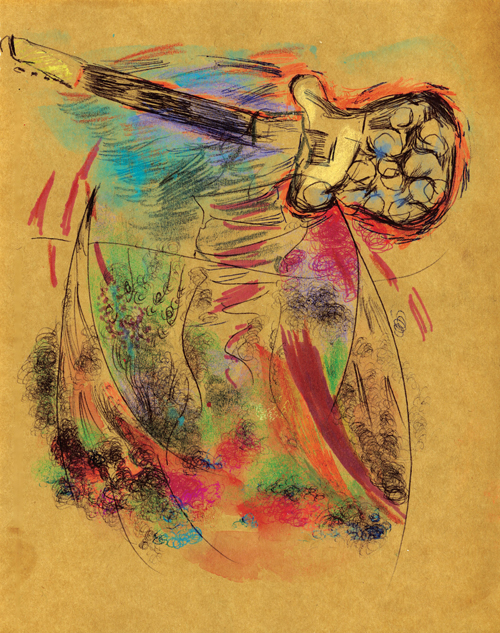
In an ironic twist of fate, Barrett turned up at Abbey Road Studios on June 5, 1975, while Pink Floyd were finalising the album dedicated to him. The sight of an overweight, bald, and unrecognisable Barrett was a shock to his old friends. Waters was reportedly in tears upon seeing him. Mason recognised Barrett only after being told it was him by Gilmour, and wrote that he was “horrified by this physical change.” After the remaining members played ‘Shine On’ to Barrett, he quietly slipped out of their lives once more, never to be seen by them again.
by Venantius J Pinto
Songs
Waters wrote all the lyrics for the album. The long opening and closing track, ‘Shine On You Crazy Diamond’ has been claimed by the band to be about Syd Barrett and the cost of genius, although the lyrics in the closing part of ‘Shine On You Crazy Diamond (Part 2)’ might be said to sound somewhat encouraging in their farewell address to Barrett.
‘Welcome to the Machine’, the second track of the album, tells a story of a young artist who disappoints his parents to pursue his dream of fame and fortune, only to find his artistic voice controlled by the mechanical, impersonal forces of the music industry. This song, which opens with throbbing echoes of machines, seems to embody Marx’s critique of capitalism.
The third track, ‘Have a Cigar’, sung by guest vocalist Roy Harper, continues Waters’ cynicism toward the music industry. With his usual sarcastic wit, Waters portrays a record executive flattering the band to keep them clinging to their dreams of fame by producing more records. At the same time, the executive’s insincerity is laid bare when he asks, “Oh by the way, which one’s Pink?” The sarcasm of this pun in the record executive’s glib encouragement can also be observed in the lines about teamwork as the path to success – which blithely ignore the relationship problems in group dynamics.
Storm Thorgerson’s imagery of the album cover, showing a robot and a statue in a handshake, reinforces the artificiality of the music industry while also tying into the theme of the absence of human feeling. This is amplified by images inside the album cover: two businessmen shaking hands, one of the men literally on fire; a sharply-dressed record executive with missing wrists and ankles, misplaced in a desert; a veil floating in a windswept grove; and a diver plunging into a lake without making a splash.
The title track of Wish You Were Here expresses in its very title a longing for connection in a world so often dominated by absence. Performed entirely on acoustic guitars, it remains a popular song across generations for conveying a sense of intimacy, despite being a sad reflection on absence. The song remains deeply personal for Waters, who describes it as a dialogue between his generous and his selfish self.
The song in its first two verses also touches on one of the oldest and most enduring problems in philosophy by questioning the human ability to distinguish truth from illusion, appearance from reality, asking, for example: “Can you tell… a smile from a veil?” This questioning has preoccupied philosophers for millennia. Plato famously explored it in the Allegory of the Cave, illustrating how humans can mistake shadows for reality. Centuries later, Descartes grappled with similar questions, hypothesizing that a “malicious demon of the utmost power and cunning” might be trying to deceive him about everything. Such questions allude also to the divide in epistemology between rationalists, who claim that the senses are deceptive and that reality can only be understood through reason, and empiricists, who claim that the mind begins as a blank slate grasping understanding only through sense experience. With lines like “So you think you can tell?”, Waters perhaps leans more towards the view that reality is shaped by perception, reflecting the postmodern distrust of universal grand narratives that seem to explain everything.
Aftermath
Similarly to The Dark Side of the Moon, the album Wish You Were Here may appear to be a gloomy, pessimistic reflection of Waters’ view of the human condition. Nevertheless, it also makes one conscious of the fragility of identity, the transitory nature of human relationships, and the ever-present threat of absence. At the same time, the album seems to be urging us to value presence, cherish friendship, seek genuine connections, and resist the alienating forces of society.
The classic Pink Floyd lineup held together from The Dark Side of the Moon (1973) until the album The Wall (1979), but Wish You Were Here marked the beginning of the end. At this point, the harmony that had defined the band during Dark Side was lost forever. Waters became increasingly dominant, eventually leading to Wright’s withdrawal from the band. This left Gilmour alone to struggle against Waters’ imposing direction. It was becoming clear that the band could not continue under such a divisive relationship. Eventually, it was Waters who gave up and left the band, convinced that Pink Floyd could not survive without him. Yet it did regroup without him under the leadership of Gilmour and with the re-engagement of Wright.
Barrett died in 2006, followed by Wright two years later. Pink Floyd, now reduced to two core members, Gilmour and Mason, released their final album The Endless River in 2014. This was composed mostly of instrumental material left over from the earlier Division Bell sessions, but includes the vocal track ‘Louder than Words’, written by Gilmour and his wife Polly Samson. This song was inspired by Samson’s observation of how communication was so minimal in the recording sessions, and yet their music endured beyond all the conflict.
This circles back to existentialism: Pink Floyd, like all existentialist philosophers, might at first appear pessimistic and depressing, but their deep awareness of life’s struggles and the complexities of human relationships only sharpens the appreciation of human resilience in the face of such adversity. This is why, fifty years on, the album Wish You Were Here remains as haunting and relevant to our lives as ever.
© Ian Rizzo 2025
Ian Rizzo is a finance and administrative manager who passionately pursues the study of philosophy in his free time. He currently leads the Philosophy Sharing Foundation in Malta.
Advertisement
