


Your complimentary articles
You’ve read one of your two complimentary articles for this month. To have complete access to the thousands of philosophy articles on this site, please
You can register for a free account to have four complimentary articles per month. We will occasionally email you a newsletter, from which you can unsubscribe at any time. We do not sell personal data or otherwise disclose personal information to other organisations.
Classics
The Necessity of Art by Ernst Fischer
Karzan Aziz Mahmood looks at Ernst Fischer’s advocacy of art.
In his classic work The Necessity of Art (1963), Ernst Fischer asserted that art is indispensable to experience. This perspective stemmed from his belief that humans need to transcend the confines of their individuality and find themselves within the collective. Fischer explores the idea that art fulfills the fundamental human need to reach beyond the self, to connect with others, and to experience a sense of wholeness that transcends individual limitations. He argues that the individual is driven by a desire to move towards fullness and universality, never content to remain merely himself. Through art, the individual experiences not only his own potential but also the energies and experiences of others. This interaction leads to a generalization of the individual, transforming him or her into a universal human. Fischer emphasizes that in art, as in other fields, the individual and society, the part and the whole, are interconnected, thus breaking down the dualism between subject and object. He also says that while art is a reflection of reality, it does more than merely mirror it: art actively shapes and transforms reality by imbuing it with meaning and facilitating a deeper understanding of the human condition. In this sense, art is both a product of its time and a force that can transcend the limitations of its era. Fischer contends that “art derives from reality, but it also seeks to transcend it.”
Fischer’s argument hinges on the idea that a person cannot sustain himself as an isolated individual: he struggles to break free from his individual boundaries and move towards becoming what Fischer, in his 1963 way, calls ‘the whole man’. This concept is central to Fischer’s discussion of art as representing the communal or social existence of the individual. In art, the individual channels his energy and potential into something greater than himself, seeking to connect with the world at large. This transformation is not limited to any single function or formula. Rather, art evolves with society, adapting to new needs and contexts. Yet despite the changing functions of art across different societies and historical periods, its core purpose remains to help humans make sense of their existence and to facilitate their growth and development. Thus Fischer suggests that art is not just a reflection of reality, but a tool for understanding and transforming it. This dovetails with his Marxist view that art can serve as a tool for social change.
Fischer also highlights the dual nature of art, which can both immerse individuals in the experiences of others and provide a means to step back and gain perspective. This duality is what makes art so powerful, as it allows for both emotional connection and intellectual reflection. This makes art indispensable. So art is essential for human life, because it allows people to explore and express their deepest connections with reality.
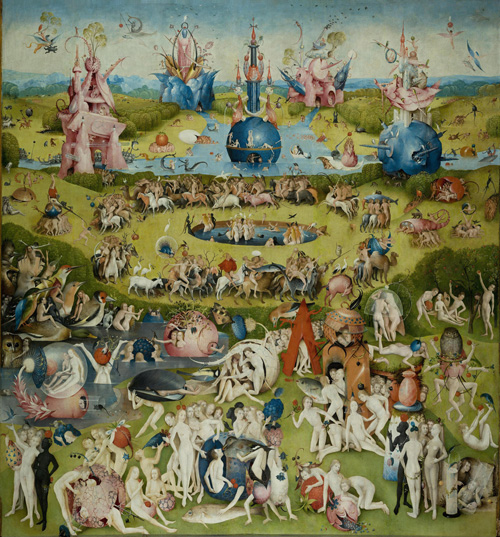
The Garden of Earthly Delights Hieronymus Bosch 1405
The Origin & Corruption of Art
The origin of art, Fischer believes, is closely linked to the development of human work and tool-making. Art emerges from the human need to transform nature. As humans began to use tools to interact with and modify their environment, they also developed the ability to imagine and plan, creating objects in their minds before bringing them into existence. This imaginative process – somewhat akin to magical thinking – is seen as the precursor to art. The act of shaping and improving tools, which required creativity and foresight, also laid the foundation for artistic expression. As early humans refined their tools, they also started to perceive and use them in ways that went beyond mere utility, imbuing them with meaning and purpose that transcended their immediate function. This process of attributing deeper significance to objects is what ultimately led to the emergence of art. Thus art originated as a byproduct of human labor, where the manipulation of natural materials to meet human needs evolved into the creation of objects that held symbolic and aesthetic value. So art is deeply rooted in the human capacity for work, creativity, and the desire to impose order and meaning on the world. It began as a practical response to human needs, but gradually acquired symbolic significance, blending practical skills with imagination to create works that reflected both their reality and their aspirations. The best evidence for this is the cave art of early humans, which was born out of the direct needs for survival rather than any artistic tradition (hunting scenes to teach hunting techniques, for example). These early forms of art were message-laden, conveying the dangers and realities of the world to the tribe through symbolic representation.
In the age of capitalism, however, art undergoes a significant transformation as it becomes commodified. Under capitalism, the direct relationship between the artist and the audience who commission the art is replaced by a free market system where art is produced for an anonymous competitive market. This leads to the artist’s alienation, as they’re forced to create not for a known patron but for an unknown buyer. This strips art of its previous direct social and human connections, reducing it to a commodity to be bought and sold, which fundamentally changes the nature of artistic creation and the role of the artist.
Moreover, while due to the expansion of production capitalism fosters the growth of new ideas, styles, and forms of artistic expression, it also creates a paradoxical environment for artists. On one hand, capitalism enables a tremendous diversity of artistic production and the exploration of new themes; on the other hand, it leads to the alienation and fragmentation of the artist, who becomes increasingly isolated and disillusioned. This is why the initial energy and optimism from the rise of the middle class, which supported artistic innovation, eventually gave way to a sense of disenchantment as the artist confronts the alienating effects of developed capitalist society. This disillusionment manifested in movements like Romanticism, which protested against the dehumanizing and commodifying tendencies of capitalism, reflecting the contradictions and struggles within this system.
The Purpose of Art & Artists
In his introduction of the book, John Berger provides a poignant insight into Fischer’s life and beliefs, emphasizing the philosopher's deep conviction about the transformative power of art. Despite Fischer’s political disappointments and personal struggles, he remained fully convinced of the role of art in challenging and reshaping reality.
It is often said that meaning is a subjective issue, residing within the mind, feelings, and world of the artist, and therefore cannot be well understood by others. For example, some consider it inappropriate to ask an artist about the intention or message behind their work. Fischer counters this by arguing that art, when it engages with reality, serves as a bridge between the individual and the world. Art, in Fischer’s view, is not a solitary activity but a communal one, capable of expressing shared experiences and emotions that resonate across different contexts and societies. This reflection of humanity allows us to recognize aspects of ourselves in others or in the broader world. He emphasizes that this process is a fundamental part of the creation of the ‘universal man’ – a concept rooted in the process of history rather than in metaphysical or theoretical abstraction. Art, he says, serves as the tool that merges and expresses the worlds of the individual and the collective. It is through art that man transcends his individual limits and progresses toward a universal existence. The necessity of art, therefore, lies in its ability to facilitate this process of human globalization and universality. However, Fischer warns that this connection should not be confused with ideological influences, which may distort this interaction.
Fischer also cautions that the connection between the individual and the world does not imply a conflict-free relationship. The individual’s interaction with the world should not lead to passive acceptance or unconditional participation. Fischer fears that such an approach could mislead artists into believing that they can remain detached from the world and still be true artists. He asserts that participation in reality is not optional for the artist, it’s essential. He dismisses the notion of art as a mere escape or diversion, stressing that true art must engage with and reflect the struggles and aspirations of humanity. For Fischer, art is a battleground where the forces of ideology, power, and human experience converge, making it a potent tool for both personal and societal transformation.
So, who is an artist, and what is their duty? Fischer believes that an artist must be capable of capturing and expressing experiences, turning memory into narrative and material into form. Fischer critiques Aristotle’s concept of art as a means of catharsis or emotional release, suggesting that art’s true function is far greater: it is the mastery and subjugation of the world’s most powerful forces. He also criticizes the notion that emotion alone is sufficient for artistic creation, emphasizing the need for knowledge and skill to shape and manipulate nature effectively. The artist must not be overwhelmed by the forces of nature, but should instead master and tame them.
To wrap up, The Necessity of Art offers a compelling argument for the indispensable role of art in both individual and social development. Art, according to Fischer, is not just a reflection of reality but a transformative force that shapes and is shaped by the human experience. It is through art that individuals can transcend their limitations, connect with the broader world, and contribute to the creation of a more universal human experience.
© Karzan Aziz Mahmood 2026
Karzan Aziz Mahmood, an Iraqi Kurdish writer, researcher, and translator currently in Canada, has a PhD in Literature and Creative Translation from Jaume I University, Spain, and an MA in English Literature from the UK. He is the writer and translator of nine books in or into Kurdish, and seven research papers in English.
Advertisement
