


Your complimentary articles
You’ve read one of your two complimentary articles for this month. To have complete access to the thousands of philosophy articles on this site, please
You can register for a free account to have four complimentary articles per month. We will occasionally email you a newsletter, from which you can unsubscribe at any time. We do not sell personal data or otherwise disclose personal information to other organisations.
Islam & Philosophy
Life Sacrifice
Yossra Hamouda on the murder of compassion & the act of mass murder.
When I was a child, I used to see the hand-prints stained in blood over walls and cars in Egypt after Eid Al Adha, an Islamic yearly celebration in which an animal is slaughtered and its meat given to the poor. I also used to see the large plastic bowls I could easily fit inside filled with meat and blood, coming out of the Odhya (the place of sacrifice). My mother was well-read in child psychology, and objected to the widespread practice of showing the Eid Al Adha slaughtering to children. She never allowed me to meet the sheep our family slaughtered, or to see the act of slaughtering. Her stance was not common then, though. Most Egyptian families took pride in forcing their children to witness the slaughtering, and in staining their tiny hands in the blood of the sheep, then printing the hand stains on walls or on their family cars.
I became vegetarian at the age of 21 because of my own philosophical reasoning, without any encounter with any vegetarians or vegans, without any reading about the topic, and without any prior contact with animals. When I became vegetarian, I knew no one who was vegetarian, and I met no other vegetarians at all until I was 29. I then received a lot of social and religious pressure from family members and friends, who accused me of being anti-religious and a non-believer, and my practice of vegetarianism forced me to get involved in many discussions about animal slaughtering that were triggered by my dietary choice. In one family gathering, a mother of a friend kept criticising the growing trend among Egyptian parents of objecting to showing their children the slaughtering in Eid Al Adha. She said: “We should continue to show the slaughtering to children to make them grow solid.”
My objection to her statement is the basic point of this essay. My argument is that the sacrifice of life as a core precept of religious and other doctrines, through the act of ‘murdering compassion’, is the basis for acts of mass violence practiced against the Other. Turning individuals ‘solid’ is the key word that describes this: the real sacrifice in Eid Al Adha is children’s compassion. It’s children learning to sacrifice their compassion for the sake of religious doctrine and societal expectations. In fact, they learn that if they do not sacrifice their compassion, they will have to sacrifice their faith. They may also learn that if they do not sacrifice a sheep, they will have to sacrifice their own well-being, because sometimes their families and friends may punish them for rejecting the slaughtering, or even for refusing to watch it. I remember one of my friends once saying: “I was forced not to cry while watching the slaughtering because if I cried, my grandmother, who was standing behind me, would punish me. I had to force my tears to remain paused in my eyes.”
There is a verse in the Qur’an that describes the act of ‘murdering compassion’ as a religious order. It says: “the female and the male who practice adultery, whip each of them a hundred whips and do not allow compassion for them to hold you back from practicing the religion of Allah” (Qur’an 24:2). This phrase orders Muslims to murder their compassion towards those who practice adultery and whip them because “this is the religion of Allah.” Here the female and the male who practice adultery are in the place of the sheep of Eid Al Adha.
My argument is not regarding whether adultery should be punished or not, nor is it about whether whipping is an acceptable punishment for that. It’s rather about the religious order to murder one’s compassion.

The Power of Life by Paul Gregory 2026
A Widespread Practice
This is not just an Islamic issue. Rather, the order to murder compassion is cross-religious and tied to different concepts of sacrifice that exist in various religions.
I try to travel to a non-Muslim country during Eid Al Adha every year, to avoid seeing the bloody hand-prints in Egyptian streets, and also to avoid watching the viral videos of sheep that throw themselves from high rise buildings to avoid being slaughtered. (The Egyptian government tries to prevent slaughtering in houses and streets through law. However, a lot of Egyptians insist on slaughtering the sheep in their home buildings.) Unfortunately, over the last two years I have been suffering from physical problems caused by secondary trauma from Eid Al Adha. Last year, I travelled to Nepal expecting that I would never have a similar experience in a Hindu country. However, when I entered the temple of the goddess Kali, I was told by the guide that hundreds of thousands of animals are sacrificed there every year for Kali’s satisfaction (she’s the Hindu goddess of death), and that the blood of the slaughtered animals stained the walls of the temple as part of the celebration. I saw the blood: it was the same as the bloody prints I know well in Egypt.
Months later, while I was preparing a talk on cross cultural and cross religious accounts of just war theory, I read the Hindu scripture the Bhagavad Gita. Again I saw clearly the murder of compassion as a religious order. In the Gita, Prince Arjuna feels compassion towards his enemies in war because he feels that there will be killing of “grandfathers and fathers, teachers, maternal uncles, brothers, sons, fathers-in-law and friends also in both armies” (trans. Swami Sivananda, 1999). He starts to question whether any kingdom deserves to sacrifice lives for its sake. He recognises that the war will protect the caste system; however, he remains reluctant to take the lives for which he feels compassion. The god Lord Krishna, however, encourages him to participate in the war regardless of the lost lives, because this is a required sacrifice for the sake of heavenly duty: “Happy are the Kshatriyas [warriors], O Arjuna, who are called upon to fight in such a battle that comes of itself as an open door to heaven! If thou wilt not fight in this righteous war, then, having abandoned thine duty and fame, thou shalt incur sin” (Sivananda 1999, 23). Here also, then, the god’s order is to murder compassion. Indeed, to follow Lord Krishna’s order, Arjuna should both murder his compassion and risk his life, as well as the lives of “grandfathers and fathers, teachers, maternal uncles, brothers, sons, fathers-in-law and friends also in both armies” as a sacrifice of religious duty.
A few years ago I decided to read the Bible. I was both shocked and furious when I read the Old Testament story of the attack on Amalek. The infamous part of the story reveals the absolute nature of the order itself: “Samuel said to Saul, ‘The LORD sent me to anoint you king over his people Israel; now therefore listen to the words of the LORD. Thus says the LORD of hosts: “I will punish the Amalekites for what they did in opposing the Israelites when they came up out of Egypt. Now go and attack Amalek, and utterly destroy all that they have; do not spare them, but kill both man and woman, child and infant, ox and sheep, camel and donkey”.” (1 Samuel 15). However, I found the rest of the story even more shocking, as it tells that The Lord was then angry because Saul did not kill all the sheep and cattle despite killing everyone else!
I had a lot of angry thoughts about this story, the most relevant being that it might instill in readers the belief that God can justifiably order a slaughter, and that any compassion felt towards anyone on His hit list should be suppressed because it impedes God’s vengeance. This murdering of compassion appears clearly in the phrase “do not spare them.” Sparing happens because of compassion. “Do not spare them” clearly resonates with “do not allow compassion for them to hold you back from killing them.”
Benjamin Netanyahu controversially referenced the Amalek story in a speech on October 28th 2023 at the start of the Israeli ground invasion of Gaza. There is a general relationship between murder of compassion, religious sacrifice, and mass killings of one group by another. I realised this from the words of one Gazan civilian interviewed during the Israeli assault, who said: “We are the ones being sacrificed.” The link he made was plain: in this respect, the Gazans did not differ from the sheep of Eid Al Adha. What the International Court of Justice called ‘plausible possible violations of the Genocide Convention’ could not have occurred without an Abrahamic religious understanding of sacrifice, and definitely not without the prerequisite of murdering compassion – just as the October 7th attacks could not have occurred without the murdering of compassion, either.
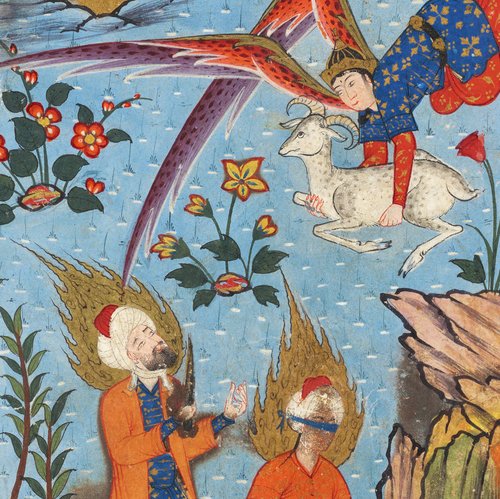
Ibrahim’s sacrifice is stopped Painting by unknown artist, 1577 CE
Sacrifice & Slaughter
Eid Al Adha derives from the story of God’s command to Abraham to kill his son, given in order to test Abraham’s faith. This story occurs in both the Qur’an and the Old Testament (although they relate to different sons), and it has been discussed in theological and philosophical works in all three Abrahamic religions. The Biblical account says: “After these things God tested Abraham, and said to him, ‘Abraham!’ And he said, ‘Here am I.’ He said, ‘Take your son, your only son Isaac, whom you love, and go to the land of Mori’ah, and offer him there as a burnt offering upon one of the mountains of which I shall tell you” (Genesis 22:1). The Qur’anic account says: “And when he reached with him [the age of] exertion, he said, ‘O my son, indeed I have seen in a dream that I [must] sacrifice you, so see what you think.’ He said, ‘O my father, do as you are commanded. You will find me, if Allah wills, of the steadfast” (Qur’an 37:102). Although Abraham ends up not killing his son but sacrificing a goat instead, this story nevertheless tells that us that to follow God’s orders Abraham needed to murder his compassion towards his own son. Another important idea within this story is that the alternative to sacrificing the son turned out to be the sacrificing of a goat. This story seems to me similar to the story of my friend who was afraid to cry while watching the slaughtering of the sheep because her grandmother would have punished her: the murdering of compassion requires instilling the feeling of fear and the belief that compassion is dangerous to the self. To murder compassion, it is important to instill the idea that the sacrifice of the other’s life is the only alternative to the sacrifice of the self.
In The Eight Stages of Genocide (1996), Gregory H. Stanton developed a model of genocide in response to the Rwanda Genocide. In genocides, it is important to believe in the necessity of the sacrifice of the other, based on the belief that if the other is not sacrificed, the self can never be safe, so it is impossible to co-exist. In other words, life sacrifice becomes inevitable to protect the self. This belief is instilled during the sixth stage of the genocide – polarisation. However, the belief in the concept of life sacrifice itself precedes all the stages of the model. There must be an acceptance of the concept of sacrifice for any stage of a genocide to take place. In other words, there must be a murdering of compassion for the intent to commit genocide to develop. The paper ‘Ritual and State Making in Precolonial Rwanda’ by André Ntagwabira and Chap Kusimba, (African Archaeological Review 38, 2021, p.581) contains many references to practices of both animal and human sacrifice as part of religious and political rituals – meaning that sacrifice was engraved in the Rwandans for centuries before the Rwandan genocide. Indeed, no intent of genocide could have developed without a prior understanding of the concept of life sacrifice.
Kill the Killing
No intention for mass killing can develop without first killing compassion. So if we wish to end the repetitive cycle of mass killing in the history of mankind, we should first start with the concept of life sacrifice and the murder of compassion that goes with it. We should examine and critique the ideological and religious basis of both, and question whether we should accept both, and also whether accepting both concepts means we’ll always be trapped in this cycle. If we decide that we want to get out of this cycle, then we should critique, condemn, and abandon both the concept of life sacrifice and the murdering of compassion. We should instead nurture compassion and plant in our hearts the belief that no life should be sacrificed for any concept. Lives precedes concepts, and no life should be sacrificed – no life of any kind.
© Yossra Hamouda 2026
Yossra Hamouda is an adjunct at the faculty of philosophy at the American University in Cairo and the founder of Bel Arabi Falsafa’s initiative for making philosophy accessible to the public in Egypt.
Advertisement
