


Your complimentary articles
You’ve read one of your two complimentary articles for this month. To have complete access to the thousands of philosophy articles on this site, please
You can register for a free account to have four complimentary articles per month. We will occasionally email you a newsletter, from which you can unsubscribe at any time. We do not sell personal data or otherwise disclose personal information to other organisations.
Brief Lives
Xenophon (c.430-355 BC)
Hilarius Bogbinder looks at the life of the other biographer of Socrates.
“Well, Xenophon, I have been told that you are an Athenian, and that was all I knew about you” (Anabasis, III,I,45). The philosopher, biographer, economist, horseman, and soldier Xenophon (430-355 BC) wrote these lines about himself in his perhaps most famous book Anabasis (The Expedition) – an eye-witness account of an ill-fated military operation.
His apparently effortless ease of writing earned him the sobriquet ‘the Attic muse’; but poor Xenophon was always destined to play second fiddle to his compatriot Plato (428-348 BC), who according to the ancient biographer Diogenes Laertius (180-240 AD) was jealous of ‘the sweetness of his style’ (The Lives of Eminent Philosophers). Certainly, there was competition between the two. Like Plato, Xenophon wrote a book called Symposium (the word means ‘drinking party’). In his version, like Plato’s, Socrates is one of the guests, though the topics of conversation are mostly different. Like Plato, he also wrote an account of Socrates’s trial called the Apology (which means In Defence). In some ways, as you’d expect, it overlaps with Plato’s Apology. Only, Xenophon’s account was more historical than philosophical: “It is true that others have written about this, and that all of them have reproduced the loftiness of his [Socrates’] words” (Apology, I,1), he wrote, with perhaps ill-disguised distain for Plato’s account. It does seem closer to the actual Socrates than the idealised version portrayed by Plato.
This stands to reason. One of Xenophon’s most celebrated works, Hellenica (On Greece) was a continuation of Thucydides’ (460-400 BC) History of the Peloponnesian War. Like that father of the discipline of history, Xenophon’s work was stepped in factual, realist historiography. The same sombre assessment was found in Memorabilia, which contained longer reminiscences of Socrates. In this book, Xenophon claims that Socrates developed the first Design Argument, or argument that the perfection of the universe is a proof of the existence of gods. Yet overall, he portrays Socrates more as a paragon of virtue and a good citizen and less as a deep thinker.
So was Xenophon merely a chronicler? An eyewitness to history rather than a thinker? Far from it. His writings were just different from those of Plato and other philosophers, and the topics he covered, from hunting and horsemanship to running a state as a household, had a more practical focus; but they were philosophical reflections none the less.
Xenophon the Man
Laertius described Xenophon as “a man of rare modesty and extremely handsome” (The Lives of Eminent Philosophers). His looks might have been good, but he was not always as self-deprecating as the biographer would have us believe. For example, in Anabasis he depicts a man telling him “I praise you for your words and depths, and I should wish as many as possible to be like you” (III, I, 45). This book was largely a study in military strategies and others in that field since have taken the view that our writer was every bit as profound a strategist as Sun Tzu (544–496 BC) or Carl von Clausewitz (1780-1831): “The centuries since have devised nothing to surpass the genius of this warrior” wrote Theodore Ayrault Dodge (1842-1909), perhaps the foremost military historian of the nineteenth century, in A History of the Origin of the Art of War from the Earliest Times to the Battle of Ipsus.
Born to an aristocratic family, Xenophon became a disciple of Socrates. After the Peloponnesian War fully ended in 404 BC with the defeat of Athens by Sparta and the fall of its democratic government, Xenophon supported the ‘Thirty Tyrants’ oligarchy that replaced it. As a commander, he was then responsible for quelling a democratic revolt. The restoration of democratic government understandably made him look for employment abroad. He found a position in the army of Cyrus the Younger (425-401 BC), the Persian king. That ended in failure, although Xenophon’s subsequent reflections on his defeat and subsequent retreat earned him respect among his peers.
Having sided with the Thirty Tyrants, he did not feel welcome in Athens. So, Xenophon then joined Agesilaus, one of the two Spartan kings (they always had two), for two years in 396 BC, in a campaign for the independence of Ionian Greece. For this he was banned from Athens.
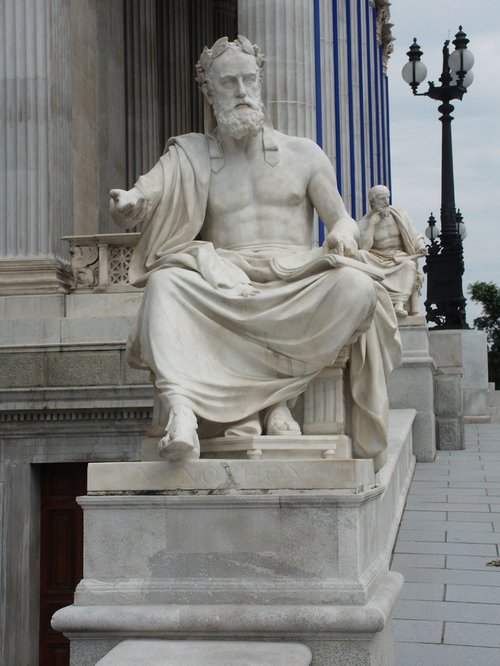
Statue of Xenophon in front of the Austrian parliament
Xenophon the Writer
Xenophon’s world was one of powerful men, and more than anything his work is a series of reflections on the difficulties of governing – often seen from the perspective of the dictators. This was especially so in Hiero, Or On Tyranny – an imaginary dialogue with the eponymous tyrant of Syracuse. Xenophon, with rare empathy for the dictator, lays bare the inherent instability in autocratic states, reflecting on “How can you possibly feel that you benefit your friends when you know that he who receives the most from you will be delighted to get you out of sight as soon as possible?” (VI,13), and the dilemma facing a tyrant who knows that “All who are subject to… despotism are enemies, and it is impossible to put them all to death or to imprison them” (Hiero VI,15). There is also a certain professional detachment in Xenophon’s reflection that “To be [a successful dictator] you must see to it that you let others do the unpleasant tasks: the duty of pronouncing censure, using coercion, inflicting pain and penalties on those who come short in any respect, is one that must of necessity give rise to a certain amount of unpopularity” (IX, 3). Hence, “a great ruler should delegate to others the task of punishing those who require to be coerced and should reserve to himself the privilege of awarding prizes” (IX, 4).
There are certain evident similarities here with the advice of the notorious renaissance writer Niccolò Machiavelli (1469- 1527 AD). Like the Italian, Xenophon also wrote largely fictional biographies to exemplify his theories. But whereas the former chronicled the lives and deeds of relatively minor Cavalieri – rulers of small states – Xenophon wrote about mighty men like the Persian ruler Cyrus the Great (600-530 BC), the founder of the Achaemenid Empire.
Although an Athenian from a democratic state, Xenophon had a thing for ‘strongmen’. Maybe it was for this reason he was ostracised from his native city. It might also explain why he took refuge in (and wrote positively about) Sparta. But the fact that he preferred to stay in the rival city once his banishment from Athens was lifted cannot have won him Athenian admirers. Nor can it have won him many favours with them that he rhetorically asked, “when will the Athenians…reach the standard of obedience to their rulers… [and] attain harmony?” (Memorabilia, III,v,16).
Plato was on the same page about aristocracy being preferable to democracy – however he showed more tact and did not spell out his admiration for the Lacedaemonians (their name for the Spartans). Not so Xenophon, who lavished his adopted home with praise:
“It occurred to me one day that Sparta, though among the most thinly populated of states, was evidently the most powerful and most celebrated city in Greece; and I fell to wondering how this could have happened. But when I considered the institutions of the Spartans, I wondered no longer”
(The Lacedaemonians, I,1).
Moreover, he was blunt and dismissive of his compatriots, whom he wrote were “like horses. The more they get the more they want” (Hiero, x,2). Coming from the man who penned On the Art of Horsemanship, it is tempting to joke that he knew what he was talking about. But the sly remark was, in truth about economics and not on the correct method of dealing with horses. Xenophon might be a giant of military and strategic studies, but his contribution to economics is strangely overlooked, especially as his Ways and Means can lay some claim to being the first book on economics in Western thought. The book reads rather like a manual from an MBA course, with empirically proven advice, such as “It is sound business to export silver, for whenever they sell it, they [the shipping firms] are sure to make some profit on the capital invested” (Ways and Means, II,3). Or this when he speaks about the ancient equivalent of sovereign bonds: “no instrument can yield… so fine a return as the money advanced by them to form the capital fund. For every subscriber of ten Minae drawing three Obols a day gets nearly twenty per cent” (III,9). But this economic treatise was not just a business manual written in the style of the Financial Times supplement. The book also provided economic reflections of a more theoretical nature that were literally millennia ahead of their time. For instance, he was the first to discuss the phenomenon in microeconomics known as ‘substitution goods’, namely, “that if gold is plentiful, silver rises, and gold falls in value” (IV). The little book also contained political observations of a more liberal persuasion. A kind of early Keynesian, who championed state intervention rather than pure market forces, Xenophon recommended that it was “a good plan to take the hint from the state ownership of public warships, and see whether it was possible to acquire a fleet of public merchant vessels and lease these under security like our other public property” (III, 14).
Xenophon the Contrarian
Xenophon was a contrarian – an occasionally cantankerous git – who came of age in a democratic state, but who lamented that in Athens “they have chosen to let the worst people be better off than the good” (The Constitution of Athens, I,1). He certainly paid a high price for such brusque remarks, but his bluntness was his hallmark. He wanted to tell things as they were. This remark about the Spartan king Agesilaus II (400-360 BC) is perhaps fitting: “If I speak falsely against the knowledge of the Greek world, I am in no way praising my hero, but I am censuring myself” (Agesilaus, V,1).
© Hilarius Bogbinder 2026
Hilarius Bogbinder is a Danish-born writer and translator. He studied politics and theology at Oxford University and lives in Australia.
Advertisement
