


Your complimentary articles
You’ve read one of your two complimentary articles for this month. To have complete access to the thousands of philosophy articles on this site, please
You can register for a free account to have four complimentary articles per month. We will occasionally email you a newsletter, from which you can unsubscribe at any time. We do not sell personal data or otherwise disclose personal information to other organisations.
Articles
Jürgen Habermas: Defender of the Enlightenment
Patrick West on postmodernism and communicative reason.
Jürgen Habermas (1929-2026) was a great thinker with wide interests. His work encompassed a vast array of fields from philosophy, social theory, sociology, politics to anthropology. Much has been written about him since his death on 14th March aged 96, by those revisiting his copious writings, placing into perspective his thoughts and theories, assessing his overall legacy. He will be remembered for many things, but he stood out for a stance which made him almost unique. For in the post-war period, when most Continental, left-leaning public intellectuals of his generation were either swayed by, or proponents of, postmodernism and relativism, Habermas stood firm as lonely champion of reason and the values of the Enlightenment. He was, in the judgement of many, ‘the last great rationalist’.
Born in Düsseldorf and raised in Gummersbach, to the east of Cologne, Jürgen Habermas studied philosophy at the University of Bonn, later moving to Göttingen and Zurich. He secured his first major post in 1956, when he was appointed assistant at the University of Frankfurt’s famous Institute of Social Research, widely known as the Frankfurt School. It was run by the two great radical leftwing thinkers of the age, Theodor Adorno and Max Horkheimer. In their 1947 work Dialectic of Enlightenment, the pair had not only condemned the oppressive nature of contemporary capitalist society, but attacked what they saw as the inherently oppressive nature and malevolent legacy of Enlightenment rationalism: its desire to suppress difference and eradicate otherness.
How did they reach that conclusion? Well, the Enlightenment of the 18th century had been about the application of reasons and science to expand our knowledge of the world. It led to an explosion of scientific discovery and material progress – to modernity, in short. But the systematic application of such methods to history and the human sciences inspired the creation of ‘grand narratives’ – overarching theories aiming to explain all of human social and political development. Such narratives – such as liberalism, social darwinism, Marxism – sidelined traditional loyalties or local attachments and customs with a cry of “you can’t stop progress!” Among the darkest eventual manifestation of this tendency was the ‘racial science’ of the Nazis, and the bureaucratised, mechanised mass murder in the death camps. Adorno and Horkheimer’s book helped plant the seeds of the future ‘postmodern’ turn of rejecting all grand narratives.
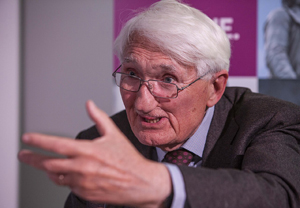
© Európa Pont 2014 CC 2.0 Licence
While Habermas was not as pessimistic as his mentors, being himself at that time more sympathetic to Marxism, he was likewise concerned with a West Germany and a western world which had become disconnected and disillusioned. His early research came together in his first substantial and acclaimed work, The Structural Transformation of the Public Sphere, in 1962. In this he charted the emergence in the 18th century of open ‘public spheres’, embodied in places such as salons and coffee houses, localities in which individuals could voluntarily assemble to engage in open, non-hierarchical conversation and rational debate. He also lamented their demise with the growth of mass media, mass entertainment and an ever more intrusive bureaucratic state, all of which, he thought, tended to turn citizens from participants into passive spectators and clients. The book was also a riposte to Adorno and Horkheimer, expressing the hope that this public sphere could be revived, and that the Enlightenment project could be redeemed.
The quest for dialogue, and the necessity of reason as a means through which it was to be conducted: these were the two constants of his oeuvre. It culminated in his magnum opus of 1981, his two-volume Theory of Communicative Action. In it he sought to draw a distinction between on the one hand ‘instrumental reason’, a mode of thinking that Adorno and Horkheimer deemed typical of the Enlightenment, which treated knowledge as an empirically self-evident means to an end, and on the other hand what he called ‘communicative reason’. This valued the exchange of knowledge and the collaborative employment of reason for the purpose of attaining consensus. Once the barriers to free and open communication had been dismantled – shorn of a legal-bureaucratic state and the distracting trappings of capitalism, particularly mass media – Habermas envisaged an ‘ideal speech situation’ in society in which the ‘non-coercive force of the better argument’ prevailed.
This, somewhat understandably, led to accusations of naïve utopianism from his detractors. These emanated not only from conservatives who scorned his ill-defined, lofty political vision, but by many on the left. By the 1980s, with the dreams of world-changing socialism having been dealt a fatal blow by the abortive student uprisings of 1968, and with the shortcomings of state socialism in the east becoming all too apparent, a mood of pessimism had enveloped progressive thought throughout the west. In academia and among progressive intellectual circles this manifested itself in the belief that the Enlightenment project was moribund, not least because, in the opinion of many, it was faulty to begin with.
Many in the years after the war came to think that the West was now in a state of fragmentation, moral fatigue and relativism that they called postmodernity. A corresponding theory, postmodernism, held that all rational foundations for knowledge were unsupportable and even oppressive, yet it was not until the publication in 1979 of The Postmodern Condition by Jean-François Lyotard that both the diagnosis and the theory gained wider acceptance.
That book’s main purpose was to declare that the age of ‘grand narratives’, of secular theories with their belief ‘in progress, in consensus, in transcendental values’, was over. And Lyotard’s principal, personal target of condemnation was Habermas, who he saw not just as purveyor of a ‘totalising’ grand narrative which valorised conformism, but of supporting the unsustainable idea that we had any foundation to establish truth and therefore build a better society.
For his endorsement of reason and seemingly tacit acceptance of human subjectivity, Habermas was likewise dismissed as a dreamer by another postmodern luminary, Michel Foucault. Whereas Habermas was proud to call himself as “a defender of modernity… in the tradition of philosophy from Descartes to Kant”, Foucault believed neither in a Kantian autonomous self nor in the Cartesian self-contained mind, holding instead that we consisted of fragmented, decentred selves and that ‘man’ was but a western invention.
Foucault contended that there couldn’t exist any standpoint or universal principle from which to make judgements. Habermas replied by asking from which standpoint Foucault could possibly make such a judgement, or how he could employ reason to make that or any other cogent argument. Habermas deemed his detractors to be hopelessly snared by this paradox, taking this as proof that the mental trappings of modernity could not be discarded so easily.
Notwithstanding Lyotard’s assault and Foucault’s derision, Habermas remained resolute. He knew that his task wasn’t easy, that he was almost a lone figure swimming against the tide. In a 1981 interview, defending his theory of rationality, he poked fun at those “who find such a theory of communicative rationality a shocking requirement, who cannot swallow such an awkward word as rationality without turning red.”
He himself was rarely flustered. Indeed, his eagerness to engage in controversy can be understood as intrinsic to his life goal of participatory debate. He put this into practice on a more political stage during the mid-1980s when he helped to launch the ‘Historians’ Dispute’ (Historikerstreit) in West Germany, denouncing an emergent tendency by some conservative historians to downplay or relativise the crimes of the Nazis.
Rather than take offence at the slings and arrows of postmodernists, Habermas was more concerned about the causes and consequences of this intellectual mood personified by Foucault and Jacques Derrida. He feared it represented a frivolous and reactionary development, even a nihilistic renunciation of politics altogether. In his 1987 work The Philosophical Discourses of Modernity he accused those who had “bade farewell to modernity” of embodying a kind of “neo-conservatism and aesthetically-inspired anarchism.”
In many respects, however, his detractors had been assailing a straw man all along. It was not as though Habermas pushed a fundamentalist strain of Enlightenment thinking, one found more openly in the positivist scientism of August Comte. His was more like the contingent and open-ended mode of thinking typical of the essayist and pamphleteer Voltaire. Indeed, Habermas himself was once a journalist, and first made a name for himself in 1953 with an essay in the Frankfurter Allegemeine Zeitung, criticising Martin Heidegger not so much for his public endorsement of the Nazis in 1933 but for his continued silence about the horrors of the Third Reich after the war.
Whereas his detractors believed there was a profound epistemological crisis afoot in the West, what with the death of God and then the death of rational, autonomous ‘man’, Habermas still believed in the sustaining force of consensus through discussion. His 1992 collection of essays, Postmetaphysical Thinking, argued that we could jettison the crutch of a religious or noumenal ‘beyond world’ and still pursue truth through critical thinking. He came to conclude that emancipatory potentials were built within the structure of language, and that rational communicative action, working through speech acts, could bring to the surface an inherent universal morality; he spoke of ‘reason embodied in cognition, speech, and action.’ And though he described himself as being in the tradition of Descartes and Kant, he was no disciple of either, dismissing as inadequate the notion of the autonomous human subject. He shifted instead the emphasis to intersubjectivity in pursuing his ideal state of ‘mutual understanding’.
Habermas’s enterprise was directed not so much to a totalising, moral absolute, but to a new Dialectic of the Enlightenment, one which acknowledged and explained the negatives of the Enlightenment, yet which still justified its core tenets in the hope of pursuing freedom and justice. The title of one of his most celebrated essays, first given as a speech in Frankfurt in September 1980, summed it up: ‘Modernity: an Unfinished Project’. In a 1987 essay he restated his approach in even more unfashionable terms, espousing a philosophy that adhered to “empirical theories with strong universalistic claims.”
It could be argued that we need Habermas’s vision now more than ever. While arguments over postmodernity might appear archaic now, or postmodernism a bygone fad, many of the latter’s tenets have seeped into the mainstream. It’s no coincidence that wokery, or hyper-liberalism, is referred to in some academic circles today as ‘reified postmodernism’, a recognition of its indebtedness to that movement. That inheritance is clear. One only has to observe hyper-liberalism’s preoccupations with subjectivity and personal experience, its Foucauldian belief in ubiquitous and invisible power forces, its reliance on Judith Butler’s theory of gender. Its activists have much the same targets of opprobrium as their forebears: Western, rational, hierarchical, binary thought systems, locating them all in the context of an oppressive Eurocentric realm. Here we see the obvious legacy of Adorno and Horkheimer.
One of the main accusations levelled against hyperliberalism is that it is intolerant and irrational. This charge not only hails from conservatives, but from feminists, classical liberals and from the centre-left. In an age when some still turn red at the mere mention of rationality, it remains timely to recall the appeal from Jürgen Habermas for reasoned dialogue, and recognise the value and need for mutual understanding.
© Patrick West 2026
Patrick West is a columnist for Spiked, contributor to The Spectator, and author of Get Over Yourself: Nietzsche For Our Times (Societas, 2017). Contact him on X at @patrickxwest.
Advertisement
