


Your complimentary articles
You’ve read one of your two complimentary articles for this month. To have complete access to the thousands of philosophy articles on this site, please
You can register for a free account to have four complimentary articles per month. We will occasionally email you a newsletter, from which you can unsubscribe at any time. We do not sell personal data or otherwise disclose personal information to other organisations.
Fiction
The Tragic Destiny of Life on Earth
Grant Bartley regrets ever getting into a time machine.
A thousand years after the idea was first proposed, in the twenty ninth century humanity finally cracks time travel. For our first expedition in our time ark the Epimetheus – a glinting crystalline egg on legs – my fellow adventurers and I set off to discover humanity’s future. It turns out to be a depressing odyssey, as you might guess.
We’re responding to an apparent distress signal, which itself isn’t a great omen of things to come. Our sights are set on some quantum tech our sweeps have spotted around 500 Million Years In The Future, pulsing out “SOS” in Morse code in tachyons like a time beacon. (SOS! Morse Code! The Intel had to look them up.) But first we’ll stop off at 100 Million Years In The Future, just to see how bad (or possibly good – wouldn’t that be a nice surprise?) it’s become for life on Earth once our species has had more time to stew on it. We plan to advance in 100-million-year hops until life is extinguished or the Sun expands to swallow the Earth, whichever comes first. We’re told that at present we’re just over half way through the projected billion year adventure of multicellular life on Earth; that the Sun will become hotter until in perhaps half a billion years the surface of the Earth will be too hot for liquid water. The last remaining life will boil away.
This is what science has long predicted, but now we’ve the ability to find out whether that is correct – or whether future humans will find some way to save ourselves from the Sun. (I have a bet with Cassandra on that. Unsurprisingly, she took the more pessimistic wager. I fear she’ll win, unfortunately.)
First stop, then: 100 Million Years In The Future.
Astonishingly, we find that our descendents are still recognisably Homo sapiens. But Cassandra and I feel human society to be both uncanny and dismaying, like the sun of civilisation’s already set. It didn’t help our first impression that they swarmed over the ship with black machines and wide eyes pretty fast when we popped up. We had to shake them off before we could open the airlock to introduce ourselves. Not a great start to our whole expedition.
Our descendants show themselves to be pallid, shrinking simulations of their intrepid forbears. They live most of their waking half-lives hooked up through neurally-fused wires in an internet so advanced it’s alive. Our zomboid ratlike great grandchildren can still move about unaided when they need to – like a short walk or other brief exercise. For most physical activities though they’re assisted by biological machines they call ‘shepherds’, built, run, and maintained by the watching web.
The lighting of their communal hives is not so impressive, either, being an uninviting icy blue. “Funny,” I whisper to Cassandra on our guided tour of the local human warren, “the worst thing about this is, it reminds me of the tech dependency of our own time – except now it’s written in stone as Human Destiny.”
She grumbles: “Our tech dependency has become engrained into the gene pool! I suppose it was virtually inevitable.” I chose Cassandra for this mission because she’s an evolutionary biologist who studies why species develop in the ways that they do – in particular, the human species. Looking around at our pallid big-headed offspring hooked together in artificial icy gloom I whisper to her, “We gotta get outta here… I hope there’s something better for humanity in the future future.” I grimace-smile to signal my resistance to despair.
“Me too,” Cassandra says, smile frozen desperately, too.
“Me too,”agrees our recording droid. He’s not smiling, mainly because he doesn’t have a mouth.
The electrotermites didn’t seem sad to see us leave their hive, and the feeling was mutual.
200 MYITF. Cassandra recites her observations to the droid: “Humanity seems to be adopting an ever more sedentary lifestyle. From using tech to link together, as we saw on our last stop, humans have now evolved into having their nervous systems connected together organically, through vinelike extensions from their heads. Evolutionarily, apparently the body is taking on a more botanical or perhaps fungal form, the more it integrates with the biotech. There are still many species of plants and animals, I’m glad to report” she notes. “Humanity still manipulates and exploits the ecosphere for its own benefit, though.
They were friendly enough, but we didn’t stay for dinner.
Next: 300 MYITF. The network of human culture that’s grown into our species vegetating across the Earth has become decidedly dank. The ambience is dark, hot, humid, swamplike. A low hum fills the air from the murmuring of human pods and the rustling of leaves. Dark green humanoids squat lethargically at the edges of steaming pools. Their head-vines connect them to central hubs which sprout fat, flat, dark green leaves like cyberlotus. Cassandra dictates her reports to the droid: “Three hundred million years from now, we’ve become more plant-like than human-like in many ways, including becoming green, as you can see.” The droid looks round to record the nearest ring of vegehumans connected together through green vines. When it faces her again she continues: “Now that humanity is almost a global plant, biodiversity is an antique idea. There are few other animals or plants apart from the organisms strictly needed to maintain the human ecosphere, for example to keep the carbon cycle going – such as trees, sea-weed, and plankton, and all the insect and animal species helpful for vegetable humanity, too. See Appendix for more.”
“This isn’t exactly the picture of Heaven on Earth from the end of the Bible,” I comment.
Cassandra replies, but looking at the droid rather than me: “Unfortunately, this seems to be the human race stagnating to extinction. A long, green fade-out of the flickering light of self-awareness – maybe the only such light in the whole universe.”
“It doesn’t look good,” I agree, looking round.
“Humanity vegging out under a canopy of thickening atmosphere is not good?” the droid asks sarcastically – cheekily, I think.
“Who can blame humanity?” Cassandra ponders. “It’s a long path to extinction. Might as well relax and enjoy the slide.”
We only hang round here long enough to record what’s going on with the planet biologically. Our translators never got anything intelligible from any encounter with ‘post-engagement’ humanity. Our IT systems were totally incompatible, theirs being completely organic. Try patching into a CPU as self-aware tree. Well, we did, repeatedly. But their codes, and their minds, had become too alien for us to decipher. So we didn’t talk to each other.
In the final era to which the Epimetheus jumps us, humanity has turned into a crystalline fungus, having networked itself together through silicon-encrusted filaments underground around the Earth, like a giant brain – or rather, as a giant brain.
None of this was apparent to us at first, though.
We land 412 MYITF, approx. Through the diamond portholes we see sand, rock, and dust. Thick brown clouds smother the land in shifting brown shadow. Cassandra glances skyward: “That must be some pressure cooker planet out there, right?”
“It’s 200 degrees,” I say, tapping the temp display. “Phew. What a scorcher.”
“Nevertheless, it’s raining something.” She points to the ground. For a few moments we stare in disbelief, watching the steamy rain hit khaki rocks and instantly sizzle to nothing. Pointing, I say, “Those lily pads or whatever they are must be super resilient.” (On further investigation, it turns out that their spiky ochre leaves are as hard as teeth, and that the chemicals they suck from the blasting atmosphere are cooled through aluminium-reinforced root filaments.)
Studying screens, Cassandra responds: “Apart from those plants, tardigrades, and lichens, the data we have so far indicate no complex life. The Sun must have burnt it all away some time in the last hundred million, I’m afraid. Very sorry to have missed your departure, human race.”
“Maybe the end of humanity will remain a mystery after all, then.” I match her dejection: “I’m very disappointed. I was relying on the sponsorship from this trip to expand the research.”
“Not so fast!” Cassandra exclaims, holding up her index finger, squinting at the screen, then turning to me smiling: “We’re picking up radio signals! From several locations around the world… The nearest is about 1,800 kilometres west of here.”
“What we waiting for? Let’s go!” I say, pulling the throttle to lift us into the solemn air of the cemetery planet, its stony landscape filling our view as the Epimetheus banks to turn towards the nearest pulse. It means humanity’s still broadcasting into the void even after almost half a billion years!
“Unfortunately, the signals don’t guarantee that anyone’s still around,” Cassandra comments. “It’s more likely that the facilities are automated and self-maintaining.”
The signal leads us to land next to a mountainous rock, and we suit up for extravehicular nosing about. The sand storms are so hot and furious that without a pressure suit the grains would punch through your body at the speed of sound. Welcome to Future Earth. Cauterised to death in a second by a gust of wind.
Upon our landing, a doorway opened in the rock. It shuts when we walk inside. For a moment we’re in darkness, then light shines from a hologram in front of us. We watch it cycle flickering and glitchy through the biohistory of humanity, presenting images from each stage of our evolution a few times until it settles on what I and Cassandra would recognise as a human being – female, with brown eyes, olive skin, black hair, smiling.
Silent, waiting.
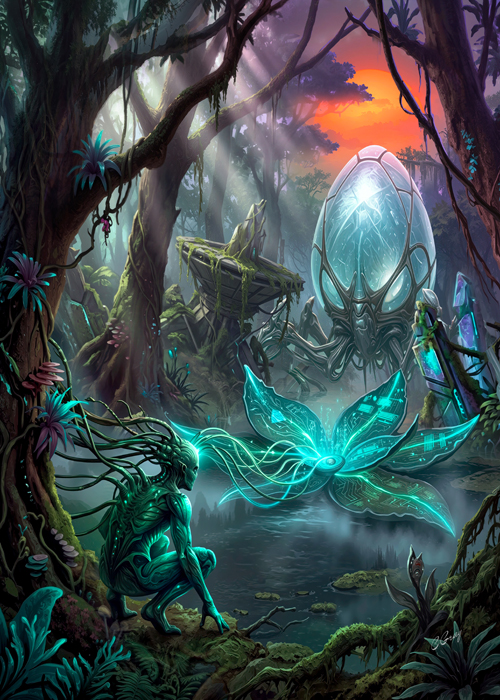
For more art by Cameron Gray, please visit parablevisions.com and facebook.com/camerongraytheartist
“Hello,” I say, “ Errr… Who, or what, are you?”
After a second she says, “Welcome fellow humans. I am Sapphira. I am assigned so that you, our lost cousins returning at last from the stars, can make familiar contact with us Remainer humans. How fares humanity in the universe? And may I ask, from which system or perhaps galaxy do you return to us? What are the co-ordinates of your colonies?”
I hold my palm up to the light: “We’re not extraterrestrial. We’ve actually come from the past – from about four hundred million years ago, in fact. We’ve been seeking the destiny of humanity. We’re sad to find that we’ve apparently disembarked too late. These automated facilities are the only evidence we’ve found of humanity, or human history, still left on the Earth.”
“It’s not surprising, given the weather,” Cassandra explains.
“The facility is not automated, and the human race is not dead!” the woman of light replies – I could swear, laughing.
Cassandra asks before I can: “What do you mean?”
A deep, soft voice behind us hisses, “She means we’re not dead yet! And you won’t be, either, if you want to remove your helmets. I’ve adjusted the atmosphere in the station to accommodate your early-Earth bodies.” We turn to peer into shadows. Stony vines cover stony walls, floor, and other stony surfaces, including tables, and large cubes. I can see nothing vaguely human – even the rough approximation to humanity the world wide weed had been. Nothing organic at all, in fact. Then a bunch of wires emerging from a small stone pyramid conspicuously wave: “I’m over here. I’m Tirex X Delta 157, the Guardian of Station 157. I apologise for not introducing myself sooner. It took us humans a few seconds more than the AI to relearn your language.”
“Pleased to meet you, Tirex” I say, resisting the urge to bow to a waving rock. Cassandra asks, “We’re visiting from the twenty-ninth century, if that means anything to you?”
“No. But clearly, it is a very long time ago… It seems your problem with finding humanity is, you don’t know what you’re looking for!” Tirex’s delocalised voice laughs round the chamber, then elaborates: “You really wouldn’t recognise us. The human community has become a little, you might say, crystalline, and we have dug our roots deep into the Earth.”
We turn back round as Sapphira’s image is replaced with a floor-to-ceiling display of the Earth. For a second we glimpse the thick cloud shrouding the planet, then dive through it to fly across a barren plain looking to me like Mars – rocks and sand without apparent life, and without rivers, lakes, or seas. Then we dive into the soil – and suddenly the room’s lit up with a glow-worm tangle of filaments. They start just beneath the Earth’s surface, but grow deep. The Earth indeed looks like a brain. “This is what we’ve become! Human culture has become an immense network of minds, literally throughout the Earth! And within our collective memory is housed… all the treasures of human history!” our host finishes triumphantly, proving that even a stalagmite can be pompous. He’s probably glad to have an audience, especially after unknown thousands of years of waiting. He adds: “We even have the archaic scripture called Pride and Prejudice in our banks. But although many scholars theorise, I confess I cannot understand it.”
“Neither do we understand it in the twenty-ninth century,” I say.
“Speak for yourself,” Cassandra retorts.
“The Mind stretches around the planet, and controls it!” Tirex boasts further. “We can act into this world through vicarious embodiment, too. Like… this!” Three cubes morph into seat shapes, then shuffle shyly behind Cassandra, me and the droid. We’re nudged persistently by the chairs to sit in them, as our narrator continues the history of the burial and calcification of living humanity: “Once the rains became too hot and violent for vegetation, the Remainer Parents thought hard about our options. The only long-term way they could think for surviving climate change, was to go underground – while assuring a source of energy, water, minerals, and oxygen, of course…” Images of water reclamation and of vast civic engineering projects flicker all around us.
After an hour or so more of a (depressing) history lesson, we take our leave to hunt the rogue quantum distress beacon. We finally pinpoint it, at just over 600 MYITF. The mystery only deepened as the signal was from within the crushed shell of a ship whose nature we couldn’t make out. We had to drill deep with Epimetheus’s laser just to reach it; then melt the rock around it before we could get in.
In fact, the anomalous tech proved to be a standard spacetime stabiliser, such as we already have in our time, repurposed to broadcast tachyons. The surprise was that the wild-eyed, bearded castaway who’d set it off is a human human – and he’s still alive!
His name is Raowul Torvis, and he’s from the thirty-second century. His ship was damaged when he’d leapt far forward to see the scattered debris of the Earth 5 Billion Years In The Future: “The Earth was just a ring of asteroids bathed in the blood orange glow of the bloated Sun,” he laments, and jokes, “I think a chunk of old America hit me! I managed to phase back to the previous time I visited – now, or 642 Million Years In The Future, whatever you prefer – but as I popped up my ship was caught in a lava flow, so the last man on Earth became the last man under it.”
Once safely inside the Ep, Torvis sighs: “I followed the dying trace of life to the End of Days.” He insists on showing us holographic highlights of his journey, while giving a eulogy for life on Earth: “Even after liquid water disappears from the surface, complex life still holds out for nearly another hundred million years,” he pronounces. “Then, after a mega-greenhouse period the atmosphere evaporates. Eventually the CO2 clouds boil away, over a million-year period.” We watch the tragedy speeded-up across the floor and walls of Epimetheus’s bridge, clouds fizzing fast into nothingness. Torvis continues: “The human species holds out for another forty million years even after this, incredibly… then an infection finally finishes off subterranean-web-brain humanity. And once we go, rest in peace all multicellular life on Earth, since we were sustaining whatever other complex life was left.” The lights go dim. “After a couple hundred million more years or so, all single-celled life is baked out of the Earth, too – until we get to the emptiness around us…” The landscape, both inside and outside the ship, is grey sand and rocks under a starry sky. The Earth-desert shimmers eerily against the glass and walls.
“It’s like the surface of the Moon,” Cassandra points out.
“Before they blew it up!” Torvis retorts. “It’s a long story.”
“Thus all life presently becomes dust. RIP humanity, and life on Earth.” I intone darkly in the shadows, as Cassandra and I instinctively bow our heads.
“Well at least Titan and Enceledus are having a renaissance, apparently!” Raowul says, brightly, looking into the sky, perhaps even in the right direction for one of them. “I caught transmissions from them just before you turned up.”
Cassandra replies, “It’s a shame we can’t get there in this, then.” She pats the white-faux-leather arm of her chair.
“We’ll visit them once we get a sponsor who can upgrade it to interplanetary,” I say hopefully, still feeling wistful for life on Earth even as I click the button home. “We have data someone somewhere will pay a lot for us to publicise.”
“Or to keep quiet,” Cassandra says with a knowing smile.
© Grant Bartley 2026
Grant Bartley is Editor of Philosophy Now. He’s glad he’s not a materialist. His video on the nature of history, The Metarevolution, can be found at miniurl.com/Metarevolution.
Advertisement
