


Your complimentary articles
You’ve read one of your two complimentary articles for this month. To have complete access to the thousands of philosophy articles on this site, please
You can register for a free account to have four complimentary articles per month. We will occasionally email you a newsletter, from which you can unsubscribe at any time. We do not sell personal data or otherwise disclose personal information to other organisations.
Tallis in Wonderland
Martin Heidegger & the Evaporation of Freedom
Raymond Tallis watches freedom disappear in a puff of Heideggerian smoke.
It’s one of the ironies of the history of philosophy that Martin Heidegger (1889-1976) was embraced as a father of the existentialist thought that dominated Continental philosophy in the middle of last century. There is no mystery as to why he was initially welcomed into the existentialist fold. His description of the relationship between ‘essence’ and ‘existence’ in humanity could have been the motto of existentialism: “ The ‘essence’ of [human being] lies in its existence. Accordingly, those characteristics which can be exhibited in this entity are not ‘properties’… of some entity which ‘looks’ so and so… they are in each case possible ways for it to be, and no more than that” (Being and Time, trans. John MacQuarrie, Edward Robinson, p.67, 1927). This prioritising of existence over any predetermined human essence lay at the heart of Being and Nothingness Jean-Paul Sartre’s magnum opus of 1943. We humans, Sartre proclaimed, are free to choose what we are. Our freedom is limited only by our not being able to choose not to be free. Heidegger’s ideas, then, had directly fed into the birth of Sartre and Simone de Beauvoir’s classic version of existentialism. So whence the irony?
After initially welcoming Being and Nothingness, Heidegger changed his mind. Sartre’s book was “too metaphysical” – though it’s not clear what he meant by that. More to the point, the human body was central to Sartre’s account of human being; and yet it scarcely has a walk-on part in Being and Time (I discussed this in ‘Heidegger’s Ghost’, Philosophy Now 173). Embodiment is the necessary condition of what Sartre called ‘human reality’ – his stand-in for Heidegger’s ‘Dasein’. The Sartrean body has a three-fold existence: firstly as a ‘for-itself’, lived in the first-person; secondly as an object revealed to the others’ gaze; and thirdly in the bodily self-consciousness we feel in the presence of others. Yet as I argued in ‘Heidegger’s Ghost’, it’s impossible to understand how Heidegger’s bodiless Dasein could have had any reason to exercise its freedom, or the means to do so.
This notwithstanding, existentialists were attracted to Heidegger’s notion of ‘authentic’ as opposed to ‘inauthentic’ behaviour, with the former being closer to genuine agency.
It is not entirely clear why. After all, according to Heidegger, our customary state is that of inauthentic being. Lost in the ‘they’ (the mass of humanity), we are subservient to “the tasks, rules, and standards, the urgency and extent of concernful and solicitous Being-in-the-world” we have not chosen (Being and Time, p.268). For most of us, adherence to ‘tasks, rules, and standards’ while being ‘concernful and solicitous’ are surely the characteristics of a conscientious, reliable, trustworthy, honest, competent human being. A partner, colleague, or parent who is not, sounds like a partner, colleague, or parent from Hell. But Heidegger dismisses this inauthentic Dasein as being ‘carried along by the nobody’.
Authentic being, a genuine expression of freedom, is on the other hand for Heidegger ‘Being-towards-death’ – an anticipation that “reveals to Dasein its lostness in the they-self, and brings it face-to-face with the possibility of being itself… in an impassioned freedom towards death – a freedom which has been released from the Illusions of the ‘they’, and which is factical, certain of itself, and anxious” (p.311).
This rather narrows the scope of freedom. What’s more, it’s a high price to pay for what may be a contradiction: “to the extent that this Being towards its potentiality-for-being is itself characterised by freedom, Dasein can comport itself towards its possibilities, even unwillingly” (p.237). How do you act with conscientious freedom ‘unwillingly’?
To add to the confusion, Heidegger argues that describing the behaviour of the ‘they-self’ as ‘inauthentic’ is not meant to express any ‘negative evaluation’. Many existentialists would cancel their subscription to the Heideggerian Club at this point, as authenticity is one of their highest values.
Taming Time & Being
There’s worse to come. According to Charles Guignon in Interpreting Heidegger: Heidegger’s Concept of Freedom, in his pursuit of (bodiless) freedom, Heidegger seems to argue that a proof of freedom is neither possible nor necessary. Instead, proof is replaced by some spectacular assertions, according to which human freedom is found in – even founded in – the very nature of Being. (Fasten your seat belts: you’re in for an even bumpier ride.)
Heidegger took the first step of this argument in On the Essence of Human Freedom (1930), where he asserted that freedom was ‘the ground of possibility of Dasein’; in short, human being comes packaged with freedom. If freedom were written into the very nature of Dasein, however, it would be difficult to understand the contrast between free and unfree human acts, or, indeed, between authentic and inauthentic modes of comporting ourselves. This does not seem to have worried Heidegger, for he subsequently embraced the even more radical claim that freedom is ‘prior to Being and Time’, the protagonists of his magnum opus. The rationale of this leap is worth examining.
First of all, Time. In Being and Time and subsequent writings, Heidegger argued that Dasein’s time is primordial time, in that it has priority over the time of the physical world. Dasein’s time is the time of care – the time of Dasein’s way of ‘being an issue for itself’. This kind of time is however tensed time: the time of present, past, and future. In it we are for instance ‘ahead of ourselves’ as ‘Being towards one’s ownmost possibility’. This being ahead of ourselves, we are assured, is the condition of freedom.
Unfortunately, prioritising tensed, human-experienced time, does not fit with our usual understanding of our place in nature. Physical time vastly precedes (and may, alas, vastly succeed) the time of human beings: there was a lot of time before Dasein cared about anything. The sun shone before Dasein got to care for itself. But Heidegger does not seem to acknowledge that we’re late arrivals in the universe and that the earth was born billions of years before the first human. Besides, if humanity really were gathered up entirely into the tensed time of care of present, past, and future, it’s not clear how its actions could interact with a material world, which is subordinate to tenseless (physical) time.
All of this is pretty obvious. So why was it not obvious to Heidegger? Why did he overlook the difference between (tenseless) time as a property of the material world and (tensed) time as a feature of the human world?
And what of Being? According to Heidegger himself, “the decisive experience of my path of thinking which cannot be remembered enough” was a ‘thunderbolt’ that struck him early in his philosophical career and remained with him to the end of his days. What was this thunderbolt? It was the revelation that ‘Being is presence’. He means that Being itself cannot be separated from Dasein (which means, ‘being there’), that is, from experience. No Dasein, no Being. This is reflected in his never completed Introduction to his collected works, The Legacy of the Question of Being, where he argues that Being needs human being.
I don’t have space to trace all the ways in which Heidegger engaged with this thought, and the problems it presents to his scholars, and indeed to Heidegger himself. Suffice it to say that Heidegger tried to separate Being-as-presence from beings (that is, individual entities or objects). Affirming this so-called ‘ontological difference’ led him to the idea of ‘beingless beings’ – determinate things that existed before there was anyone to make them present – with which idea even he felt uncomfortable, because it sounded like idealism.
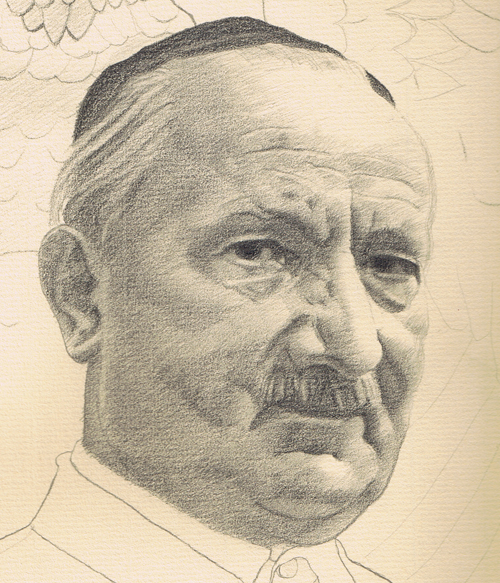
Heidegger by Darren McAndrew
To Free or Not To Free?
Underneath the priority Heidegger gives to Dasein’s time and the presence he builds into Being, is a conflation (indeed confusion) of time with ‘time made explicit’ and Being with ‘Being made explicit’. Nevertheless, with physical time subordinate to Dasein’s time, and Being-as-presence dependent on Dasein, Dasein’s freedom would seem to be guaranteed. As Heidegger put it, “Freedom alone can let a world prevail and let it world for Dasein” (Pathmarks). Yet notwithstanding the already high cost of this seemingly happy outcome, the pickings are slim. I’ve already mentioned the disappointing consequences of narrowing freedom to ‘authentic freedom-towards-death’ released from ‘the illusions of the ‘they”, and the lack of meaning, purpose, or content for bodiless freedom.
Disconnected from anything as specific or muscular as autonomy or self-regulation, Heidegger’s freedom morphed into what he called Gelassenheit. Heidegger borrowed this term from the mediaeval Catholic philosopher and priest Meister Eckhart. It means ‘releasement’ or ‘letting be’, or ‘non-willing disclosedness’. With freedom thus redefined, the voluntaristic, decisional dimension of free will, so central to existentialism, has disappeared. While it could be accepted that ‘disclosing ourselves’ to entities – locating them in an outside from which they can be acted upon – is a necessary condition of agency, ‘letting be’ is surely remote from agency – from having and fulfilling goals, or from incurring and delivering on obligations. In short, releasement is remote from living a way of life, and seems more like merely being lived by one.
At best, Gelassenheit occupies a middle position between activity and passivity. Unlike ‘willing’, which has an end – a desired outcome – it seems to have no target. ‘Letting be’ is at best a revelation of what-is rather than a shaping, defining, changing, manipulation of it. It is remote from using entities, beginning with our own body and involving a vast range of tools to serve purposes we have conceived. It seems inconceivable that the world around us would require the assistance, never mind the permission, of Dasein to exist. There is considerable difficulty, therefore, in connecting Gelassenheit with anything like individual (or cooperative, or collective) agency. At the very least, it seems to have little to do with the transformative impact we humans have had on the planet on which we live. ‘Letting beings be’ does not sound like an honest day’s work. Indeed, the lighter-than-light touch agency of Gelassenheit is not clearly distinguishable from simply going with the flow. This wilting of freedom into passivity, into what we might call ‘omnimpotence’, is captured well by Charles Guignon when he characterizes humans as “more like conduits carried along by the event of being.”
Is Heidegger an Existentialist?
We’ve travelled a long way from the Heidegger of the existentialist imagination. For Heidegger, human freedom was, at first, necessitated by the priority of existence over essence. Later, as Heidegger dug deeper for its origin, it narrowed to embrace a version of one’s self liberated from the they-self. Finally, giving way to merely ‘letting-be’, freedom became unrecognisable. Heidegger’s freedom, rooted in Dasein’s time and in Being-as-presence, has ceased to be an aspect of human life expressed in specific actions regulated by choice and volition, as the existentialists would have it. So Heidegger’s appeal to the existentialists that first propelled him to international fame, may have been based on their misunderstanding him.
© Prof. Raymond Tallis 2026
The Palgrave Companion to the Philosophy of Raymond Tallis, edited by Robert Doede, (Palgrave Macmillan) is out now.
Advertisement
