


Your complimentary articles
You’ve read one of your two complimentary articles for this month. To have complete access to the thousands of philosophy articles on this site, please
You can register for a free account to have four complimentary articles per month. We will occasionally email you a newsletter, from which you can unsubscribe at any time. We do not sell personal data or otherwise disclose personal information to other organisations.
Tallis in Wonderland
Heidegger’s Ghost
Raymond Tallis wonders where Heidegger’s body went when he was philosophising.
The ghost that haunts Martin Heidegger’s collected works – particularly the early ones leading up to his 1927 magnum opus Being and Time – is Dasein. That is his word for human being. So, gentle reader, the ghost is you. Why do I say ‘ghost’? Because Heidegger finds it difficult to deal with Dasein as having a body.
The word ‘Dasein’ has two elements: sein means ‘being’, and da means ‘here’ or, confusingly, ‘there’. Importantly, though, ‘ da’ does not, in this context, signify a spatial location. Our existence as Dasein is ‘being-in-the-world’ – but it is not in the world in the way that, for example, a match is in a match box, or my body is in my study, as I write this. Rather, it means being involved with the world.
Much of the two published parts of Heidegger’s unfinished Being and Time are devoted to the analysis of Dasein. The most consequential fruit of this analysis is the discovery that Dasein is “a being that in its Being is an issue for itself.” Dasein, he says. cares for itself, and for those things that are relevant to its self-care. Indeed, care is the very essence of Dasein. Crucially, for Heidegger, care is inseparable from tensed time. Dasein reaches towards its own future from the springboard of its own present; and that present draws on its own past.
Since Dasein cares for itself, being-in-the-world is not a mere spectator sport. Central to Heidegger’s thought is a constant reminder that engagement with what is present to us is central to our lives. While that which is present can be present merely as background – what Heidegger calls the ‘present-at-hand’ – it can, more importantly be ‘ready-to-hand’, as in the case of a piece of equipment, such as the computer on which I am typing this column.
His emphasis on engagement with, as opposed to mere perception of, what is ‘out there’, is an important aspect of Heidegger’s project of distancing himself from René Descartes’ vision of the self as a spatially unextended mind distinct from the physically extended objects of nature, and hence to distance himself from Descartes’ mind-body dualism. Indeed, Heidegger’s vision of human being as being-in-the-world removes any gap between the mental and material realms. This vision was unpacked (with, by Heidegger’s standards, admirable clarity) in his Basic Problems of Phenomenology, written a few years before Being and Time, and published in the same year, 1927:
“Self and world belong together in the single entity, Dasein. Self and world are not two entities, like subject and object… but self and world are the basic determinations of Dasein itself in the unity of the structure of being-in-the-world.”
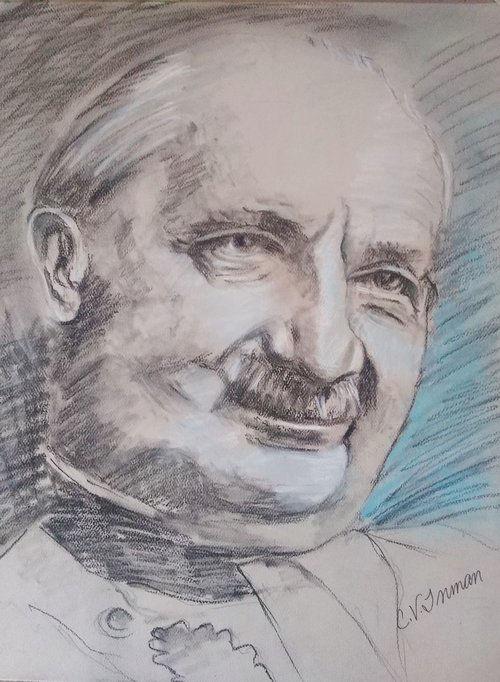
Martin Heidegger by Clint Inman
Bodies in The World
Problems come with this vision of human being that, so it seems to me, highlight the fundamental flaws of Heidegger’s account of human nature. The most significant relate to the question of the individuation of Dasein: in virtue of what is the Dasein that is you, the Dasein that is me, and the Dasein that was the philosopher with the moustache whose works we are currently discussing, a distinct, individual person?
The seriousness of this question for Heidegger is highlighted by the fact that his account of Dasein has led some scholars to question whether Dasein is divided into individual persons. John Haugeland argued that Dasein “is neither people nor their being but rather a way of life shared by members of some community” (quoted from ‘Is Dasein People? Heidegger According to Haugeland’, Taylor Carman, Boundary 2 41:2, 2014). This is at odds with what Heidegger called the ‘mineness’ of Dasein. It is, however, an entirely unsurprising consequence of a major omission in the account of human being in Being and Time – the human body.
This omission is not an accident. It is connected with Heidegger’s determination to pre-empt any impression that Dasein “has… the kind of Being which belongs to something present at hand… Man’s substance is not… a synthesis of soul and body; it is rather existence” (Being and Time, p.153). And in an infamous passage, our bodily nature is parked up in the ‘too difficult’ box: Heidegger writes that our corporeality “hides a whole problematic of its own, though we shall not treat it here” (p.143). Nor, as it turns out, is our being embodied addressed anywhere else in Being and Time. In fact, there is no satisfactory treatment of embodied humanity anywhere in Heidegger’s massive oeuvre.
Many reputable Heidegger scholars seem happy with this. For Hubert Dreyfus, “having a body does not belong to Dasein’s essential structure” and “Dasein is not necessarily embodied”. (Being-in-the-World: A Commentary on Heidegger’s Being and Time, Division 1, 1991). For Heidegger, the body is not even an optional extra for Dasein. On the contrary, it is, or seems to be, an embarrassment. According to Didier Franck, “the disappearance of the body is the phenomenological price of the appearance of Being”. What does this mean? Heidegger tells us that the ‘there’ of Dasein is a ‘clearing’ of Being, which allows entities to be ‘disclosed’ and hence encountered. The opacity of the human body would seem to get in the way of this disclosedness. The body is difficult to accommodate also because it is a thing, an organism, that is part of material nature. Hence its lack of place in a Heideggerian world picture that envisages humans as lights opening up in Being to reveal it as a world in which things are either present-at-hand (inert) or ready-to-hand (useful).
Exercising or Exorcising Dasein
So the body is frogmarched into exile. This has disastrous consequences even for Heidegger’s own thinking. The most obvious is the lack of explanation of how Dasein can be ‘an issue for itself’. Even less is there an explanation of what actual issues it has, why it has them, and how they are satisfied. The most basic of the concerns that occupy our lives are rooted in our organic nature – needs for food, drink, shelter, protection. Of course we soar way beyond these, into ambitions, dreams, preoccupations, responsibilities, that are only distantly related to basic organic nature; but we never leave them behind. And with hunger, cold, thirst, or illness, we become ever more tightly nailed to our body.
More worryingly, if Dasein were bodiless, it would have no spatio-temporal location, no environment, no material surroundings. There would consequently be no accounting for why certain things and not others are present-at-hand or ready-to-hand, or why we have an agenda such that at any given time there is any point in moving forwards or backwards, never mind running for a bus. The ‘clearing’ or ‘openness’ imported into being by Dasein would have no anchorage in reality. While my inhabiting my study is not reducible to the location of one entity in another, it is difficult to see how I could inhabit my study without having a body in virtue of which I am located in it.
Heidegger’s foregrounding being-in-the-world while marginalising ourselves as material beings in a material world, bypasses something that lies at the heart of our agency. It is what in Circling Round Explicitness: The Heart of the Mystery of Human Being (2025) I called ‘ontological democracy’: the inescapable thing-on-thing aspect of our need-driven engagement with the world. My using a hammer to bang in a nail requires a physical interaction between my hand and the handle, in which both parties are subject to the same laws of mechanical nature. The friction central to my grip on the hammer straddles both my flesh and its wood. There is, of course, a fundamental inequality: I hammer with the hammer to pursue my ends, but the hammer does not exploit my flesh to pursue its ends. Indeed, the hammer has no ends: it is a mere substrate through which I realize my agenda, whose vision – for example, building a fence to define and affirm my territory – cannot be captured in physical interactions.
This last point shows that the ontological democracy between a body-as-a-thing and the external physical substrate of someone’s agency is incomplete. This is illustrated by something as basic as eating. Without the thing-on-thing interaction between food, fork, and hand, there could be no dining. But, of course, dining goes beyond stuffing nutrition into an orifice opened to receive it. Dining together by appointment has recreational, ceremonial, symbolic dimensions. Nevertheless, none of these could be realised without diner and dinner being moved into contiguous spaces. And not only must diner and dinner be located near to one another, the diner must occupy the relevant space as the same time as the dinner.
What we might call ‘the social articulation of space and time’ is of course not reducible to mere physical locations translatable into spatio-temporal coordinates. Even so, without proximities of physical space and time, social articulation is not possible. Without a body located in space and time, I could not be a welcome, or indeed an unwelcome, guest. And although honouring an appointment is not definable in merely spatial or temporal terms, ‘turning up’ still has to meet certain spatio-temporal criteria.
All of this seems pretty obvious – the kind of thing of which perhaps only a philosopher would require to be reminded. So why is Heidegger so reluctant to acknowledge the centrality of the body in our human being?
There are several answers to this entirely reasonable question. The first is methodological. Throughout his six-decade career, Heidegger was a phenomenologist, focussing on the structures of consciousness and on subjective experience rather than objective entities. His confusion of these methodological constraints with the limits of reality itself meant that he never escaped from the influence of Immanuel Kant (1724–1804). According to Kant, space and time themselves, and consequently (according to some, but not all, commentators) the spatio-temporal localisation ascribed to physical entities such as the human body, are products of the mind. As mentioned, Heidegger also wished to avoid anything like the gap Descartes thought existed between the mind and the material world. What’s more, prioritising the body would narrow the difference between humans and what he calls ‘world-poor’ animals. Finally, it might result in philosophy straying into territory that belongs to science, which Heidegger wished to put in its place.
Being and Time was a much-needed corrective to prevalent philosophical trends, notably neo-Cartesianism and materialism. The corrective, however, has proved to be an over-corrective. One reason that this is important is that disembodied – or ‘body-poor’ – Dasein, as a ghost, has no means to exercise freedom, nor, indeed, any reason for doing so. But now I am straying into the territory of another column.
© Prof. Raymond Tallis 2026
Raymond Tallis’s Prague 22: A Philosopher Takes a Tram Through a City is out now in conjunction with Philosophy Now.
Advertisement
