


Your complimentary articles
You’ve read all of your two complimentary articles for this month. To have complete access to the thousands of philosophy articles on this site, please
If you are a subscriber please sign in to your account.
To buy or renew a subscription please visit Subscriptions.
If you are a print subscriber you can contact us to create an online account.
You can register for a free account to have four complimentary articles per month. We will occasionally email you a newsletter, from which you can unsubscribe at any time. We do not sell personal data or otherwise disclose personal information to other organisations.
Metaphysics
The Nature of Reality
Simon Everson says Immanuel Kant can help with quantum mechanics.
Could it be that the ideas of Immanuel Kant offer an insight into one of the latest branches of physics? The strangeness of quantum physics is well known. It takes us into a counter-intuitive world of apparent weirdness, so odd that physicists are often told to cease to try to make sense of the theory and simply do the calculations. However, there may be a way to engage with the weirdness and understand it. One possible route is to re-examine the problems through the lens of the philosophy of Immanuel Kant. Before we address the potential significance of the pre-eminent 18th Century philosopher, we should define the nature of the problems we will try to resolve.
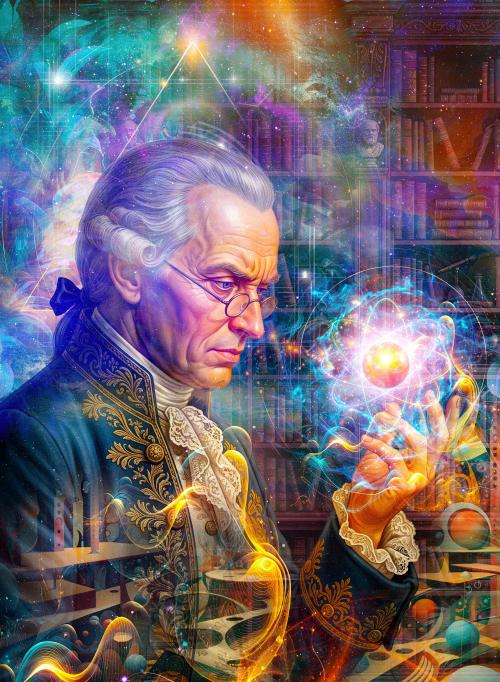
For more art by Cameron Gray , please visit parablevisions.com and facebook.com/CameronGrayTheArtist
Welcome To The Weird
The first problem is that much of physics describes a world that is a blend of possibilities rather than the linear, single experience of the world that describes the everyday. In everyday life, things seem to do one thing at one time, in one place. A thrown ball follows a path you could draw with your finger. This is classical physics. However, even within the world of classical physics, blended realities emerge. Many classical phenomena (pressure, temperature, solidity) are not fundamental – they arise from countless microscopic interactions. A solid table feels solid, but it is 99.9999% empty space held together by electromagnetic interactions. We blend trillions of tiny quantum events into a single ‘object’. According to Feynman, in quantum physics, motion is described by summing over all possible paths, with the classical path emerging because it dominates through constructive interference. That thrown ball, whose arc you trace with your finger, isn’t so simple after all.
But if you focus on the quantum scale, this blending is especially evident: our best descriptions don’t give us a single, definite story in advance – they give us a spread of possibilities, and the ‘one outcome’ is what we end up recording.
What are the other examples of a ‘blended reality’? Let’s start with wave–particle duality. Light and matter are both waves and particles – not alternately, but simultaneously. What we ‘see’ (a particle hitting a screen) hides a deeper wavefunction describing probabilities spread across space. Objects are not ‘either-or’ but both at once, depending on context. Or, one could flip the statement and describe light and matter as neither waves nor particles, but something else entirely. We see this otherness in terms of concepts accessible to our minds.
Then there is superposition and decoherence. At the quantum level, things can be described as existing in a combination of possible states. We experience a single, definite outcome because quantum systems don’t stay isolated: they interact with their environment, and that interaction immediately turns the initial ‘blend’ of possibilities into a single thing: something that behaves according to classical physics. Exactly what we should say about this ‘collapse’ depends on interpretation – but the practical point is the same: what is describable depends on the conditions of observation and measurement.
Next, consider the relationship between time and space. Einstein’s Theories of Relativity tell us reality is not space plus time but one unified 4 ‑ dimensional spacetime. However, humans perceive space and time as being totally different. According to Einstein, past, present, and future form a single block. Our ‘present moment’ is a perceptual slice, not a physical feature of reality. Physical laws (like Schrödinger’s equation) are time ‑ symmetric – time can go backwards as easily as it goes forwards. We experience time as a smooth sequence, even though that is not how our brains work. The brain seems to work in terms of ‘chunking’ the information taken in over short periods of time rather than having a continuous steady input. In other words consciousness seems to be quantised. It also seems to use predictive and after-the-event systems to make sense of what is seen. In other words, time as we experience it is a product of the way we think rather than the world as it is.
Particles are not what they seem. In Quantum Field Theory, the most accurate model of matter we have, particles aren’t solid objects; they’re excitations (or ‘ripples’) of underlying fields that fill all of space. We perceive discrete particles, but the reality is continuous fields, interacting excitations, vacuum bubbling with virtual particles. Two particles can share a single quantum state even when far apart; this is called quantum entanglement. There is no obvious way in which they can become correlated – even more oddly, this correlation doesn’t exist until measurement. The ‘separateness’ of things we perceive is partly illusion. In short, quantum physics is weird – totally counter-intuitive but at the same time provably correct. Amongst other things, time, causation and distance all seem to be irrelevant in the quantum world.
The problem is how to explain all this. Two leading contenders are the Many Worlds Interpretation and the Copenhagen Interpretation of quantum mechanics. The first proposes a near infinity of possible worlds, which feels too complicated and too messy. However, the generally agreed alternative is the Copenhagen Interpretation, which requires us to accept that our consciousness somehow alters the nature of the world around us.
Our final problem is an extension of the last: how is it that the world is understandable to us at all? It should not be the case that our limited brains can so perfectly describe and predict such a complex and alien object as the universe using a tool, mathematics, that (arguably) we created ourselves. But that is apparently not the case – the universe is very much comprehensible to a short-lived primate who evolved to survive on the savannah. I prefer to agree with J.B.S. Haldane, who said (with a minor paraphrase): ‘I have a suspicion that the universe is not only stranger than we suppose, it is stranger than we can suppose.’
How Can We Make Sense of All This?
David Hume (1711-76) was a Scottish philosopher and historian, who is a great read and a challenging sceptic. One of Hume’s key challenges was that causation (such as one billiard ball hitting another and it moves) is assumed but never actually observed. All we see is consistent conjunction, not necessity. The concept of causation is not based on reason, but on habit or custom. Hume also gave us the problem of induction. That states that all our evidence for the laws of science is based on observation of things that have happened. We see regular occurrences of one type of event being followed by another type – what Hume called ‘constant conjugations’ – and we conclude that the forrmer must cause the latter. But we cannot logically assume the future will be the same as the past. Therefore, laws of science are based not on reason, but on habit and custom.
This was a wake-up call for another great thinker of the time, Immanuel Kant, who wrote that Hume had roused him from his dogmatic slumber. Yet Kant would not accept the outcome of Hume’s thinking, which was that science has no basis in reason, but is an act of faith. Kant’s reply to Hume’s challenge was radical and revolutionary. Rather than agreeing that the mind passively receives impressions of the world (as Hume assumed), Kant argued in The Critique of Pure Reason (1781) that the mind actively structures experience.
We’re generally comfortable with the idea that the world we experience is shaped by our sense organs. There will be some readers of this article who are colour-blind – they will perceive the world differently to those who aren’t. How you see, hear, smell, etc will affect the world you inhabit. I can’t know what it is like to be a bat and use echolocation. This feels obvious and intuitive. But Kant went further. He saw that your understanding of the world depends on more than your sense organs: it depends upon your mind’s conceptual framework. The world we experience is as much created by the way we think as it is by the way we perceive. He argued that concepts like causation, substance, and unity are imposed by the mind as part of its basic cognitive framework.
Hence, for Kant in answer to Hume, we do not discover causal necessity in our experience of the world. We supply it as a condition under which that experience becomes intelligible. Hume’s external problem is internalised to become a necessary element of human understanding.

Immanuel Kant in an engraving by John Chapman, 1812
However, by stating that minds add fundamental categories (Kant’s word) to experience, including time, distance, extension in space, and causality, amongst others, Kant was making a crucial distinction between what we perceive and how things really are. He developed this idea further: the noumena are whatever exists independently of our minds. They are contrasted with phenomena, which are things as they appear to us. Kant insists that human knowledge is restricted to phenomena; noumena are not objects of possible experience. By definition, we cannot perceive them, and we cannot know them. As soon as we try to see them or know them, they turn into phenomena.
For Kant, this breakthrough saves science: Hume’s problem of induction disappears. Causality is not an a series of coincidences; it is a necessary product of our own cognition. And, since we cannot engage with the noumenon, we can safely set it aside and get on with our lives.
I just said that we cannot engage with noumena, but there are some things that we can say about noumena. Firstly, we can be sure that noumena exist. Kant holds that appearances must be appearances of something. We aren’t just making it all up. He would not agree with Bishop Berkeley’s idealism, for whom there are only minds and ideas. Bishop Berkeley said things are only ideas in minds. Kant says there are things. It’s just that the nature of the thing that prompts us to experience a phenomenon is not the same as the phenomenon. Secondly, noumena are not spatial or temporal. Because space and time are forms of intuition contributed by the mind, noumena are not in space or time. Thirdly, causation, substance, necessity, and unity apply only to things we experience as phenomena. So noumena cannot be described in terms of causes, substances, or unified objects. Finally, noumena are thinkable but not knowable. I’m thinking about them now. But I don’t (and can’t) know about them.
They certainly do seem weird. But however weird they are, since they are unknowable, they appear to remain in the realm of the theoretical. Apparently forever sealed from our sight, engagement with them stops there. Perhaps because of this, although there have been many philosophical debates about Kant’s thought, his brilliant insight hasn’t had the impact that it should on the way people think about the world. It should be shattering to think that our minds construct the reality we experience out of an alien ‘otherness’. But most people see Kant’s ideas as a kind of controlled explosion. It is explosive, but it is very far away. We can get on with our lives in the everyday world and never have to think about noumena, only phenomena.
However, I would like to argue that modern physics gives us a new way to take Kant seriously. What was once a largely theoretical distinction – between the world as it is in itself and the world as it appears to us – now seems to be expressed in new ways, in what we are encountering in laboratories.
Beyond Appearance, To Reality
If Kant is right that space, time, and causation are not supplied by the world but are part of our mental framework, through which experience becomes intelligible, then it should not be surprising that quantum theory seems to be in close alignment with his ideas. After all, it is pushing against those same notions. The ‘weirdness’ I described earlier may reflect the limits of what we can achieve with a phenomenal, human-scale description when we attempt to engage with what lies beneath it. With Kant’s ideas in mind, quantum ‘weirdness’ starts to look less like absurdity and more like a clue.
Could it be that what we encounter as quantum weirdness is in fact an actual sighting of the noumenal world, before our consciousness alters it to fit our sensory and conceptual apparatus?
With that thought, suddenly, quantum weirdness is not weird at all. It is exactly what you might expect to find if what we are encountering in the quantum world is noumena.
If so, it makes sense that the world as described by quantum theory does not have the qualities that Kant says are imposed upon it by our own minds as we perceive it. Hence, of course (before we collapse the underlying reality into phenomena) there is no causality. If time as we know it exists because our conceptual framework requires it, but the underlying reality doesn’t require time, then for instance its not a problem if Schrödinger’s equations allow time to go backwards as well as forwards. Or if, outside our own perception, there is no such thing as distance, then there’s no problem with what Einstein called ‘spooky action at a distance’ between entangled particles. Indeed, that ‘spooky action’ could also be seen as a problem of causality as well.
All of this apparent weirdness becomes reasonable, as Kant states that we impose the concept of causality, time and distance upon noumena when we turn them into phenomena. That these are absent or irrelevant in the quantum world is exactly in keeping with what one might expect.
I raised the question whether the Many Worlds theory or the Copenhagen Interpretation is a better explanation for the quantum world. Kant’s insight allows us the luxury of not having to choose. Both are the case. The world of noumena contains the mingled near infinity of possible worlds, blended together. They do not exist as separate timelines, but as simultaneously held possibilities. When noumena collapse into phenomena, through engagement with our consciousness, then we see the behaviour we associate with the Copenhagen Interpretation.
So yes indeed, what we observe or measure is changed by that process. Yes, our consciousness really is affecting the nature of the universe. However, we should not see the interaction as altering something beyond our minds: it is better seen as the interaction between our consciousness and what we are conscious of, which is collapsing noumena into phenomena. The things in themselves are as they always were; it is just that when we observe or measure them, we are passing them through our sensory and conceptual filters. That is why waves (a blended reality) become particles when we look at them. What we are seeing is the universe adjusting itself to present a version of itself that is comprehensible to us, given the way we think.
A further thought: we know that when we measure something and render it a phenomenon, then it remains as it was originally measured. Why? Perhaps because, through the measurement, we have entered into a quantum entanglement with the phenomenon and remain entangled with it thereafter.
At the outset, we wanted to understand why the universe is explicable to us, when there is no obvious reason why it should be. But if it is true, as Kant said, that our consciousness creates the universe we perceive around us, then of course that means that the universe we observe is explicable in terms of our capacities. Of course we can understand it and make exquisitely accurate predictions. Of course it works in terms of a mathematics that we have invented. It would, wouldn’t it?
In fact, could this be an explanation for the mystery that is consciousness itself? We have never been able to explain the nature of consciousness. Could it be considered to be the process of collapsing noumena into phenomena? After all, we ourselves are part of the universe – we ourselves are noumena. We are not separate from the larger whole. When we think, we might be experiencing the universe thinking itself into being.
Convergence & Distinction
I would like to argue that we have addressed all of the problems I began with. We now understand how physics can describe a world that is a blend of possibilities rather than the single experience of the world we have everyday. In the process, we have even made sense of quantum weirdness. We have found a way to embrace both the Many Worlds theory and the Copenhagen Interpretation. Finally, we have found an answer to the question of how the world is understandable to us at all. In doing so, we used nothing more than the philosophy of an 18th Century thinker – albeit Immanuel Kant was a genius.
As an aside, this may cause problems if we ever encounter aliens. The animals around us, even very different ones like the octopus, are broadly similar to ourselves – we share a common evolutionary root. Animals and humans will not experience the world around us in quite the same way, but we have enough common ground to share a roughly similar perception of the world. On the other hand, by definition, aliens will be alien. They will have a very different sensory and conceptual apparatus. An alien may one day share a room with a human, but the two will (quite literally) inhabit a different reality, as each constructs their own separate phenomenal world. If I am right, not only will communication be impossible, but our different biology (and hence different conceptual frameworks) will also almost certainly mean that we actually have a different physics and chemistry to each other. Their technologies will be able to do things ours simply cannot. And vice versa.
This article is called ‘The Nature of Reality’; you might have thought that I am using the word ‘nature’ to mean character, kind or sort. In part I am, but I also intend it to mean that our perception of reality is a product of our nature, our biology. The traditional hierarchy of sciences sees physics as the foundational subject, from which emerges chemistry, from which emerges biology. We could go further with that model: we could place mathematics beneath physics as its foundational subject, and foundational to mathematics is philosophy. If what I propose in this article is right, we have used philosophy to flip the pyramid – biology becomes the foundational subject, as the biology of our consciousness generates our chemistry and physics from the boundless possibilities contained within the noumenon.
Perhaps the best place to finish is with some lines written by William Blake in 1803 from a poem called Auguries of Innocence that speak to his sense of the interconnectedness of all life:
“To see a world in a grain of sand
And a heaven in a wild flower,
Hold infinity in the palm of your hand
And eternity in an hour.”
For Blake, the greatest things (a world, heaven, infinity and eternity) are contained within and explicable through engagement with the smallest (a grain of sand, a wildflower, your palm and an hour). Everything is fundamentally intertwined. Through the lens of Kant and quantum physics, we reimagine Blake’s words and understand that they are not mystical or poetic. Given what I have proposed, nothing could be more practically true.
© Simon Everson 2026
Simon Everson recently retired as Head Master of Merchant Taylors’ School, Northwood.
Advertisement
