


Your complimentary articles
You’ve read one of your two complimentary articles for this month. To have complete access to the thousands of philosophy articles on this site, please
You can register for a free account to have four complimentary articles per month. We will occasionally email you a newsletter, from which you can unsubscribe at any time. We do not sell personal data or otherwise disclose personal information to other organisations.
Happiness
The Necessary Ache
Tara Daneshmand on regret and the courage to choose.
“A mountain begins with the first stone, and a human being – with the first pain.” – Ahmad Shamloo
Renowned Iranian poet Ahmad Shamloo says that pain is fundamental to human existence – not merely an incidental experience, but its very starting point. Pain is the price of consciousness, freedom, and choice itself. Reflecting on this insight, I recognized a profound yet rarely acknowledged truth: every choice we make inherently involves regret, so there are no completely pain-free paths in life. Regret is not just residue from poor decisions – it is the echo of roads not taken, resurfacing unexpectedly at various points in life. Even choices aligned deeply with our values can lead to regret as values evolve and circumstances shift. What once felt essential might later feel misaligned.
The idea of a regret-free life is a comforting but unrealistic fantasy. As psychologist Barry Schwartz argues in his exploration of the paradox of choice (The Paradox of Choice: Why More Is Less, 2004), increased freedom does not diminish regret; rather, it often magnifies it, precisely because we become more acutely aware of the paths we did not take. Even when we make conscious, ethical, well-considered decisions, regret inevitably finds its way in – not due to failure, but because choosing inherently involves loss: every path taken leaves behind untaken lives, and these untaken lives remain with us, haunting us not because we erred, but because we had to choose. So regret is not a glitch in human psychology; it’s the shadow cast by our agency. Even the best decisions cannot escape regret. Research on regret confirms that, over time, people are more haunted by things they did not do than by actions they took; yet both action and inaction bear their own weight.
The Myth of a Painless Life
In modern society, in cultures that idealize comfort, convenience, and uninterrupted happiness, we are constantly implicitly urged to avoid pain at all costs. This pressure is evident everywhere, from curated joy on social media, to self-help books promising painless solutions to life’s complexities. Yet these attempts to entirely eliminate discomfort frequently prove futile, leaving us instead more deeply disappointed when inevitable hardships arise. Meanwhile, therapeutic models such as Acceptance and Commitment Therapy (ACT) encourage us to allow uncomfortable feelings such as sadness, anxiety, and guilt to emerge without resistance.
However, what if pain and regret are not merely things to manage or tolerate, but necessary conditions of life? Perhaps they are not flaws to correct, but signs that our human experience is functioning precisely as it should. The idea of ‘acceptance’ itself suggests that living aligned with the right values mitigates discomfort. Yet values themselves are inherently unstable, shaped by our evolving identities. The regret we suppress today in the name of alignment can reemerge later. Thus, the central question here is not how to accept pain and regret passively, but how we can summon the courage to choose anyway, fully aware that regret will inevitably accompany our choices. True control lies not in avoiding pain, but in having the courage to act, conscious that whichever path we take, pain and regret are likely to accompany us. Happiness does not lie outside of pain or regret, in some distant, painless ideal: genuine happiness emerges precisely through the meaningful struggles we face, and the clarity gained by navigating them. So pain is not happiness’s opposite – it’s the very condition that makes authentic happiness possible. Perhaps the most brutal truth of all is that even the best decisions come with pain.
Contemporary culture also reinforces the belief that rational, value-aligned decisions can shield us from regret, sometimes portraying regret as evidence of poor judgment. Therapeutic strategies such as ACT or Cognitive Behavioral Therapy (CBT) offer effective tools for managing emotional discomfort, reframing thoughts, and building resilience and value-driven lives. CBT helps individuals reframe experiences to reduce their emotional pain, while ACT promotes psychological flexibility and encourages living in alignment with one’s values despite discomfort. in fact, ACT acknowledges pain as a permanent part of life, helping us move forward with pain, not around it.
These approaches are effective and valuable, but they have limits. They rarely prepare us to face the soul-level ache that no amount of reframing can dissolve. Psychological tools are immensely helpful, but cannot eliminate regret. The limitation lies not in these frameworks, but in the expectation that they should erase the ache of what might have been. So despite their efficacy, these approaches cannot eliminate regret, as regret is not simply a cognitive distortion or a flaw in our reasoning – it’s an inescapable shadow of our agency, arising precisely because every choice we make inherently excludes countless other possibilities. Studies indicate that even values-based ‘wise’ decisions result in regret, often unexpectedly and long after the choice has been made (‘Regret Regulation: Theoretical and Empirical Review’, Journal of Behavioral Decision Making, Zeelenberg & Pieters, 2007). This isn’t due to poor reasoning – it’s the natural consequence of living a finite life with infinite alternatives. So regret is not merely due to a failure of logic or judgement, but it’s the inescapable emotional echo of paths not taken – the felt consequence of our freedom and choices. It isn’t a thought pattern to restructure, it’s an existential condition, the emotional shadow cast by our agency. It is a condition of human existence – a symptom of having a self, a past, and a memory. Unlike anxiety or guilt, regret does not resolve with insight or exposure. To experience regret is not a sign of failure or weakness, but a mark of existential honesty – proof that we genuinely care about the consequences of our choices. The courage to be human lies not in rising above regret, then, but in knowing that regret will come, and choosing all the same. This courage is not heroic or grandiose, but quietly resilient – an everyday bravery that acknowledges regret’s inevitability. To be human, then, is not to escape regret but to coexist with it, integrate it into the architecture of the self. Our goal should not be to cure regret, but to live meaningfully in its presence, allowing it to contribute to our understanding of ourselves and the lives we choose.
The Shadow of Freedom
Every meaningful choice involves loss. Choose independence, and you may sacrifice intimacy. Choose family, and autonomy may shrink. Stay where you are, and the unknown remains untouched. Move forward, and you leave behind a familiar past you might one day miss. But these sort of choices aren’t mistakes. Rather, they highlight a paradox of conscious living.
Take the choice to live far from family: you gain freedom and room to grow, but miss shared rituals and physical closeness. Or stay close, and tradition offers comfort, but dreams may go unexplored. Parenthood carries the same symmetry: having children grounds life in love and responsibility, but may cost parts of your former self. Forgoing parenthood preserves your freedom, but may awaken a longing for legacy and connection. And in relationships, regret takes equally complex forms: speak your truth and risk damage. Stay silent, and betray your needs. The pain we choose doesn’t necessarily signal virtue or strength; it simply reveals which form of suffering we’re most willing to bear for the sake of what we value most. Some embrace the pain of closeness, others the ache of distance. Some endure loneliness for freedom, while others trade autonomy for connection. Every path extracts a cost – there is no choice without consequence.
Evidently, regret doesn’t live just on one side of a bad decision: it lives on both sides of every meaningful one. These choices aren’t flaws or failures; they’re the unavoidable cost of being a self, of living awake. So to be human is to live with a tension we can never fully resolve: each decision defines us while simultaneously severing the infinite other versions of who we might have become. This tension isn’t a flaw – it’s the very structure of our reality.
Moreover, regret itself evolves with time. Choices we grieve today may later reveal themselves as good turning points. Conversely, decisions we once celebrated may quietly sour. This mutability raises questions, such as: Is regret an honest reflection on our past, or the residue of memory’s distortions? Can regret be redemptive – or is it inherently melancholic? As our identity shifts, do different versions of ourselves regret different choices?
Ultimately, regret isn’t always a problem to solve; it’s often the natural consequence of freedom. Even the wisest decisions carry regret, not because they were wrong, but because every real choice carries loss. The challenge, then, isn’t to avoid regret, but to live with it – not to glorify or drown in it, but to recognize it as proof that we chose courageously, and perhaps that we cared deeply when it mattered most.
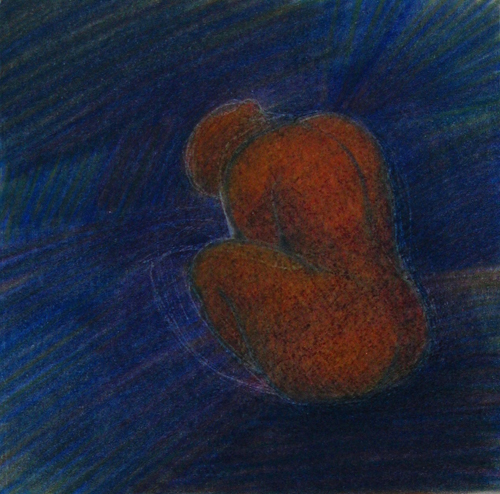
Aching Heart by Paul Gregory
The Paradox in Every Choice
Existential philosophy has long emphasized that freedom is inherently bound to anguish. Jean-Paul Sartre famously declared that we are ‘condemned to be free’. Viktor Frankl likewise asserted that meaning often emerges from suffering. In his seminal work Man’s Search for Meaning (1946), Frankl argued that even in the depths of pain we retain the freedom to discover purpose. Psychological research supports this, showing that perceiving life, even pain, as meaningful, can significantly enhance emotional resilience.
Yet this existential insight invites deeper reflection. We often imagine courage as a rare heroic quality reserved for dramatic moments or extraordinary transformations. But perhaps courage can be quieter, simpler, more deeply human: perhaps it is found in the willingness to choose, fully aware that pain and regret are inevitable outcomes. This courage doesn’t earn applause or headlines; it isn’t the valor of grand gestures. Instead, it’s the subtle, daily courage to decide, knowing that every choice carries loss. No matter how pure our intentions, how rational our decisions, we cannot escape the truth of exclusion. Every choice inherently means leaving other lives unlived.
Existential courage, then, is not about eliminating fear or avoiding regret: it’s the ability to move forward without pretending the alternative would have spared us pain. This is not to glorify suffering – pain and regret are not inherently noble. But they are inescapable, and fundamental aspects of being human. We didn’t choose to be born into pain and regret; they arrive with consciousness, memory, and freedom. And because they’re unavoidable, living honestly with them, without denial or illusion, becomes our only path to authenticity. What matters isn’t how much courage we possess, but how deeply we understand that courage is for choosing life whilst being fully aware that pain and regret will come. We are brave not because we avoid suffering, but because we choose to live knowing that suffering is part of the price of life. This truth lies beyond psychological techniques or therapeutic optimization. It’s something no therapy can fix, but only help us name, witness, and face with unwavering honesty.
Conclusion: The Necessary Ache
Pain and regret are not unfortunate byproducts of poor choices, they’re proof that we’ve chosen at all. They’re evidence, not of failure, but of active participation in life – of having dared to care, to desire, and to act. They’re the very ground from which meaning grows. So pain and regret are not malfunctions of the human condition; they define it. They arise not from living wrongly or incompletely, but simply from living. Psychological tools can help us navigate the turbulence, teaching us to breathe through the ache, act despite fear, and stay grounded. But no framework, philosophy, or system of thought can shield us entirely from the fundamental truth that every choice hurts, and every path forward leaves something behind. Still, we choose – not because we are fearless or certain, but because choosing is the only authentic way to exist, the only real way to be human.
Rather than striving for a painless life, then, we must reclaim the power to confront our regrets honestly and find meaning, not despite suffering, but because of it. As Shamloo reminds us, we begin with pain; and as Sartre insists, freedom is steeped in loss. And as life continually teaches us, being human was never about avoiding pain: it was about knowing it would come, and walking forward anyway.
© Tara Daneshmand 2025
Tara Daneshmand is a psychological counselor and writer exploring the dialogue between psychology and philosophy in understanding the lived experience of being human.
Advertisement
