


Your complimentary articles
You’ve read one of your two complimentary articles for this month. To have complete access to the thousands of philosophy articles on this site, please
You can register for a free account to have four complimentary articles per month. We will occasionally email you a newsletter, from which you can unsubscribe at any time. We do not sell personal data or otherwise disclose personal information to other organisations.
Fiction
Bilbo Theorizes About Wellbeing
Eric Comerford overhears Bilbo and Gandalf discussing happiness.
After all their adventures, having now sailed to the Undying Lands, Gandalf and Bilbo sit on Bilbo’s front porch after dinner, partaking of tea and the occasional puff of pipe-weed.
Bilbo: I was happy, Gandalf – or so I thought – before, by your traps, devices, and designs, you lured me into the quest to claim the Lonely Mountain. I mean, I had everything a hobbit could have or desire, and by all estimates of those esteemed and respectable in our county – whether with a little wisdom or not – I was as good-fortuned and well-grounded as a hobbit could hope to be or ask for. And indeed, I asked for nothing more.
Gandalf: You needed a push, my dear friend, to become more than what you were, but which was always inside you.
Bilbo: Yes, we hobbits don’t tend to think of ourselves as fitting for fables and legends. But our adventure was full of fearful things, gloomy things…. sad things. And did it make me happy? Well, I dare say there’s something more important than ‘happiness’, which is happiness, though I know that’s a strange way of putting it. What I mean is, you taught me that the comfortable hobbit life was not all there was. It was only when I left my home – nearly losing it altogether, along with all my possessions, to the blasted Sackville-Bagginses, I should add – and forgot myself, fled from myself, my home, my ‘happiness’ – let go of myself, and gave myself over to the company – that I began to be filled with something fresh. By emptying myself of my self and giving myself over to the quest, I was able to be filled with new things far more precious than what I had before, and which that life could not give me.
Gandalf: I suppose a pertinent question is, what was this higher calling, which was greater than happiness?
Bilbo: We were all fragile creatures amidst so much adversity and peril – but we rode on eagles’ wings, which I shall never forget! For my part, I learned to love a people with whom I never previously conversed, and their thirst to reclaim their kingdom became a cause dear to me too. Strange to think it, when the pain in their hearts turned into pain in my own – I mean, when I suffered with their suffering and loss – then I was able to find the deepest of friendships, which brought me joy. I also learned of things of the world beyond the borders of the Shire, and became, maybe not the stuff of brave warriors and knights, but of their stock. Yes, that I became; that and more. But none of those experiences were particularly pleasant, and I couldn’t tell you if the pleasant outweighed the unpleasant during the adventure, or in my life as a whole. As Samwise once wisely said when speaking of tales that really mattered –the ones that stay in the mind, “Folk seem to have been just landed in them, usually – their paths were laid that way… I expect they had lots of chances, like us, of turning back, only they didn’t… We hear about those as just went on – and not all to a good end, mind you,” he said. He went on to say that such tales go “past the happiness and into grief and beyond it” [The Two Towers]. So the pleasant mixes with the unpleasant, joy is pierced with sorrow, and a tale that really matters can be one without a happy ending.
Gandalf: I would not believe you if you told me now that you regret your adventure.
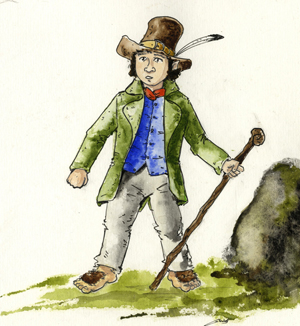
Hobbit © Khaerr 2013 Public Domain
Bilbo: What I could tell you is that during all the moments of the adventure I was not concerned at all with my belongings, my garden, my house, my heirlooms, but was entirely immersed in and devoted to nothing other than seeing the danger through! – and in giving myself wholly over to each new challenge for my friends. I was able to touch life and find a happiness I never before knew – whereas before, I was shut off from the world in a happiness that only seemed so. How busy I was before the adventure, but I didn’t do anything: my whole life was busy, but busy for nothing! I now feel that my life had not yet acquired a single-minded purpose that would root it. The adventure was needed for me to judge that my life went well overall. When looking back, I suppose I would say I had a favorable attitude toward my life as a whole, but I do not think that is what made me happy or why I was happy. What I mean is that I was content with my life because I did well with it, or at least not so bad as I could have done, all things considered. Or rather, my life went well because I did well.
Gandalf: Let us consider what made your life go well.
Bilbo: Well, I can recall the adventure not being consistent with my desires in the first place, even after I was informed of its reasons. I remember I first desired not to go on it; then I desired not for the adventure, but for something I know not what, and I both desired and did not desire for something more. What I mean is that we don’t know what we desire half the time, or what will make us happy in our desires more than half of the time, even if we are informed of what is and what isn’t, because we often don’t know what is good for us. If my life finally turned out well, it was thanks to something outside of me – I mean, knowing that I was part of a great story of the victory of light over darkness, good over evil, of life over death. So perhaps being truly well off, and therefore truly happy, means to be active in that struggle.
Gandalf: So would you say your life went well because you had a greater balance of pleasure over pain, or because you satisfied your heart’s true desires?
Bilbo: There were moments of pleasantness and relief, and there were times when everything was new and different and I was excited and inquisitive; but then, many times in our adventure we got lost; and there was the time we were almost turned into troll mush – which thanks to your cunning we were spared from. And then I acquired an insatiable, sickly lust for that thing I found in the dark, which took me out of myself and into a pit of desire, unnatural and deadly. That heavy bondage brought me much sorrow, Gandalf, and grief – and hideous, unjoyful delight, and hateful, painful joy. And now, with all these states of mind, you want to know if I had more satisfactory states of mind than not, or if that’s what I tried to pursue in my actions more than not? You’re confusing me, Gandalf!
Gandalf takes a long, silent puff on his pipe, and blows out a smokey question mark.
Bilbo: Anyway, even if I did have a balance of pleasure over pain, I would not say that is what made me well off in the end. That was because I was part of a story – seeking ultimately not for gold, possessions, honor, right, land, but for the good against the darkness, against that snake under the mountain. But these ends were not for pleasure. Remember, for example, that time when I could not stand the jealous greed that had overcome dear Thorin, so I took it upon myself to enter into the squabbling mess to make peace among dwarfs, elves, and men. It could have got me killed, but I dare say was the right thing to do, and only I knew it enough to think it truly. And I think, in these types of happenings, I found my soul’s contentment, as if my hobbit happiness were one thing and not necessarily related to my soul’s contentment, which is something else and maybe altogether different.
Gandalf: I see. And what would you say now to someone looking for what is good for them – their own wellbeing?
Bilbo: We look in all the wrong cubby holes, Gandalf! In the nasty holes of desire without end, in the accumulation of things, experiences, homes, properties, trinkets: and if we do not know what is right, then our attempts to secure the pleasant will lead only to pain.
Gandalf: And what about your guilt?
Bilbo: My guilt?
Gandalf: With the ring. Your jealous love for it, your concealment of it, how it damaged you and your relationships?
Bilbo: Ah, well, I have had much sorrow over what it did to me. Under its influence I became what a hobbit, or anyone else, should not be. I did not know what was happening to me at the time, but all the same I did know. The depths of how we give into what is awry and then get covered in shadow, these are dark things to consider. I also felt responsible for burdening Frodo with it, even though I was not its maker. It’s usually those closest to us who we hurt the most. But you’re right. We all face the problem of guilt – of having done or been involved in doing wrong; and no one can be considered happy unless they face their wrongs and seek forgiveness. Neither defining being well-off in terms of hunting after pleasure over pain, nor the dearest of the heart’s desires fulfilled, can quite get at this.
Gandalf: Perhaps there’s a concept of wellbeing we are overlooking, then?
Bilbo: What, about being part of good and wonderful things, Gandalf – like you – that made my life well-spent?
Gandalf: Like me?
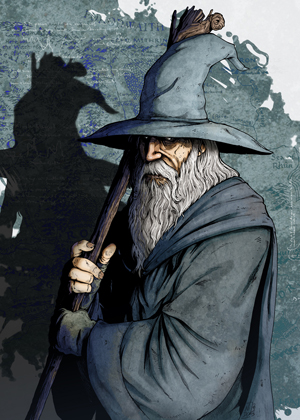
Gandalf © Nidoart 2013 Creative Commons 3.0
Bilbo: Yes, you, one of the Ainur, sent to protect, guide, serve Arda – ‘servant of the Secret Fire, wielder of the flame of Anor’ [The Fellowship of the Ring] and all that. You were a friend of the good, the true. You fulfilled your oaths as one of the Ainur – unlike that contemptible Saruman! I mean, to miss the mark to such a degree! That is abyssal, soul-crushing failure. I fear to think how it would break someone to pieces and leave no more, even less than dust.
Gandalf: Yes. Saruman turning to evil was… disappointing.
Bilbo: You know I like drawing up maps, Gandalf. Well, living a well-lived life is like mapping yourself onto the right parts of the good life, or like hitting the right notes of the good in the song of your life, while being part of the larger Song. You know more about that than I do, as it concerns the Valar and their designs and orderings, of which I cannot say anything. But I loved and fought for the things they loved – the true, the good, and the beautiful. That was needed in order to live aright. My life went well because I was part of the victory over darkness. Victory over darkness! So a life well lived – a happifying life – is one that does not succumb to darkness. And while in my old life evil’s ways to bait, beguile and betray always seemed so many, now they all seem as one.
All the same, Gandalf, I cannot say enough about quiet nights, time for quiet, even solitude, and the wide, true world. One wonders what good anything would be to anyone if there were no good world to be in. And this Undying world! – where the shimmering, undulating hills of light melodize with the open expanse above and the fresh rushing rivers glide over the glassy rocks below, as if there were a glowing ageless twilight in each stone!
Gandalf: We do need the world to be well. How terrible it is that the people of Middle Earth should tear it apart and destroy the very thing that keeps them alive!
Bilbo: But now, in these blessed isles, I find happiness in the peace of this place, in the quiet evenings and the light of stars on my face, and the candles in my room where I work on my stories and think the world over, and on new adventures to come – endless wonder, infinite wonder, Gandalf! That too, I should say, we could not do without. I think upon endless things in ways I cannot recount or put into words; but I dare say none could be good without bearing the mark of the infinite wonder of the world within them – the fact that there’s always more to know and to consider. There is infinite wonder in the infinite itself, from which the endless wonder derives! That I think about too. I could not ponder the things of the world without sometimes thinking about it.
Gandalf: So far you have been speaking of how well-being is constituted by the realization of certain capacities, sometimes irrespective of pleasure or desire; but now you say that the goodness of the world is necessary for well-being. How does that fit in with your theory?
Bilbo: Well, you cannot be well-off without a world to be well-off in! How you make good fish into poor porridge, Gandalf! It’s not as mismatched as you think. The wonders of this world uplift my soul and put it at ease: and doesn’t that reveal something in me that needs perfecting? There’s a great spirit on one of the highest mountaintops now – they call him Callicott – and I’ve heard that he’s of the opinion that the world is valuable in itself, regardless of our needs; and I mean something like this: that the world is good, and its goodness is necessary for our being well-off.
Gandalf: My goodness, look at the hour. It’s almost time for your second dinner, my friend.
Bilbo: Let me see what I can rummage up!
© Eric Comerford 2025
Eric Comerford is co-editor of Being Ethical (Broadview Press, 2016). He dedicates this piece to his mother for her invincible strength, to the late Robert Woods, who introduced him to The Lord of the Rings, and to his most improbable mellon (Elvish for friend) and life partner, Kevin Martinez, with whom he has shared many unexpected journeys.
Advertisement
