


Your complimentary articles
You’ve read all of your two complimentary articles for this month. To have complete access to the thousands of philosophy articles on this site, please
If you are a subscriber please sign in to your account.
To buy or renew a subscription please visit Subscriptions.
If you are a print subscriber you can contact us to create an online account.
You can register for a free account to have four complimentary articles per month. We will occasionally email you a newsletter, from which you can unsubscribe at any time. We do not sell personal data or otherwise disclose personal information to other organisations.
Books
The Entanglement by Alva Noë
Luka Zurkic considers how art and philosophy affect life.
Alva Noë argues in The Entanglement: How Art and Philosophy Make Us What We Are (2023) that art and philosophy are not optional add-ons to ordinary life; they are practices that reshape how we perceive, act, and understand ourselves. Rather than arguing about whether art or philosophy are valuable, Noë asks us to notice how artistic and reflective activities become inextricably woven into everyday activities.
The book unfolds not as a polemic or a manifesto, but as a series of careful demonstrations. Noë builds his case through vivid, close attention to particular practices and artworks. He moves across dance, visual art, writing, and everyday habits, to show how ‘second-order’ practices use ‘first-order’ activities as their material. For instances, a choreographer pulls out some steps people usually perform automatically and makes them noticeable. A painter changes the conditions of looking so that familiar shapes appear new. A philosophical description can dissolve confusion about the meaning and use of everyday concepts. In each case, the practice turns to ordinary activity, and in doing so, can change how that activity is carried out.
Looping, or feedback, is a key idea running throughout the book. Practices and their products do not simply reflect life: they feed back into the habits they describe and become part of what shapes future action. A new way of seeing or talking can move from a gallery, book, or classroom into everyday routines, eventually becoming the background against which later artistic or philosophical practices make sense. This process is usually gradual and dispersed, but it is real and durable, and utilising it helps explain how cultural forms build into human capacities without invoking anything mystical or denying biological limits.
The Entanglement also stresses an important distinction between practical, goal-directed activity, and reflective work, which is second-order. Practical skills are the ways we reliably navigate the world, while reflection takes those skills as their object (that’s why they’re second-order). In Noë’s view, both art and philosophy belong to the reflective sphere – their main role is not to deliver new facts, but to make the structure of our habits visible, and therefore open to revision. In this broad sense, their work is ‘aesthetic’: it makes our ways of living easier to see so that we can change them if we choose (‘aesthetic’ literally means ‘relating to perception‘).
Noë draws philosophy closer to art by arguing that both aim for clarity about how things fit together. For instance, many philosophical problems arise from muddles about how words, actions, or contexts connect. Sometimes those problems dissolve once we describe the situation differently. This is the therapeutic value of ordinary language philosophy. So on Noë’s account, philosophy becomes less about building grand theories, and more about crafting clearer pictures of human practices – pictures that stay connected to everyday life. Art too, of course, is about creating pictures, metaphorically or not.
One of The Entanglement’s more provocative claims concerns human nature. Noë doesn’t dismiss biology, but argues that many capacities we treat as purely ‘natural’ are also profoundly shaped by culture and by aesthetic forms. Technologies, habits, and institutions influence how we perceive things and take action. Art and philosophy play a significant role in shaping this framework. This challenges a simple nature-nurture split, and supports a more pluralistic kind of explanation – one that treats history, technique, and norms as important considerations alongside neural mechanisms.
A major strength of the book is its style. Noë models the kind of clarity he recommends by staying close to concrete examples and avoiding heavy jargon. This makes the argument accessible to non-specialists, while also showing what it might look like to apply his approach in practice. So at its best, the book does precisely what it describes: it turns familiar materials into tools for thinking. It also encourages readers to notice how their own lives are already shaped by aesthetic and reflective work.
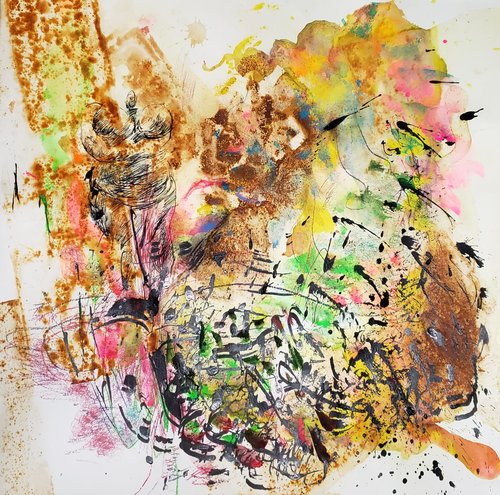
Painting by Venantius J. Pinto 2026
Still, his approach raises questions. The leap from compelling case studies to broad claims about how art ‘constitutes’ our capacities, feels less than fully argued. For instance, if art shapes what we do, how much influence does any single artwork or type of practice really have? And how do we separate ordinary cultural influence from a deeper redesign of character or ideals? Noë gestures toward historical and material processes, but he doesn’t provide the kind of explanations that readers looking for precision or clear evaluative criteria might want.
However, even with these limits, the book offers a valuable reorientation: without dismissing scientific insight, it pushes back against the idea that science alone can explain human life. It also encourages artists to see their work as more than private expression, and philosophers to treat textual analysis as serious intellectual labor. The point is practical as much as theoretical: once we recognize the entanglement of human life and culture, we can better understand how changes in practice and products can produce real shifts in capacities and norms.
The book works well as an intervention, though. It reframes debates about embodiment, normativity, and the reach of scientific explanation in clear language, with sustained attention to cultural detail. It will appeal to philosophers interested in aesthetics, and to artists curious about the wider effects of their work – especially those willing to trade theoretical positions for a richer, historically sensitive picture of how human life is organized.
In the end, Noë offers less a final theory than a way of seeing. He asks us to take seriously the thought that reflection and creativity are not luxuries but part of what makes us human. The book invites us to pay ongoing attention to the practices that shape us, and to the arts that can, if we pay attention, help us reshape ourselves. It makes that invitation clear and credible, and it does so by modelling a style of attention and creation that artists and philosophers can actually use. The implications for the discipline of philosophy may be modest, but the practical implications are large.
© Luka Zurkic 2026
Luka Zurkic is a data annotator and community lead with a background in philosophy, focused on responsible AI and professional development.
• The Entanglement: How Art and Philosophy Make Us What We Are, Alva Nöe, Princeton UP, 2023, £22 pb, 288 pages
Advertisement
