


Your complimentary articles
You’ve read one of your two complimentary articles for this month. To have complete access to the thousands of philosophy articles on this site, please
You can register for a free account to have four complimentary articles per month. We will occasionally email you a newsletter, from which you can unsubscribe at any time. We do not sell personal data or otherwise disclose personal information to other organisations.
Interview
Antonio Negri (1933-2023)
Antonio Negri was an Italian political philosopher who in his time courted controversy, and was even jailed for links with Communist organisations. Leonardo Caffo talked with him about the future of the Left.
This is a fragment of an interview with the late Toni Negri I conducted in Paris several years ago during my doctoral research. It was originally commissioned by the newspaper Corriere della Sera, but was ultimately rejected by my editor at the time with the statement, “Toni Negri is someone we probably cannot publish.”
Professor Negri, I would like to start with a provocation. In various forums and even in classes we’re dissecting the neurosis of the contemporary Left: its retreat from economic conflict, its obsession with moral purity, and its submission to the digital. You yourself, along with Michael Hardt, in the book Empire (2000) diagnosed the end of classical state sovereignty. But today the Empire seems less like the diffuse network of power you described, and more like a surveillance technocracy governed by Big Tech and high finance. Is the Left now serving as the public relations agent for this very Empire?
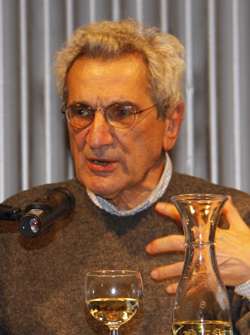
Portrait photo Rosa Luxemburg-Stiftung 2009 Creative Commons 2
That is an accurate, albeit tragic, formulation. You see, the core concept of Empire was not precisely the end of sovereignty, but rather its transformation into a total, center-less, but reticular [network-like] apparatus of dominion. Moreover, what you generically called ‘digital’ is updated biopower [human resources]. It is the capacity to organize and control productive and emotional life. The failure of the Left in the post-2001 era lies in having misunderstood this transition. Instead of grasping the Empire in its abstraction and globality – in the flow of financial capital, in immaterial production – the Left has clung to the fetish of the nation-state, or worse, retreated into the only sphere the Empire left it: the moral domain of the small self. The modern Left have mistaken the struggle for liberation with the hygiene of language. This is a form of self-castration.
You speak of the Multitude as the revolutionary subject, capable of producing counter-power. But in protests at the G8 in 2001, the Multitude – the last collective on the streets against physical and political capital – was crushed by state violence and subsequently fragmented. In the 1980s, heroin served as a chemical mechanism to disarm revolt, as I have analyzed. Today, the mechanism is the Algorithm, which transforms the body into an avatar and political action into a feed performance. Does the Multitude still exist, or is it now merely an aggregation of isolated and surveilled individuals?
The Multitude is always present, because it is the totality of the productive subjects of biopower. We all produce value through our communication, our relationships, our knowledge – this is immaterial labor. But it’s true, the discipline of the people by the state has become subtler and more total, moving from the truncheon to the network.
You mention the 1980s and heroin, which touches a crucial point of my own biography and the Potere Operaio experience [a radical Italian left-wing political group founded by Negri]: repression is not solely military; it is ontological. The state does not want us to exist! After my own judicial troubles [Negri is referring to his long imprisonment], the state learned that incarceration is not enough. It must disarticulate the very possibility of people acting in common. So heroin was chemical dispersion. The Algorithm is relational and cognitive dispersion. The web is the reproduction of the Panopticon [the all-seeing state] in a democratic and friendly form. It deceives us into thinking we are connected and have freedom of speech, while in reality it measures, predicts, and modulates our every desire and political gesture (Shoshana Zuboff has described this well). The Multitude is still there, but it has been forced to communicate through the Empire’s chain of command.
Many on the Left today, even radicals, are having second thoughts regarding the nation-state as a place to be reconquered for ‘protection’ from globalization – perhaps with a rhetoric of Left-wing sovereignty. The Right, on the other hand, has successfully used the state as an identitarian fetish and a shield for neoliberalism – for instance, by cutting taxes in the name of ‘the homeland’. You’ve always viewed the state as a finite form, merely a part of the Empire. Does this view still hold in an era of resurgent walls and nationalisms?
The nation-state is an obsolete machine, but not inactive. So I must correct you: it is a residue that the Empire utilizes as an administrative terminal and a police apparatus. Modern walls and nationalisms are not a return to the past; they are the neoliberal management of crisis. They serve to create a division of global labor and risk: the state manages immigration (in other words, fear) and security, while global capital continues to flow undisturbed. The Left that retreats into the state is attempting to return to an ideological refuge that no longer exists. You cannot fight the Empire by locking yourself in a room. The true sovereignty that the Multitude must reclaim is sovereignty over the common (il Comune) – knowledge, communication, the planet itself. This sovereignty cannot be national; it is global by nature, just as the Empire is global. So the Left must be ‘bad’ in the sense that it must be anti-national. It must break the nation-fetish and impose a global constitution of the Multitude – a poiesis [blossoming] of new transnational political forms.
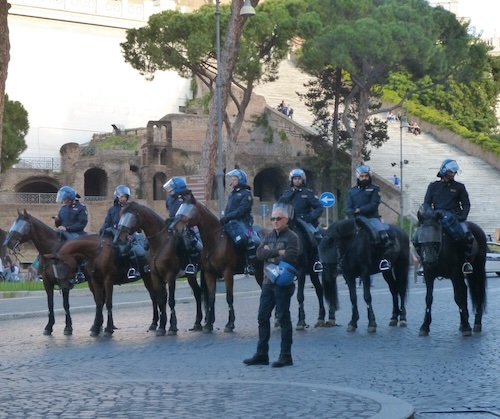
Riot Police, Rome 2016 Creative Commons Attribution-Share Alike 4.0
You evoke poiesis, the capacity to create the impossible. We might use the term ‘badness’ to describe the strategy involved – the action that generates pain within the system, such as confiscatory taxation, or the abolition of algorithms. One cannot be revolutionary without accepting the status of ‘total enemy of power and its moral allies’. How is this will to rupture society – the will to create the Event (l’Avvenimento) – to be constructed in a context of total social atomization?
As Hardt and I theorized in our later book Commonwealth (2009), the Event is the eruption of the Multiple into the Singular; it is the moment when the Multitude becomes conscious of its power and creates law. It is not a programmed demonstration; it is ontological rupture [that is, a fundamental change in what exists]. You speak of ‘badness’ as a strategic necessity. It is essential. It is the rejection of the moral hypocrisy that imprisons the Left. The Event feeds not on individualized, whining resentment, but on a fundamental political resentment against exploitation and injustice.
The body is the key. We must exit the digital simulacrum, where every act of rebellion is already predicted and monetized. We must reconstruct the sites of common production, which are also sites of conflict. Consider the ‘Immaterial Strike’: a strike today is not only about stopping the factory, but about interrupting the flow of cognitive and relational labour. It is disobedience to the Algorithm; it is the sabotaging of surveillance. It’s the Assembly against the Network. So we must reconstruct the physical assembly and unmediated collaboration as a site of poiesis, that is, the emergence of a new politics. The Event is prepared in the slowness and complexity of real encounters, not in the binary speed of the network. It’s also a return to the useful – ‘badness’ is also the denial of the useless. We must stop producing surrogate activities – entertainment and social media rhetoric – and focus on the production of the necessary, such as welfare, ecology and education. The Left is reactive because it fears the Event. It fears the violence intrinsic to political creation. But political poiesis is inherently violent because it destroys the existing.
Your life, Professor, has been marked by risk: political, legal, physical. Today, the Left avoids all risk. It is obsessed with ontological security (that is, with doctrinal purity) and with physical safety – meaning, retreat from the public square. However, the true revolutionary rupture is not having the correct theory, but action that accepts the possibility of defeat and punishment, as you yourself have lived.
You are right. Risk is the only currency of exchange for freedom. My experience, like that of many of my generation, demonstrates that power never offers the space for liberation without exacting an extremely high price. But that’s not the point. The point is that fear is the Empire’s most effective product. If the Multitude accepts the risk of failing; if it accepts that the struggle is not guaranteed by any morality; if it accepts being ‘bad’, that is, being structurally incompatible with the current order – then power loses its grip. The Empire wants us to be perfect, pure, complaining victims. However, the ‘what is to be done’ is to be imperfect, dirty, and capable of creating a political form that has never been seen. The Event is not the goal; it is the acceptance of the possibility of everything – even of returning to prison for the act of creating a new world.
• Dr Leonardo Caffo is Senior Lecturer in Philosophy, NABA University of Milan.
Advertisement
