


Your complimentary articles
You’ve read one of your two complimentary articles for this month. To have complete access to the thousands of philosophy articles on this site, please
You can register for a free account to have four complimentary articles per month. We will occasionally email you a newsletter, from which you can unsubscribe at any time. We do not sell personal data or otherwise disclose personal information to other organisations.
Articles
Breakfast with Habermas
Matt Qvortrup recalls chat over coffee and scrambled eggs with a champion of reasoned debate.
“Frühstück um 8 Uhr, dann?” – “Breakfast at 8 a.m., then?”
“Yes,” I replied. It is not every day you dine with a living legend, and certainly not someone of the calibre of Jürgen Habermas, who died at the age of 96 in March of this year.
It was in Princeton in 2014, and we were both visiting the Ivy League university to give talks. I was walking up the stairs when I saw him standing on the landing, searching his pockets.
He looked at me for a second, and I broke the silence:
“Sie sind Professor Habermas, nicht wahr?” – “You are Professor Habermas, right?”
He smiled and replied, in German, “Yes – and we have met before. I remember we spoke about Kant.”
We had indeed, though I was surprised he could recall our previous encounter in Oxford in 1996. He had been invited to speak about Kant’s 1795 essay ‘Perpetual Peace’ and his own philosophy. A mere student at the time, I had audaciously questioned his methodology. That was not popular – at least not with the organisers. Ronald Dworkin, who chaired the talk, shot me an angry look and made a gesture suggesting he wanted to slit my throat. Habermas, however, answered my irreverent question willingly. And more than that. After the talk, he came down to me and said, “We need to talk.”
And that, in many ways, is what he was all about.
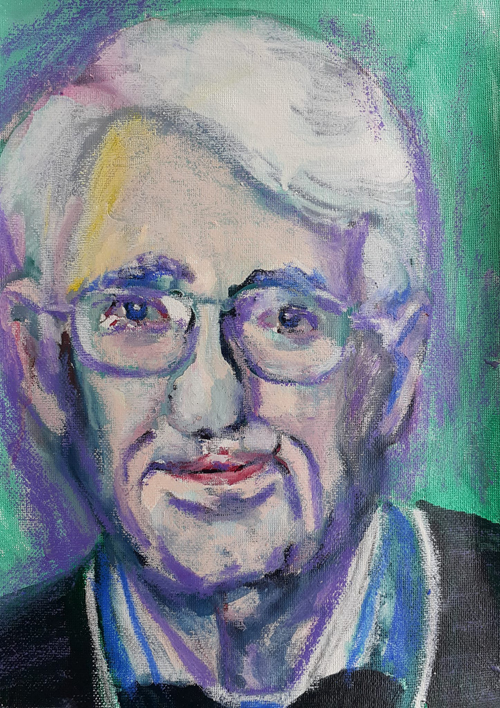
Jürgen Habermas by Gail Campbell, 2026
In The Theory of Communicative Action (1981), he synthesised ideas he had developed throughout the 1970s, influenced in part by analytical philosophy and speech act theory as developed by the ordinary language philosophers of the 1960s. I had ploughed through the book – including its long concluding section on how the “system colonises the lifeworld.” (The Theory of Communicative Action II, 522).
Yet what impressed me most in the book was his insistence that we must engage in rational debate through discussion. It was in this book that he brought to fruition the idea which he had expressed a decade earlier when he praised the “forceless force of the better argument,” and suggested that the respect for the other implicit in free communication itself provides the best basis for ethics (‘Towards a Theory of Communicative Competence’, 137).
It was on this foundation that he later wrote the shorter – and more accessible – The Philosophical Discourse of Modernity (1985), in which he took aim at the then-fashionable postmodernists.
These thinkers had questioned ‘grand narratives’ and had defended forms of relativism that were anathema to Habermas. For, he argued presciently, if we abandon the very distinction between truth and falsehood, then we open the door to demagogues. It is hard to exaggerate how prophetic this insight was.
Habermas was never neutral. He began as a moderate Marxist, studying under Theodor W. Adorno at the Frankfurt School. His doctoral work examined the ideas of 19th century idealist philosopher Friedrich Wilhelm Joseph Schelling. He later completed his Habilitationsschrift on the public sphere in The Structural Transformation of the Public Sphere (1962). Traces of his early intellectual formation remained visible in works such as Legitimation Crisis (1973).
But Habermas was never a doctrinaire Marxist. Indeed, he had to submit his higher doctorate at Marburg University, because he had fallen out with Max Horkheimer, the director of the Frankfurt School.
Language – and the possibility of rational agreement – remained his central concern. Debate, for him, was not an end in itself, but a means of improving society.
On that spring day in Princeton, he wanted to know what I thought about German politics. I told him I was writing a book about Angela Merkel. This intrigued him – hence the invitation to breakfast.
We met the following morning in the dining room of the guesthouse for visiting scholars, beneath photographs of alumni as varied as Donald Rumsfeld and Brooke Shields. Habermas had watermelon. I had hash browns and scrambled eggs.
We disagreed on more than the menu – notably politics, and the then leader of his country.
“Angela Merkel has no ideology. She has no goal…” He paused, narrowed his eyes, and added, “But do not underestimate her. She is very clever – sie ist sehr klug.”
He went on to explain how societies are driven forward by the exchange of ideas, and why he so disliked Friedrich Nietzsche: Nietzsche, he felt, had not articulated a philosophy that could be meaningfully criticised.
It was surreal to sit face-to-face with a thinker I had studied alongside Georg Wilhelm Friedrich Hegel, Plato, and Thomas Hobbes.
I recalled spending weeks as an undergraduate trying to decipher his essay Knowledge and Human Interests (1968), in which he argued that the aim of the social sciences was not merely understanding, but emancipation.
I also remembered that he had made pronouncements on the use of referendums to resolve ethnic and nationalist issues. I was in America to promote my book Referendums and Ethnic Conflict, in which I had cited his article in New Left Review in which he had written that referendums on sovereignty issues – given certain safeguards – could be “a way of proceeding which permitted a broader discussion and opinion formation as well as a more extensive and, above all, better prepared participation.” This would give the voters “the eventual responsibility for the process” (‘National Unification and Popular Sovereignty’, New Left Review Sept/Oct 1996). He seemed less keen to discuss this. Flattery was unimportant and small-talk less so.
But, when I mentioned the German Idealists, Habermas lit up. He recounted how Friedrich Wilhelm Joseph Schelling, in an aside, seems to have suggested that God gave humans language when withdrawing from the world – for only through communication could we rediscover paradise.
“Did you discuss that with Pope Benedict XVI?” I asked, recalling Habermas’s dialogue with Joseph Ratzinger published in a book with the anything but popular title, The Dialectics of Secularization: On Reason and Religion (2005)
Habermas smiled. “Oh yes. His Holiness is very erudite and broad-minded. You know, he cited Marx and Adorno in his most recent book about Jesus.”
We finished breakfast, and I promised to send him my biography of Merkel – which I did two years later.
I did not expect a reply. I was wrong. I received one. Typed on an old typewriter, it read: “You can imagine that many people send me books. But I was very pleased to receive yours. I do not agree with Merkel. But we learn by listening to other arguments.”
“Listening.” That is the legacy Jürgen Habermas leaves us.
At a time when democracy is under strain – in an age of ‘fake news’ and ‘alternative facts’ – he defended the project of modernity by insisting that societies grounded in rational, open debate ultimately rest on a recognition of the dignity of the other. When he spoke to me, first as a student and later as a colleague, he convinced me of this – not only through argument, but through example.
Habermas was the personification of the European Enlightenment. With his passing, we have lost a giant. It falls to us to follow his example.
© Professor Matt Qvortrup 2026
Matt Qvortrup’s book The Political Philosophy of Jean-Jacques Rousseau is published by Manchester University Press.
Advertisement
