


Your complimentary articles
You’ve read one of your two complimentary articles for this month. To have complete access to the thousands of philosophy articles on this site, please
You can register for a free account to have four complimentary articles per month. We will occasionally email you a newsletter, from which you can unsubscribe at any time. We do not sell personal data or otherwise disclose personal information to other organisations.
Articles
Great Minds, Flawed Lives
Tony Shenton asks, should we cancel the compromised intellectual, or read them?
There’s a particular kind of discomfort that doesn’t feel purely intellectual. It feels personal. It arises when a thinker who helped shape your moral or political outlook turns out to be, in some significant way, morally compromised.
For many readers, intellectual life is not formed only by arguments, but by voices. One of those voices for me was Noam Chomsky. Long before I had a formal philosophical education, his work sharpened my sense that power hides behind institutions, that media narratives deserve suspicion, and that the suffering of distant strangers is not morally distant at all. He didn’t just offer analyses; he modelled a stance – serious, unsentimental, and persistently on the side of the vulnerable. It’s also important to remember that Chomsky’s intellectual stature does not rest only on political commentary. He transformed the entire field of linguistics. His work on generative grammar reshaped how we think about language, mind, and human cognitive capacities, establishing him as one of the most influential scholars of the twentieth century.
Nor was his political engagement merely rhetorical. During the Vietnam War era, Chomsky took public stands that put him at personal risk, including involvement in draft resistance that led to arrest and the possibility of imprisonment. His presence among anti-war intellectuals was noted at the time by Norman Mailer in The Armies of the Night (1968), a reminder that Chomsky’s reputation as a critic of power was forged not only in print but in visible acts of dissent
Chomsky wrote relentlessly, spoke publicly, showed up at protests, and treated political engagement as a lifelong responsibility. That visible moral commitment gave his political thinking a particular authority. He seemed to embody the values he articulated. This is precisely why recent revelations about his association with the convicted sex offender Jeffrey Epstein felt so disorienting to many of his readers. There is no evidence that Chomsky had any knowledge of, or involvement in, Epstein’s crimes. The discomfort arises from the mere association itself. In a cultural climate where moral judgment is increasingly shaped by proximity as much as action, reputational damage can stem not from wrongdoing, but from who one met, spoke with, or accepted hospitality from. The philosophical question this raises is whether intellectual standing should be reassessed in light of associations that create moral unease even when no direct guilt is present.
Step back from the present moment and the problem deepens. Few cases are more unsettling than that of Martin Heidegger (1889-1976). His pioneering work in existentialism and phenomenology transformed twentieth-century philosophy, yet he was entangled with National Socialism, and spoke positively about it. In his 1933 Rectoral Address after becoming Rector of Freiburg University, he declared, “The Führer himself and he alone is the present and future German reality and its law.”
If moral failure disqualifies a thinker entirely, we would have to discard not just controversial public intellectuals, but major figures in the philosophical canon, including their philosophy. But if we insist that ideas stand wholly apart from their authors, we pretend that thought emerges untouched by the moral worlds in which thinkers live.
Heidegger’s case is made even more difficult by his later reluctance to offer an unequivocal acknowledgement of moral guilt. In a 1966 interview with German magazine Der Spiegel, for instance, he framed his involvement with the Nazi Party largely as a philosophical error rather than a moral collapse.
There are many less dramatic examples of great philosophers being flawed or being morally compromised. Bertrand Russell (1872-1970), celebrated as a voice against war and oppression, also wrote eloquently about justice and humanitarian values. Yet accounts from those close to him portray a more complicated figure. In her memoir My Father Bertrand Russell (1995), his daughter Katharine Tait describes him as emotionally distant and ‘remote’. Intellectual clarity in public, it seems, can coexist with emotional reserve or a difficult personality in private life.
We might go back further still. The work of Karl Marx (1818-83) has shaped global politics and moral imagination for more than a century. His analysis of economic exploitation continues to influence debates about inequality and justice. Yet Marx’s own writings include passages that strike modern readers as racially and ethnically prejudiced. In On the Jewish Question (1844), for example, he asks: “What is the worldly religion of the Jew? Huckstering. What is his worldly God? Money.”
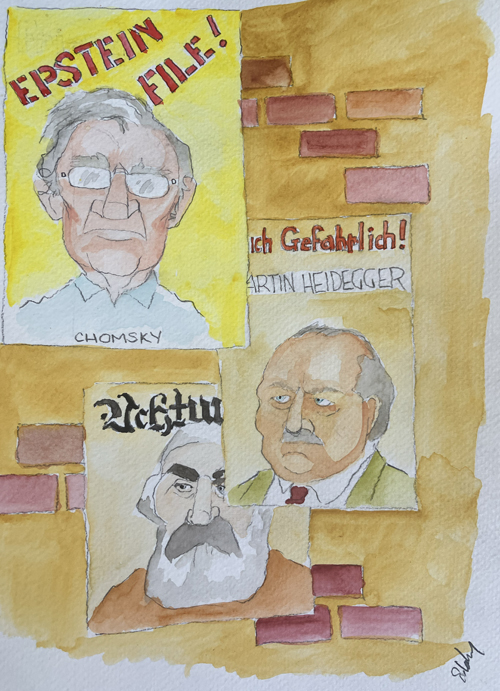
by Stephen Lahey, 2026
Scholars disagree about whether Marx was here criticising Judaism as a religion, using ‘Judaism’ metaphorically as a critique of capitalism, or drawing on contemporary stereotypes for rhetorical force. Whatever his intention, the language echoes antisemitic tropes that many readers now find deeply troubling.
His private correspondence is more explicit still. In an 1862 letter discussing Ferdinand Lassalle, Marx used derogatory language about Lassalle’s Jewish heritage and appearance – remarks that most modern readers would recognise as plainly racist. This reminds us that even thinkers devoted to human emancipation were not free from the prejudices of their time.
Seen in this light, discomfort about intellectual figures is not a new cultural pathology, but a familiar philosophical predicament. We are heirs to ideas whose creators were not morally pristine. The question is how to live with that fact.
Cancel culture only intensifies this dilemma. Public figures are now subject to glib, rapid moral judgment, and instant outrage amplified by digital algorithms. Past failures are never forgotten, let alone forgiven, and calls to withdraw from platforms can be swift. At its best, this reflects a serious moral impulse. We do not want prestige to shield wrongdoing, and we recognise that ideas must have consequences. But a philosophical confusion often enters the picture and distorts it. In cancel culture we often collapse three distinct kinds of judgment into one: moral judgment (was this person good or bad?); intellectual judgment (are their ideas true or illuminating?); and social judgment (should we no-platform them or celebrate them?). These questions are related, but not identical. Pertinently, refusing to celebrate someone is not the same as refusing to study them. Criticising a person’s character does not refute their arguments; indeed, ad hominem is a logical fallacy. And recognising the insight of an idea does not require treating its author as a moral exemplar. When we fuse these judgments together, then, we risk replacing careful thinking with symbolic moral purification. The goal becomes moral tidiness rather than understanding or truth. We should remember then that our reactions are not just conceptual; they are psychological.
We’re drawn to moral heroes because they simplify the landscape of thought. If a thinker seems both insightful and admirable, their life appears to validate their philosophy. But human beings are shaped by their historical moments, their blind spots, and their fears. Expecting those who illuminate injustice in one domain to be free of error in all other domains is merely a comforting illusion.
What, then, is the alternative to either cancellation or excuse-making for moral failure among important intellectuals? Perhaps it’s a more demanding form of intellectual maturity: learning to read writers without hero worship, but also without the urge to erase. This means holding two attitudes at once: moral clarity about a person’s failures, and philosophical seriousness about the ideas they produce. Such an approach neither absolves wrongdoing nor abandons the pursuit of truth.
To read in this way is perhaps slower and less emotionally satisfying. It offers no saints and fewer villains; only human beings whose thoughts may outstrip their character in some respects. Growing up intellectually may mean accepting that those who helped us see injustice clearly may themselves sometimes be unjust. The task is not to stop reading, but to learn how to think without heroes.
© Dr Tony Shenton 2026
Tony Shenton holds a PhD in Human Geography from the University of Nottingham and is an independent researcher with interests in philosophy, politics, and the ethics of public discourse.
Advertisement
