



Your complimentary articles
You’ve read one of your two complimentary articles for this month. To have complete access to the thousands of philosophy articles on this site, please
You can register for a free account to have four complimentary articles per month. We will occasionally email you a newsletter, from which you can unsubscribe at any time. We do not sell personal data or otherwise disclose personal information to other organisations.
Articles
Margalit & Limits to Political Compromise
Laure Gillot-Assayag reflects on the political philosophy of Avishai Margalit.
Long neglected by political theorists, compromise has attracted renewed interest recently. Most analyses present compromise as a profoundly ambivalent concept. Sometimes, it is seen as an undesirable moral phenomenon, characterized by a loss of values, an acceptance of injustice or a betrayal of integrity. But compromise can also be viewed more positively, as a commendable decision-making model for resolving conflicts, or as a method for upholding values like mutual respect and reciprocity. Compromise can even be a goal for democracy in pluralist circumstances. It averts wars, it can be a necessary part of peace negotiations, and sometimes it can reunite fractured societies.
If you were to pick one pioneering book in the field of ‘compromise studies’, it should undoubtedly be On Compromise and on Rotten Compromises (2010) by Avishai Margalit, a professor emeritus in philosophy at the Hebrew University of Jerusalem. The book is pioneering for its reflection on morally acceptable political compromises. Margalit seeks to describe the limits of acceptable compromise. His argument is that sometimes it may be right to accept a bad compromise, but we should never accept a rotten compromise. He defines a ‘rotten compromise’ as an immoral agreement that seeks “to establish or maintain an inhumane regime” (p.2).
It’s intriguing to see how little interest this important work from the ‘founding father’ of compromise studies has earned within the academic community. Scholarly investigations into the limits to compromise have been sidelined in favour of analyses related to procedural, substantive, or pragmatic reasons for compromising. Authors have analyzed the end result, or the process, rather than analysing the conditions necessary for an acceptable compromise. This may seem surprising. However, the limits of compromise raise another thorny question, insofar as compromise implies that the agreement reached cannot be captured by a single underlying principle. This seems to imply a moral casuistry, meaning that the conclusions vary according to each individual situation.
Should one consider this lack of commentary as being due to the fact that Margalit’s philosophy does not neatly align with either continental or analytical labels? All of Margalit’s philosophy bears witness to the horrors of twentieth-century totalitarianism, or long-lasting conflicts – between Palestinians and Israelis; or during the Cold War period. In On Compromise, he seeks to establish a moral limit for compromise. He bases his reasoning on empirical examples from various historical periods and events, including World War II, genocides, and debates surrounding slavery in the US Constitution. This innovative approach is specifically aimed at answering the following questions: How is non-humiliation related to morally acceptable political compromise? And, what is a ‘rotten compromise’?
Margalit places at the center of his analysis the concept of ‘non-humiliation’. He argues that we should be aiming for a society in which citizens do not humiliate each other, a negative aim, as opposed to one in which they are required to do something. Therefore, the focus of political philosophy should be a decent society (rather than, say, a just society). A decent society is one that locates moral violation in the humiliation of a person’s honour and dignity. Likewise, a rotten compromise is one that, in some way, repudiates shared humanity, which is the foundation of morality. Any compromise is wrecked forever by a single rotten clause that allows humiliation. Following Margalit’s metaphor, “it is a cockroach in the soup” (2009, p.36), Margalit demonstrates that rotten compromises are never acceptable – no circumstances oblige us to tolerate them. No political necessity can justify humiliation. One implication of this position is that no state should compromise with another state whose goal is to humiliate or be cruel. The epitome of a rotten compromise in Margalit’s view is the Munich Agreement of 1938 between Hitler, Chamberlain, Daladier, and Mussolini. By accepting the transfer of the Sudetenland to Germany, this compromise strengthened the Nazi regime and so intensified the humiliation and cruelty at the core of Nazi ideology and institutions.
I shall explain the role of humiliation in unacceptable political compromise (that is, rotten compromise), and then raise some objections to this limit to compromise. Finally, I will distinguish between different democratic temporalities. While Margalit’s limits on compromise are especially important in post-conflict state-building, established liberal democracies may face additional constraints in determining what counts as an acceptable political compromise.
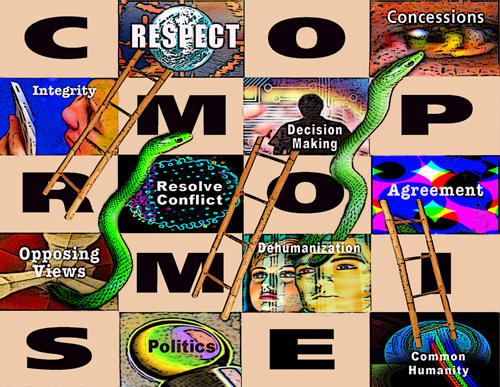
Image © Miles Walker 2026 Please visit mileswalker.com
Non-Humiliation in Political Compromise
Margalit’s philosophy of compromise is indebted to deontological morality, which means morality founded on ideas of duty, the most famous exponent of which is perhaps Immanuel Kant (1724-1804). Margalit’s approach bears witness to a Kantian sensitivity. But Kant’s positive respect for the person is superseded in Margalit’s essays by a negative characterisation of respect, as not humiliating. Thus Margalit is a ‘negative deontologist’, in the sense that he focuses his attention on negative moral concepts: of what we’re required not to do rather than what we’re required to (positively) do. He contends that the starting point for coherent and effective practical judgment is an analysis of negative concepts in order to eliminate negative phenomena. Since it seems easier to determine a negative experience than a purely positive one, as it is easier to depart from evil than to embrace good, it is the absence of evil that becomes the ideal.
Margalit’s first criticism of classical (Kantian, ‘positive’) deontological theory, concerns Kant’s choice of criteria justifying a duty of respect for human beings. Margalit lists six Kantian criteria for respect, reformulated as:
1. Being a creature who determines ends, that is, a creature who gives things value.
2. Being a creature with the capacity for self-legislation.
3. Having the ability to perfect oneself – that is, to achieve greater and greater perfection.
4. Having the capacity to be a moral agent.
5. Being rational.
6. Being the only creature capable of transcending natural causality.
(The Decent Society, 1998, p.63).
However, in particular Margalit seems to disagree with moral duties being dependent on “being a creature with the capacity of self-legislation”, “having the capacity to be a moral agent”, and “being rational.” Kant’s major mistake, he argues, is to ground respect in self-legislation (that is, people setting laws for themselves) and the moral capacity of rational agents. On the contrary, Margalit points out that individuals not only have different capacities for self-legislation, but their capacity to be rational differs. Indeed, there is a wide spectrum of human rationality. More worryingly, the Kantian theory of respect provides excuses for acting disrespectfully, because it excludes supposedly insane or irrational people from the realm of moral law, and considers mistakes as deserving disrespect.
If Kant’s delineation of respect risks dismissing the humanity of a whole category of human beings who might be considered irrational, this shows that respect must be defined by another criterion. As Kant would agree, the worst offence against humanity is when humans are treated as non-humans. This is why Margalit proposes a justification of human dignity based on the concept of non-humiliation, which is a central element of dignity and respect. Margalit considers that humiliation violates the foundation of morality because it is based on the evil grounds of not treating a human as having intrinsic dignity. (Margalit clarifies the relationship between humiliation and cruelty: “By humiliation, I mean dehumanization - treating humans as non-humans. By cruelty I mean a pattern of behaviour that willfully causes pain and distress” – On Compromise, pp.54-55. In other words, it would seem possible to humiliate without being cruel, and to be cruel without humiliating. The two attitudes are, however, complementary in characterizing the inhuman.)
It should be noted that Margalit applies his non-humiliation injunction only in the field of international relations and does not extend it to ordinary individual morality. This is because Margalit aims to defend the idea that moral principles should guide the behaviour of states and shape their relations with one another; he therefore seeks to establish a framework for moral conduct in international relations (macro-morality). As a result, Margalit develops his theory of compromise from the perspective of macro-morality, in relation to political bodies, by questioning the links between humiliation and institutions, or cruelty and political regimes.
For Margalit, any political compromise must be grounded in moral considerations and therefore exclude humiliation. This means that participants in a compromise cannot venture into humiliation or cruelty, otherwise the agreement would become rotten. In other words, there are poor, morally bad, compromises that can be negotiated (this is a relative taboo); and there are rotten compromises that are based on immoral considerations – humiliation and cruelty – which must be shunned at all costs (an absolute taboo). Let’s take the example of one party seeking to raise taxes on the wealthiest to fund social schemes, and another party seeking to keep taxes low to stimulate the economy. A compromise can be reached by raising taxes slightly on the wealthiest, while keeping tax cuts for local businesses. This compromise may be seen by both sides as difficult but acceptable, since it is not based on evil aims such as humiliation or cruelty, but on a combination of differing conceptions of social justice. Margalit notes that only rotten political compromises are so wrong as to be avoided under any circumstances, as they are “an agreement to establish or maintain an inhuman regime, a regime of cruelty and humiliation, that is, a regime that does not treat humans as humans” (On Compromise, p.2).

Avishai Margalit by Athamos Stradis, 2026
Image © Athamos Stradis 2026 For more: www.instagram.com/athamos.stradis/
A Few Objections to the Theory
This framing of compromise seems to give some latitude in defining acceptable compromises according to the situation, while being narrow enough to highlight compromises that can never be justified, under no circumstance and in any context. However, several objections can be made against the theory.
First, what does the concept of ‘non-humiliation’ bring to a theory of political compromise? What interest could a political agent have in accepting a compromise that humiliates his or her country? How, indeed, could a humiliated individual agree to give up his or her claims? It seems logical to deduce that, in order to reach a good compromise, one must not humiliate the participant, even if the latter is an adversary. So why does non-humiliation even need to be mentioned?
However, we should note that historically humiliation has been an integral part of diplomatic relations. In Le temps des humiliés (The Time of the Humiliated, 2019), Bernard Badie showed that the belittling of certain states by great powers has been a constant parameter of international relations, leading to reactive diplomacy on the part of the humiliated partners, triggering sovereigntism, nationalism, or other more or less confrontational forms of resistance. The characterization of a regime as ‘to be humiliated’ is quite common on the geopolitical scene: take the example of the label of ‘rogue states’ coined by the Bush administration after the 9/11 attacks, which referred to various members of the so-called ‘axis of evil’. Humiliation may be a powerful tool to help maximize one’s country’s advantages while keeping another country in a weak position.
Clearly, humiliation is not something exceptional, or specific to certain states. Rather, it belongs to the memory of all states without exception, and as a result is regularly referred to in discourses on colonialism, conquest, or slavery. So perhaps non-humiliation could be based on self-interest and calculation, rather than on moral duty? Shouldn’t political leaders avoid humiliating their counterparts, since doing so could earn them a lifelong enemy or even risk damaging their domestic reputation among their own citizens? Or maybe we can simply say that, in order to achieve a compromise, a good attitude is a condition of a good result? One’s counterpart should not be perceived as an absolute enemy, insofar as this would undermine the possibility of cooperation. For such self-interested reasons, they may be seen as both a partner and a rival in a competition where some issue is at stake. If a good attitude can be self-serving, it also has the virtue of inaugurating a new existential position. As Margalit says, “The issue in bargaining is not how to turn enemy into friend, but how to turn enemy into rival…recognizing the other as a legitimate partner for negotiation means treating the other less as an enemy and more as a rival” (The Decent Society, 2009, p.27).
Is non-humiliation sufficient to qualify a compromise as moral? Margalit stops short of saying this, instead pointing out that the most evil compromise is one that combines humiliation with cruelty. Moreover, if one follows the thread of Margalit’s argument, it appears that non-humiliation is entwined with a positive representation of human dignity, based on decency. As a result, Margalit’s negative justification becomes an insufficient foundation for a moral system, since the mere fact of not humiliating does not imply having respect for someone. Most people under normal conditions do not humiliate; they are content to live their own lives; but they are also indifferent to most other people.
There’s a whole range of humiliations whereby groups can be harmed or undermined by compromise. Political compromises may be influenced by power relations, institutional constraints, and historical legacies. This makes it difficult to keep all forms of humiliation at bay. For instance, individuals accustomed to occupying a privileged social position may experience a sense of humiliation when their status is changed by the advent of greater equality. This was the case for some in the South during the civil rights movement for desegregation in the United States. This remark leads to a second criticism: Margalit’s conception of good compromise as non-humiliation is tainted by a questionable subjectivity. If humiliation is defined by reasons to feel humiliated, it thus becomes contingent on individuals to decide whether or not there are those valid reasons. Alternatively, if humiliation is dependent on individual experience, it can become relative to social or cultural representations that define humiliation differently; and if individuals or cultures do not agree on a definition of humiliation, there will be a loss of consensus when it happens. Moreover, the feeling of humiliation may depend on the individual’s value system, which may be incompatible with the fundamental principles of liberal democracy. The concept of non-humiliation thus risks losing its normative component in favour of a subjective interpretation.
Compromise as Non-Humiliation
It is telling that Margalit’s argument is rooted in the memory of traumatic events such as genocides. I would like to emphasize a fact that has not been stressed by Margalit: good compromise as non-humiliation is particularly relevant in the specific political context of post-conflict or post-genocide societies.
Non-humiliation aims to avoid any form of dehumanization, discrimination, or cruelty that could be inflicted on an individual or group. After a genocide or a tragic conflict, when different groups that previously confronted one another now seek to coexist peacefully, compromise must aim to establish mechanisms for reconciliation and reconstruction. Non-humiliation is relevant, as it seeks to deal with past traumas, but also to avoid any spiral of retaliation or excessive punishment for those bearing responsibility in the conflict. A non-humiliation criterion ensures that those parties will not feel excluded from the process of rebuilding the state, nor will they harbor excessive resentment in future dialogues. The criterion of non-humiliation thus draws a line that should not be crossed, and proposes a path for reconciliation in the case of inhumane experiences by emphasizing our common humanity. By shunning humiliation, compromise in peace negotiations can be a means of building bridges between formerly opposed groups and fostering a sense of shared identity and common purpose climate of tension where the social bond has been broken. Thus, the principle of non-humiliation is particularly important for societies that have experienced civil violence, to help overcome feelings of hate and mistrust between neighbours.
In stable democracies, political compromise takes place within a framework of long-established institutions. Surely, though, the criterion of non-humiliation still stands. A democratic government should prohibit any form of dehumanization against individuals or groups, and resist any temptation to engage in it itself. However, an inquiry into the limits of political compromise may shift from the question of ‘rotten compromise’, based on humiliation, to that of ‘bad compromise’ – questioning issues of fairness, for example. Each political compromise should be in line with democratic principles: it should seek not to deepen systemic inequalities, but to ensure that individuals have equal access to political participation and to common resources, such as education, employment, social benefits, and individual rights. This is so that no individual or group is systematically disadvantaged or excluded. In this context, the boundaries of a rotten compromise might have to be reinvented. A rotten compromise in a fully-fledged democracy in times of peace might not only be based on humiliation, but might be bad in other ways too: it might jeopardize the equitable distribution of resources within society, disregard democratic procedures already in place, or undermine individual human well-being.
Non-humiliation is a vital ingredient, even a prerequisite, for the reconstruction of a state in a post-conflict society. A decent compromise ought to ensure that a regime of humiliation is not established or maintained. Non-humiliation should be prioritized in this type of society as essential for the recognition of crimes and the reparation of the victims. But it is likely that a political compromise in a liberal democratic society requires not only a rejection of humiliation, but that ‘little something extra’ – respect for democratic procedures, reduction of inequalities, a culture of attentive listening to others and engagement with opposing arguments in the deliberative arena. Surely, however, Margalit has taught us that the moral limits of political compromise are an area of inquiry ripe for further exploration.
© Dr Laure Gillot-Assayag 2026
Laure Gillot-Assayag is an associate researcher at the Centre des Savoirs sur le Politique, EHESS (Paris) and Democratic Vistas postdoctoral fellow at the Institute for Advanced Studies at Goethe University Frankfurt. She is co-editor of Decency and Non-Humiliation: The Legacy of Avishai Margalit (forthcoming, Springer).
Advertisement
