


Your complimentary articles
You’ve read one of your two complimentary articles for this month. To have complete access to the thousands of philosophy articles on this site, please
You can register for a free account to have four complimentary articles per month. We will occasionally email you a newsletter, from which you can unsubscribe at any time. We do not sell personal data or otherwise disclose personal information to other organisations.
Books
The Philosophy of Ramalinga Vallalar by Thiru R. Kuppusamy
Priya Muthukannan studies a philosophy of compassion.
Born in 1823, Ramalinga Vallalar was a Tamil philosopher, poet and social reformer from southern India. Deeply revered within Tamil intellectual and spiritual traditions, he is virtually unknown in mainstream philosophy globally – a gap these volumes aim to fill. Thiru Kuppusamy presents Vallalar’s ideas as rigorous philosophical contributions that engage with live debates in epistemology, ethics, philosophy of mind, metaphysics, and altogether about thirty different branches of philosophy.
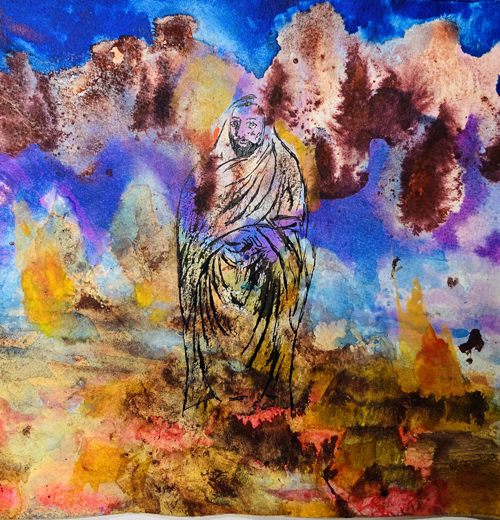
Ramalinga Vallalar by Venantius J. Pinto 2026
The author succeeds in mapping Vallalar’s philosophy with precision while avoiding both hagiography and exoticisation. First, he guides the reader through some distinctions central to Vallalar’s thinking: the difference between compassion as a sentiment or emotion, compassion as an absolute knowledge, and compassion as the ultimate nature of reality. The author also dismantles several misconceptions, for example, that Vallalar’s philosophy is merely devotional, or that his ethics implies world-renunciation. Instead, he presents Vallalar’s view as a rigorously articulated moral phenomenology grounded in a lived experience of universal love and compassion for all sentient beings.
At the heart of Vallalar’s philosophy is the concept of Jeevakarunyam, which means unconditional compassion toward all living beings. But this is not merely a call to be kind. Vallalar’s striking philosophical claim is that compassion is an epistemic faculty. In other words, how you treat other beings determines the depth of knowledge available to you. This is because, for Vallalar, the highest reality, which he calls the ‘Vast Grace Light’, is simultaneously truth, consciousness, and absolute compassion. According to Vallalar’s approach, 1) Love = Life, and 2) Absolute Compassion = God. However, you cannot think your way to knowing this compassion through argument alone: you must become compassionate through ethical practice.
This positions Vallalar in fascinating dialogue with Western theories of knowledge. Contemporary Western virtue epistemologists, such as Linda Zagzebski, have already argued that the moral character of the knower – their intellectual honesty, open-mindedness, and courage, say – is relevant to whether they can know something. Vallalar takes this much further by saying that the relevant virtues for ultimate knowledge are not primarily intellectual but moral and compassionate. So feed the hungry, refuse to harm any creature; live non-violently. Only then will access to deep reality become possible.
A comparison with Immanuel Kant is illuminating. Kant argued that human knowledge is limited to phenomena, or things as they appear to the senses. He held that ‘things in themselves’ (noumena) – things as they really are, independent of how they appear to the senses – lie beyond the reach of both experience and theoretical cognition. Kuppusamy demonstrates that Vallalar’s epistemology stands as a direct challenge to this picture. For Vallalar, the Vast Grace Light is precisely what Kant would call the noumenal – ultimate reality beyond the sensory frame – yet he insists that this reality can be directly known experientially.
According to Vallalar’s complex epistemology, there are sixteen layers of apparent reality. Beyond the sixteenth layer, at the seventeenth level, is real reality. This reality as it is in itself is divine absolute compassion. So where Kant rigorously polices the boundary between knowledge and inner reality, Vallalar effectively dissolves it. Directly experiencing and knowing reality as Absolute Compassion is presented as a simultaneously cognitive, affective, and bodily event. Moreover, whereas Kantian ethics grounds dignity and respect in human rational agency, Vallalar’s ethics demands compassion for all living beings, and he intrinsically links this universal love to the possibility of higher degrees of knowledge. Thus Kuppusamy presents Vallalar as a radical epistemic optimist who rejects Kant’s insistence that we cannot know ultimate reality, and instead recasts such knowledge as both the source and fulfilment of universal compassion. Furthermore, rather than presenting love and compassion as purely moral injunctions, the author situates Vallalar’s core principle within a broader account of human nature, in which compassion is a constitutive feature of consciousness rather than simply an ethical preference. This all places Vallalar close to contemporary Western debates about moral sentimentalism and ecological interdependence, for example.
However, Kuppusamy demonstrates that Vallalar cannot be neatly classified into either analytic or continental Western philosophical frameworks. Vallalar’s insights cut across the analytic/continental dichotomy, bridge the divide, invite both styles into conversation, and challenge their limits, calling for new ways of thinking about the nature of reality, moral motivation, ethics, and the transformation of human nature and consciousness. One of the book’s strengths is this refusal to force Vallalar into existing Western categories. Vallalar’s insistence that knowledge is transformative rather than merely representational, for instance, poses a genuine challenge to the way most Western epistemologists have defined their subject matter.
The treatment of Vallalar’s ethics and social philosophy is particularly strong in these volumes, too. Vallalar’s critique of India’s caste hierarchy, political structural inequality, and of a general human indifference to others’ hunger, has striking contemporary resonance. His framework anticipates contemporary debates in political philosophy about vulnerability, care, and moral responsibility toward those who suffer. But unlike the many ethical theories that treat compassion as one virtue among many, Vallalar sees compassion as the foundation of everything – as the key to physical, moral and social transformation, and as the basic organising principle of human existence.
To me, the most striking contribution of these volumes lies in their treatment of moral and political philosophy. Vallalar’s key principle of unconditional compassion toward all life amounts to a robust ethic. Kuppusamy applies this central tenet to modern debates on global justice, structural (that is, political) harm, and ethical universalism. Vallalar’s principle offers a cross-cultural framework that challenges contemporary assumptions about moral responsibility and the scope of moral concern. His critique of social inequity, of indifference to hunger, and of the hierarchies embedded in caste, resonates with current political philosophy’s engagement with oppression, vulnerability, and care.
The author also highlights one of Vallalar’s most distinctive and unique claims. This involves the idea that the sustained practice of compassion produces physical changes in the human body. Vallalar envisages an evolutionary transformation of human anatomy and physiology with compassion as its driver. Whether or not readers find this convincing, it illustrates how thoroughly Vallalar integrated what we would separate into ethics, biology, and metaphysics. Indeed, Kuppusamy succeeds in highlighting how Vallalar’s philosophy is different from other systems in almost all extant branches of philosophy, and how he creates new branches, such as man evolving into divinity. Generally speaking, the author emphasizes Vallalar’s originality within Tamil intellectual history while also persuasively arguing that his thought deserves a place in global philosophical discourse. Vallalar emerges from these pages not as a curiosity from the margins, but as a thinker of genuine originality whose ideas on compassion, consciousness, and the nature of reality deserve to be in conversation with the best philosophy produced anywhere in the world.
At a historical moment when philosophy is being challenged to reckon with its own insularity, as well as being asked why its canonical figures are so overwhelmingly drawn from such a narrow, European and American, slice of history, works like this perform an important service. For scholars interested in Eastern or comparative philosophy, these volumes provide an indispensable entry point into a sophisticated and underexplored system, as well as opening promising new avenues for cross-cultural philosophical inquiry.
© Dr Priya Muthukannan 2026
Priya Muthukannan is a Lecturer in Information Systems at the Australian National University in Canberra.
• The Philosophy of Ramalinga Vallalar, Vol. 1 and 2, 2025, pp.1,284. Thiru R. Kuppusamy. For copies, email r.kuppusamy@gmail.com.
Advertisement
