


Your complimentary articles
You’ve read one of your two complimentary articles for this month. To have complete access to the thousands of philosophy articles on this site, please
You can register for a free account to have four complimentary articles per month. We will occasionally email you a newsletter, from which you can unsubscribe at any time. We do not sell personal data or otherwise disclose personal information to other organisations.
Continentals
Hustle Culture & the Illusion of Freedom
Daneyal Afaqui critiques modern work culture, with input from Theodor Adorno.
Modern capitalism often phrases the concept of freedom in terms of productivity, entrepreneurship, and self-optimization. We are told that the key traits for success are discipline, hard work, and a willingness to push the limits of standard expectations. ‘Hustle culture’ takes this to extremes by encouraging people to work continually, turning every moment into a chance for economic gain, perhaps by having multiple income sources. In modern societies people often juggle precarious jobs, rising costs of living, and increased competition. Hustle culture turns these structural conditions into ‘chances for self-empowerment’. Social media, motivational literature, and corporate discourse promote hustle as a means of autonomy. However, this rhetoric of empowerment raises a question: Does hustle culture actually represent freedom, or is it, rather, subtly reproducing domination?
The German philosopher Theodor W. Adorno (1903-1969) who was a leading member of the Frankfurt School of critical theory, offers a strong framework for investigating this question. According to Adorno, the ideologically-driven character of ‘autonomy’ and the role of repression show themselves in modern societies by turning the promise of freedom into a mechanism of conformity. From this perspective, hustle culture can be seen not as the actualization of freedom but as a modern form of what Adorno describes as the ‘illusion of freedom’.

Actual Freedom by Melanie Wu
Image © Melanie Wu 2026. Please visit her Instagram: @melaniewu_Illu
Freedom as Ideology
Adorno’s criticism starts with the Enlightenment. This was a cultural movement in seventeenth and eighteenth century Europe to free human thinking from traditional sources of authority. Immanuel Kant (1724-1804) described it as “man’s emergence from his self imposed immaturity.” Thus the Enlightenment brought to birth the modern conception of autonomy, as involving an individual who is capable of rational self-determination and has the courage to use own understanding without guidance from others. Adorno and his co-author Max Horkheimer (1895-1973) themselves argue that in the Enlightenment, an attempt was made to “dispel myths and overthrow fantasy with knowledge” (Dialectic of Enlightenment, 1947). Philosophers like Francis Bacon (1561-1626) had emphasized that knowledge of nature would give humanity control over it, and as a result human life would improve. Through reason and scientific inquiry, mankind hoped to become the master of nature and author of his own destiny.
However, Adorno and Horkheimer argue that the project of the Enlightenment has a contradiction hidden within it: the same rationality that promised liberation gradually turns into a new form of domination. After the Enlightenment had produced the Industrial Revolution at the end of the eighteenth century, reason increasingly became what Max Weber (1864-1920) called ‘instrumental rationality’ – thinking directed toward the efficient and effective choice of means to practical ends. In instrumental rationality, reason ceases to be a form of reflection on the purposes of life, and instead becomes a technical instrument for the achievement of goals already defined by the social system. So there is already a close interconnection between instrumental rationality and systems of administration, economic exchange, and technological control.
For Adorno, the transformation to instrumental reasoning is part of ‘the dialectic of Enlightenment’. Enlightenment thought tries to rid the world of unjustified intellectual authority and superstition by keeping its focus on calculable questions. Yet in doing so it fosters a new myth, formed around the belief in rational calculation and technical mastery as the ultimate forms of knowledge. The world becomes an object to dominate, while human beings themselves are increasingly integrated into systems of economic and bureaucratic control. Adorno and Horkheimer opine that Enlightenment rationality is therefore turned against the promise of freedom it originally held out. Instead of making real freedom, instrumental reasoning is part of a social order in which people are subordinated to systems built from efficiency calculations.
This has severe implications for human autonomy. In classical Enlightenment philosophy, especially in the philosophy of Immanuel Kant, autonomy is the ability of rational agents to govern themselves in accordance with principles they freely endorse. Autonomy in this sense means independence from external authority. However, Adorno believes that in modern industrial societies, human choice gets caught in structures that hinder freedom. He argues that in modern societies, autonomy cannot be understood outside of the social totality that influences individual behaviour. In contemporary societies, the exchange relations (who owns what) and modes of industrial production form a social order where men and women must play particular roles in order to survive. Capitalism needs innovative and economically active individuals – autonomous people whose autonomy is nevertheless limited by the logic of the market. As Adorno puts it, the individual is free “to the extent to which the economic system required him to be autonomous” (Dialectic of Enlightenment, 1947 ). The autonomy of the individual is thus turned into a requirement and tool of the system itself. Instrumental rationality therefore leads people to organize their actions according to principles of efficiency, productivity, and economic success. Individuals then internalize these ideals as normative (‘what is to be done’), and so come to identify with them as a projection of their own rational agency. In other words, people come to pretend to themselves that this instrumental set of values is what they freely choose. So individuals seem able to act freely, but in fact their choices, and indeed their values, are shaped by the requirements of the economic system.
Hustle Culture & the Illusion of Freedom
Hustle culture is an impressive contemporary product of this formulation of autonomy. The grand theme of hustle culture is the self-made person who rises socially through sheer hard work and entrepreneurial spirit. This modern motivational discourse encourages people to optimize income, such that free time – previously always considered as being for leisure or personal development is re-packaged as a chance to advance economically. Here the ideal individual is not just employed, but constantly performing self-improvement in their own productivity. Success comes to be a constituent of self-esteem, and identity to be linked with economic performance. Things that don’t seem related to work, such as hobbies, fitness, or social relationships, are frequently represented as missed opportunities to develop yourself and so increase productivity. The outcome is a subjectivity whereby people entirely measure themselves by market standards. Under this cultural atmosphere, the struggle for economic success becomes a moral duty. The system thus ensures compliance not by any direct coercion, but by facilitating an internalization of its norms. So instead of questioning the social organization of work, individuals are admonished to adjust themselves to extant society by working harder and becoming more efficient.
This process is an illustration of what Adorno calls the ‘ideological function’ of autonomy: individuals think of themselves as freely choosing to strive for productivity and success, but the goals they choose have been determined by the economic situation. Here, freedom becomes synonymous with being able to function well in the market, and the person who fails to achieve financial success is interpreted as lacking discipline or determination, rather than provoking people to confront structural problems within the system. Hustle culture thereby covers up the social forces behind individual behavior and translates system-level inequalities into moral judgments about individuals.
The critique of hustle culture is intensified when Adorno applies psychoanalytic theory, and especially the ideas of Sigmund Freud (1856-1939). Freud claimed that the restraining or repression of instinctive desires is necessary to ensure social order. Adorno uses this observation to propose that autonomy can be built through repression at the expense of impulses linked to the unconscious. First, personal psychological repression results in the formation of the rational ego – this creation being glorified by Enlightenment philosophy as the origin of true human liberty. But the repression in contemporary societies has a different form. People are taught to control their wants, feelings, and urges so as to be able to fit in at work. The ideal subject is one who is thoroughly in control of his or her behavior, emotions, and time, in order to be productive. Hustle culture provides a good example of such a model of self-discipline. Strict time management, productive routines, and self-observation are promoted as means of liberation and achievement. However, in most cases these practices reflect external pressures, where the person is made both the object of and the means of control.
The Power of Hustle Culture
Yet hustle culture is even more ideologically powerful, as is further explained by the critique of the culture industry by Adorno.
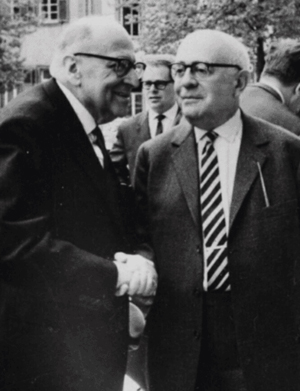
Theodor Adorno (right) and Max Horkheimer in 1964
Adorno believes that contemporary cultural industries generate a type of entertainment that homogenously supports the status quo. Cultural products (films, music, even magizines) reproduce and promote the dominant values of consumption, competition, and conformity. And although hustle culture seems more active than other types of entertainment, it has a similar ideological task.
This dynamic is only exacerbated by the power of digital media as it promotes motivational content, productivity tips, and stories of successful entrepreneurs. Social media sites can continually subject users to filtered pictures of victory by efficiency, and influencers and businesspeople showcase their images in the most stylized way, making it seem that success is inevitably achieved through unremitting persistence. These narratives utilise the culture of comparison, where people compare their own value to the perceived value of others. In such an environment the pressure to be productive will be self-sustaining and perpetual. This content thus make people internalize principles of productivity and competition while obscuring the forces that organize economic life. And hustle culture only enhances the association of individual identity with an economic role as people are advised to think of themselves as brands or as entrepreneurial projects.
A different approach to hustle culture follows the social roles formulated by Adorno. In contemporary societies people play various roles in the economic system – as employees, entrepreneurs, consumers, among other things. These roles give people identities, and expectations that shape their behavior. And although people can find opportunities to express themselves individually through such roles, Adorno believes that they can also be used as a means of social standardization, as a person identifies with the position he or she occupies. Thus the chances of real autonomy become narrower and narrower.
To Adorno this state of affairs is the tragic paradox of modern life. The Enlightenment aimed for the freedom of thought and action of individuals, independent of domination. However, the growth of capitalistic society as a result of Enlightenment discoveries changed this independence into a process of incorporation into the system, and now people are actively involved in reproducing the very structures that restrict their freedoms. The pretence of independence in modern culture thus turns out to be one of the best modes of control.
However, to Adorno this does not mean that people cannot be free. Instead, it implies that true autonomy presupposes critical thinking about the social conditions that define our behavior. Here freedom is not diminished into efficient self-management. Rather, it’s concerned with the capacity to challenge and if necessary invert the structures that shape social life. Critical theory thus aims at uncovering the concealed elements of domination encrypted in day-to-day practices faced with hustle culture, it prompts us to rethink ideas of work, productivity, and success. A never-ending search for efficiency and wealth does not necessarily reflect a real blossoming of humanity. The prevalence of burnout, anxiety, and alienation related to contemporary work cultures instead implies that the ‘freedom’ promise of economic productivity is highly questionable.
Conclusion
Hustle culture is part of the overall ideological trend of modernity outlined by Adorno and Horkheimer. The ‘freedom through reason’ called by Enlightenment thinkers such as Kant, has become entangled in systems of domination that define both society and subjectivity. The ideal of autonomy lives on, but it’s slowly and silently altered to become a tool of the capitalist system. This is reflected in a hustle culture that proposes ruthless productivity as the means of ‘becoming free’, while at the same time increasingly integrating the individual into the economic order. Through Adorno’s analysis hustle culture is thus seen as an illusion where seeming empowerment can be a type of social control where people voluntarily engage in subordinating themselves. Contemporary critical thinking does not simply need to point this illusion out, then, but also needs to envision other ways of living, where the definition of freedom does not lie in productivity and market value. It is therefore only through addressing the contradictions of modern rationality that the emancipatory promise of Enlightenment thought can be fulfilled.
© Daneyal Afaqui 2026
Daneyal Afaqui is currently pursuing Philsophy at Azim Premji University, Bangalore.
Some Currents in Continental Philosophy
Structuralism: From early 20th century work of Saussure, later advanced by Levi-Strauss, Lacan, and Althusser (1950s-80s). Language is a self-supporting structure of signs, each consisting of a signifier (sound) and signified (meaning). Societies organise around systems of communications.
Post-Structuralism: Later 20th century. Rejects stable or objective meanings and says language is fluid and shaped by changing power relations. Barthes, Derrida, Irigaray, Ricoeur, Kristeva, Deleuze & Guattari, Foucault
Deconstruction: Derrida and followers. Says all texts contain inherent tensions which undermine their surface meaning. By extension, suggests that the external world can be understood as a text.
Critical Theory / Frankfurt School: 1929-2010s in Germany. (early) Adorno, Horkheimer, Marcuse, Fromm (later) Habermas. Aimed to develop critical theories of society in ways that were loosely influenced by Marx.
Advertisement
