


Your complimentary articles
You’ve read one of your two complimentary articles for this month. To have complete access to the thousands of philosophy articles on this site, please
You can register for a free account to have four complimentary articles per month. We will occasionally email you a newsletter, from which you can unsubscribe at any time. We do not sell personal data or otherwise disclose personal information to other organisations.
Articles
In Defence of Hope
Sam Nuttall hopes to defend it with the help of Gabriel Marcel and Ernst Bloch.
The idea of ‘hope’ is a funny one for Western philosophy. It would be a little hasty to go as far as calling it a philosophical blind spot, as thoughts on hope can be found in Aristotle, Pascal, Kant, Nietzsche, and Heidegger, among others – but equally, it seems as if philosophy has never quite got comfortable with hope. And often, when one does find it mentioned in the great works of philosophy, it’s cast in a negative light. Perhaps it sits a little too close to optimism, leading to it being readily associated with naivety and a lack of critical thought – key enemies of the philosophical undertaking.
For a certain type of philosopher, optimism and hope are the poor relations of those trusty, regular philosopher’s companions, pessimism and cynicism. They think that the optimist is the child living in fairy tales, while the pessimist is the wise elder who has seen it all, and, more importantly, seen through it all: it’s Descartes seeing through the edifice of knowledge, tearing it down with a doubt-fuelled steamroller; it’s Marx, seeing through the bounty and pleasure of middle class society to find exploitation and alienation running rife underneath it; it’s Nietzsche killing God, leaving our very conception of values and morality in free-fall. The risk however is that a broader association of pessimism with intelligence starts to take hold. This proliferates in cinema and literature in the beloved archetype of the ‘tortured genius’, thus reinforcing the problematic idea that great insight must always come at the cost of happiness and comfort. This perhaps conditions a view of philosophy, and academia more broadly, as shackled to the realm of the critical.
The point of sitting down to write this is not to dismiss the works of Descartes, Marx, or Nietzsche. Nor is it to argue that philosophy should not be critical. Instead, I wish to show that the philosophical temperament need not lead to us throwing the baby out with the bathwater – the baby being hope, and the bathwater being, well, all that the philosopher dismisses as naïve! Hope can be compatible with a method of sober, critical thought.
The saving of hope from this dismissal will fall on the shoulders of Gabriel Marcel and Ernst Bloch, through whose works a more potent hope, rather different perhaps from the common understanding of it, will emerge – one that’s grounded in reality, that remains critical, and is thoroughly philosophical.
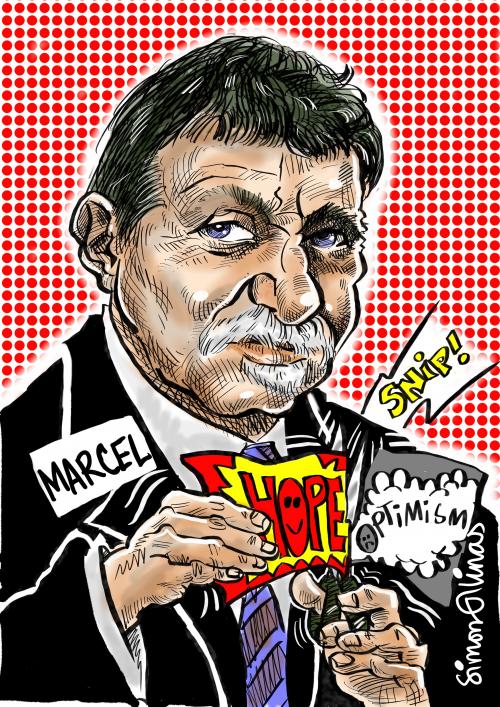
Artwork © Simon Ellinas 2026 Please visit caricatures.org.uk
Gabriel Marcel & Hope for the Individual
In his work Homo Viator: An Introduction to the Metaphysics of Hope (1962), French philosopher Gabriel Marcel (1889-1973) very quickly wants to sever the ties between hope and optimism. For Marcel, optimism is a non-critical blind faith, an assurance that things will turn out well. Hope, however, is an act of the will, a strenuous commitment that one must maintain in the face of challenges. In this Marcel is interested in a quite particular form of hope, dismissing what he terms ‘trivial’ hope – ends-based hope, the hope for specific things or events (such as a new car) – in favour of an ‘absolute’ hope that transcends particular aims. One may think of this as echoing Kant’s ethics, which isn’t concerned with particular effects or ends, but rather with the duty of the subject. Marcel’s hope is a character trait, and should be categorised alongside things such as courage, honesty and humility.
The key aspect of hope for Marcel lies in ‘availability’ – an openness to the future and the Other (person, or generally, the world beyond the subject). While the present is imperfect and may elicit feelings of despair, hope ensures that the subject remains available to the idea that their life and the wider world can be different from the present. This functions as an antidote to despair – in which the subject effectively closes themselves off from the potential of the future to be different. Despair isolates, turning us away from the world, which we view as statically bound to the negative. Hope, conversely, eases the grip of the ego. This can make a coming together and true communication between subjects possible.
Ernst Bloch & Hope for Society
The German thinker Ernst Bloch (1885-1977) investigates hope at the intersection of Marxism and Freudian psychoanalysis. He believes Western philosophy has failed to sufficiently interrogate this future-facing dimension of human subjectivity due to our preference for the past.
Bloch believes that a dissatisfaction with the state of affairs is part of the human condition. Insofar as it is impossible for any society to be perfect, there’s always some form of lack in the present, which leads to thoughts of a hypothetical, more utopian future. Bloch’s account is philosophically interesting due to the importance he places on certain emotions. He is less interested in what he calls ‘filled emotions’ – those drives such as envy, greed or ambition, that are aimed toward a specific object – and instead focuses on ‘expectant emotions’ – those drives that lack a specific present object. It is to this second category that hope belongs.
In the absence having of a precise object, expectant emotions deal generally with what Bloch calls ‘the not-yet’. Firstly, there is his idea of the ‘not-yet-conscious’, a modification of Freud that holds that there’s an element of the unconscious that looks to the future. While Freud conscribes the unconscious to recollections of the past, and takes night-dreams as illustrative of this, Bloch believes that the unconscious partially looks forward – citing daydreams as evidence. There is also the ‘not-yet-become’, which is the potential within the material reality of the present to be otherwise. Here Bloch is most clearly flying his Marxist flag. For Bloch the present is rife with potentiality, be it in the material conditions of society or within human subjectivity. Hope, consequently, is an almost inherent aspect of the human condition. As mentioned, for Bloch the present is always characterised by a certain lack; but the present can only be understood as ‘lacking’ in a temporal setting – as paling in comparison to the memory of a better past, or as an imperfect state that awaits a better future. Hope can be at its most potent and influential when the not-yet-conscious and the not-yet-become are brought together. When the future-facing consciousness of subjects comes together with elements of the present reality that can facilitate the change they are striving for, then hope becomes extremely powerful. This is the 'utopian function’ of hope.
Bringing Them Together
Marcel and Bloch both detail their accounts of hope with either explicit or implicit reference to the dismissive attitude of philosophy I mentioned earlier. Both take steps to rehabilitate the concept against any accusations of it being anti-philosophical. Marcel, does this by distinguishing hope from optimism and dismissing the idea that the two are necessarily connected. In Bloch, hope, far from belonging to the realm of wishful thinking or fantasy, is a concept grounded in material reality, is practical through-and-through.
Both thinkers also work on the basis of similar metaphysical assumptions concerning indeterminacy in both the present and the future. For Marcel, this is an adoption of the existentialist view that ‘existence precedes essence’, meaning that humans are born into (or in Heidegger’s term, ‘thrown into’) a world without a purpose or a path to follow. Similarly, Bloch, as a ‘process philosopher’, views the world as always incomplete, always changing.
Interestingly, similar assumptions have underpinned theories that have gone in a very different direction. The post-death-of-God realisations of the universe’s lack of inherent meaning and the subject’s lack of inherent purpose may seem to naturally lead to despair and pessimism. For Marcel and Bloch, therefore, to take the same base assumptions but still advocate for hope is an interesting turn. They notice that at the core of nihilism is nil, meaning nothing. So the lack of an inherent meaning does not mean that man or the universe crosses over into negative meaning, as this would mean there is some value – negative value, but still value nonetheless – and therefore not nothing. But instead, this nil, this lack, is there to be filled, showing that man and the universe are blank canvases. Yet what specifically comes to populate them is not predetermined. On this view, philosophy’s tendency to stray into pessimism is just as ungrounded as the flights into fantasy and blind optimism it so often critiques. While using the idea of hope – so often associated with optimism – Marcel and Bloch actually walk a tightrope between optimism and pessimism.
Beyond Optimism & Pessimism
Perhaps some will ask whether the hope given by Marcel and Bloch is a counterfeit hope. Perhaps some will feel that, in removing optimism from his theory, Marcel fails to offer the comfort or ease that people look for in hope. Likewise, Bloch’s picture of the world, despite the centrality of hope, may look rather bleak: a present that’s never satisfactory, human beings constantly looking to the horizon for something better. But to return to what I said earlier, ultimately, philosophy may have to shake its head and accept that it cannot satisfy a desire for a hope that’s staunchly optimistic, perpetually comforting, and completely reassuring. What use is a cosy hope that always comforts in the face of a world that will regularly contradict its reassurances?
I think what Marcel and Bloch muster is far more interesting and valuable. They tackle head on the forces that would make hope appear impossible. Hope survives the confrontation, and is far more vital for it. In fact, they highlight how hope must always be tied to that which seeks to destroy it – one simply cannot have hope without lack. The pair show that one can delve into the more abyssal aspects of philosophy, and of life, and still emerge head up, eyes on the horizon, ready to strive toward a future that’s still open.
Understood in these terms, hope can be a potent tool in response to a reality that, as much as ever, seems capable of extinguishing hope for good: a philosophy underpinned by hope, that seeks to affirm and create rather than cynically critique, holds the potential for bettering life on the individual level, and on the macro-scale, for bettering society as a whole.
© Sam Nuttall 2026
Sam Nuttall studied Philosophy at Newcastle University, where he developed a keen interest in post-Kantian European philosophy.
Advertisement
