


Your complimentary articles
You’ve read one of your two complimentary articles for this month. To have complete access to the thousands of philosophy articles on this site, please
You can register for a free account to have four complimentary articles per month. We will occasionally email you a newsletter, from which you can unsubscribe at any time. We do not sell personal data or otherwise disclose personal information to other organisations.
Interview
Kasia Muzyka
Kasia Muzyka discusses painting the unspoken and recovering the sacred in life through art.
Kasia Muzyka is a visual artist born in Poland and now based in Minneapolis, in the United States. Her paintings are abstract and swirling, with occasional human figures. In producing them she uses earth pigments but also coffee and red wine – not in the traditional way that artists use coffee and red wine, but instead by mixing them with her pigments and painting them directly onto her canvases.
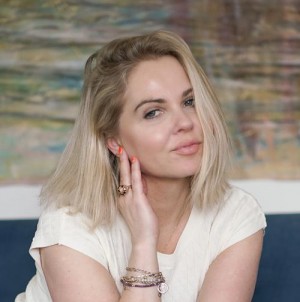
Photo of Kasia Muzyka © Lisa Cline 2026
Muzyka is a painter who thinks deeply and in philosophical terms about her art, in particular about the nature of perception. She has written that she is driven by a deep curiosity about the invisible threads that shape both our inner and outer worlds. Her themes include human nature, feminine presence, and the ever-unfolding rhythms of existence. She says that lately she been especially drawn to the mystery of numbers, not as mathematical tools, but as living symbols that form the architecture of creation.
Your work frequently explores the intersection of the sacred and the bodily. What does ‘sacred’ mean to you in a secular, postmodern world?
For me, ‘sacred’ isn’t something separate from life, it is life. It’s the thread that runs through every breath, every ending, every beginning. The sacred is not a fixed object or a dogma, it’s an ever-changing presence, like the seasons or the tides, that reminds us we’re part of a larger rhythm. Sometimes that rhythm feels beautiful. Sometimes it’s raw and violent. In my paintings, the body often appears as a glimpse – ephemeral, dissolving into its surroundings – because I see no separation between body and nature, self and world. But to me, that wholeness – the fact that birth and decay, love and loss, everything, exists as one – is the sacred. In a secular world, the sacred is often dismissed as superstition or nostalgia. But I see the sacred as the deepest reality we have: the unbroken field of being that everything emerges from and returns to. My work is simply an attempt to let that be seen.
You’ve said before that for you painting is a kind of ‘ritual’. Could you describe what happens when you begin a new piece?
When I enter the studio, I enter it as I would a temple – ready for a conversation with something unseen. My process is not about deciding what I want to paint, but asking, What wants to be seen? What’s ready to be uncovered? It’s a kind of excavation. I think of certain tribal communities who, when creating ceremonial masks, would ask the mask itself what it wanted to be – its colors, its textures, its form. My paintings begin in that same spirit. I follow the subtle cues in the materials – the bleed of wine, the grain of earth pigments, the way water settles into a surface. Each sign is part of the map.
Painting is also a way of orienting in life. You might hold the vision of an end point, but you can’t script the route. You keep moving toward it by listening, adjusting, staying attuned. You never truly know how it will happen – but you know why you’re doing it. And that purpose becomes the compass. In a way, painting is my ritual. It’s how I return to presence – each gesture, each mark, is an offering to whatever is asking to come through. By the time a piece is complete, it feels less like I’ve made something and more like I’ve met it.
You once described memory as “a language without words.” How does memory operate in your visual vocabulary?
When I say memory is a language without words, I mean it’s some experience we carry in the body, in the nervous system, in the textures of our being, often long before we can name it. It’s sensory, emotional, ancestral. It speaks through images, sensations, dreams. In my work, memory operates less like a narrative and more like sediment – layer upon layer shaping the surface, sometimes visible, sometimes buried. I don’t approach the canvas trying to illustrate a memory. Instead, the process feels like brushing away dust from an ancient carving: the image, the form, the frequency – they’re already there, waiting to be uncovered. Memory isn’t only of the past. It’s also of the future – signals of experiences we haven’t yet lived, but that already exist in some field of possibility. In that sense, memory folds past, present, and future into a single now. We’re always in dialogue with it, and we’re always influencing it, depending on our own state. That state is our choice, and it determines which layer of the memory-field we connect with, what we’re able to perceive, and what becomes visible in the work. My painting materials – earth pigments, coffee, wine – hold and transmit these layers of time. They keep the conversation honest. What surfaces in the painting is not nostalgia, but presence – a living exchange between what has been, what will be, and the attitude we choose to meet it with.
There’s an unmistakable sense of mythology in your work, even though your images also feel contemporary. Do you see yourself as creating a personal mythology, or perhaps, recovering an ancestral one?
It’s both. My personal mythology is inseparable from the collective mythology. The most intimate symbols and archetypes that surface in my work belong to a shared human field we’re all attuned to, whether consciously or not. Yet in the modern world, myth often feels removed from daily life – archived as if it belongs only to the past. When we lose that living connection, we stop seeing ourselves as part of the great weave of existence. That disconnect shows in the fractures of our society. Myth has been largely exiled from modern consciousness, and with it, our capacity to see life as whole rather than fragmented. My work is an act of restoring that connection. The idea is to encourage nature back into the psyche by reawakening an awareness of the interwoven threads between all things. In myth, as in fact in life, there is no separation: life and death, love and pain, are not opposites, but necessary mirrors, each giving the other meaning. When I paint, I step into that field where the ancient and the now meet, allowing them to speak through my hands so that the viewer might remember what has always been true.
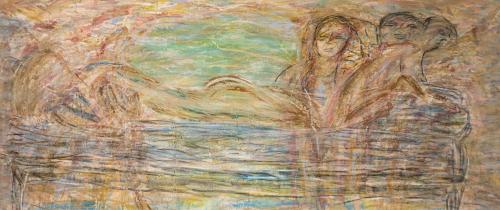
Innocence In Distress by Kasia Muzyka
Tell me about the relationship between pain and beauty in your work. Are they interdependent, or does one resist the other?
For me, pain and beauty aren’t opposites, they’re two currents in the same river. One gives shape and depth to the other. Without pain, beauty can feel weightless, unrooted. Without beauty, pain can feel unbearable.
In life they’re not meant to be separated. My work reflects that. The brushstrokes that hold the most tenderness often emerge from places that have known rupture. The colors that radiate the most warmth are often set against shadows. It’s the tension between them that makes the whole alive.
During my time in Africa, I was reminded that in nature there are no borders – that life and death, love and pain, are part of the same cycle. Yet the modern life, shaped by a scientific order that seeks to classify and contain, wants to put everything into separate boxes. It divides, draws lines, declares where one thing ends and another begins, just to make it easier to digest. But in doing so, it kills the soul of the world. You can divide a house, but you cannot divide a home. The home – the soul of the house, if you like – exists beyond partitions. My work tries to reflect the truth that the most beautiful things are often inseparable from what breaks us, and that wholeness comes from holding them together, not apart. The real beauty of life is in staying in that tension, allowing it to shape and open us.
In religious art, the body is often idealized. In your paintings, it’s much more ambiguous – intimate, carnal, even grotesque. Is that a form of resistance?
I don’t think of it as resistance for its own sake. It’s more about restoring the body to its truth. In much of religious art, the body has been smoothed, perfected, made into a symbol of purity that denies its mess, its hunger, its mortality. But the sacred isn’t found in perfection. It’s found in the places where beauty and fragility coexist. So in my paintings, the body often feels ambiguous because that’s how we live: sometimes intimate and luminous, sometimes raw, carnal, even unsettling. It’s not one or the other, it’s all of it, all at once. That ambiguity is closer to the real experience of embodiment. I want the body to be seen as part of the great weave of existence – blending into the background, merging with natural textures, dissolving into shadow… Not separate from the cycles of life and decay, but inseparable from them. That’s where holiness lives.
If there’s any resistance in my work, it’s against the idea that the sacred can only be clean and untouchable. I see the sacred in stretch marks, in scars, in skin that remembers the weight of living. The body is not an image to be worshipped, it’s a home, a threshold, a landscape that holds the story of being alive. This, to me, is The Sacred Condition of Being.
Is there a philosophical thinker who feels like a kindred spirit to your practice?
I’ve often been told my work carries something of William Blake in it – not so much in its style, but in the way he moved between myth, vision, and lived reality. He didn’t separate the spiritual from the material, or the human from the divine, and that feels deeply resonant with my own approach.
I’m drawn to thinkers who dissolve boundaries. For instance, Maurice Merleau-Ponty, in Phenomenology of Perception, spoke of the body as “the very site of perception” – a philosophy that echoes my own view of embodiment as inseparable from how we know and shape reality. And Joseph Campbell’s work on the universality of myth (see The Hero with a Thousand Faces, 1949) affirms my belief that personal symbols are also collective ones, woven into a shared human field of awareness. Philosophy isn’t only an intellectual pursuit, it’s embodied. It’s something you live into through your choices, including your way of seeing and your way of creating.
Perception is what grounds us, but it can also hold us back. Imagination is what allows us to move beyond the boundaries of limited perceptions and beliefs to create what once seemed impossible. My kindred spirits are those who understand that imagination is not an escape from reality, but a way of entering it more fully. So my influences come from many directions – from mystics, poets, scientists, and indigenous knowledge.
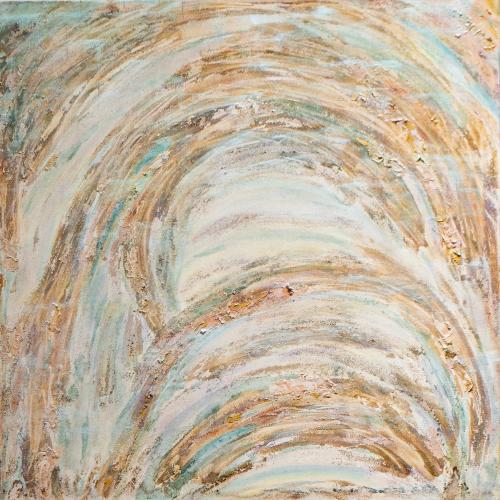
Quantum Timelines by Kasia Muzyka
In what ways has displacement – leaving Poland, living in London and now the US – influenced your understanding of identity and home?
It has taught me that identity is not a fixed location but a fluid field. At first, displacement felt like loss: the loss of familiar language, cultural rhythms, a sense of belonging. But my curiosity was stronger than that, and it pulled me forward, into the unknown, into cultures and ways of seeing that would change me in ways I couldn’t have imagined. Moving between places has also made me less attached to borders – not just political ones, but conceptual ones. The soul is not bound by the borders politicians have drawn on a map: it moves like wind or water, belonging everywhere and nowhere at once. In my work, that translates into forms that dissolve into their surroundings, colors that carry multiple geographies at once, and symbols that don’t belong to any single culture but to a shared humanity. Displacement has given me the ability to see beyond the local into the archetypal without losing the intimacy of personal experience. Ultimately, it’s made me more aware that every place, every body, every moment, is part of a much larger pattern. And that pattern has no borders.
There’s an almost silence in your work – an inwardness. Do you think art has a responsibility to speak, or is it allowed to simply feel?
I think art is allowed to simply be. Silence is not the absence of meaning – it’s often where the deepest meaning lives. We live in a culture that rushes to name, explain, and justify everything. But the moment we over-explain we often reduce the thing itself. Some truths can’t be conveyed in words – they have to be felt in the body, in the breath, in the stillness after the initial encounter. Silence itself can be a language – one that moves beyond the limits of the rational mind.
For me, the inwardness in my work isn’t about withholding, but about creating a space where the viewer can meet the piece on their own terms. If the work spoke too loudly, it would leave no room for that meeting. In this way, each painting is an invitation. Not an explanation, but a gentle call to pause, to reflect, to catch a glimpse of the ephemeral I Am beyond all filters and concepts. When a painting resonates in that quiet way, it’s not passive, it’s alive. It’s doing its work below the surface, where the real transformation happens.
Advertisement
